
UNS Community Service Programme Researches Plastic Waste Pyrolysis in Boyolali
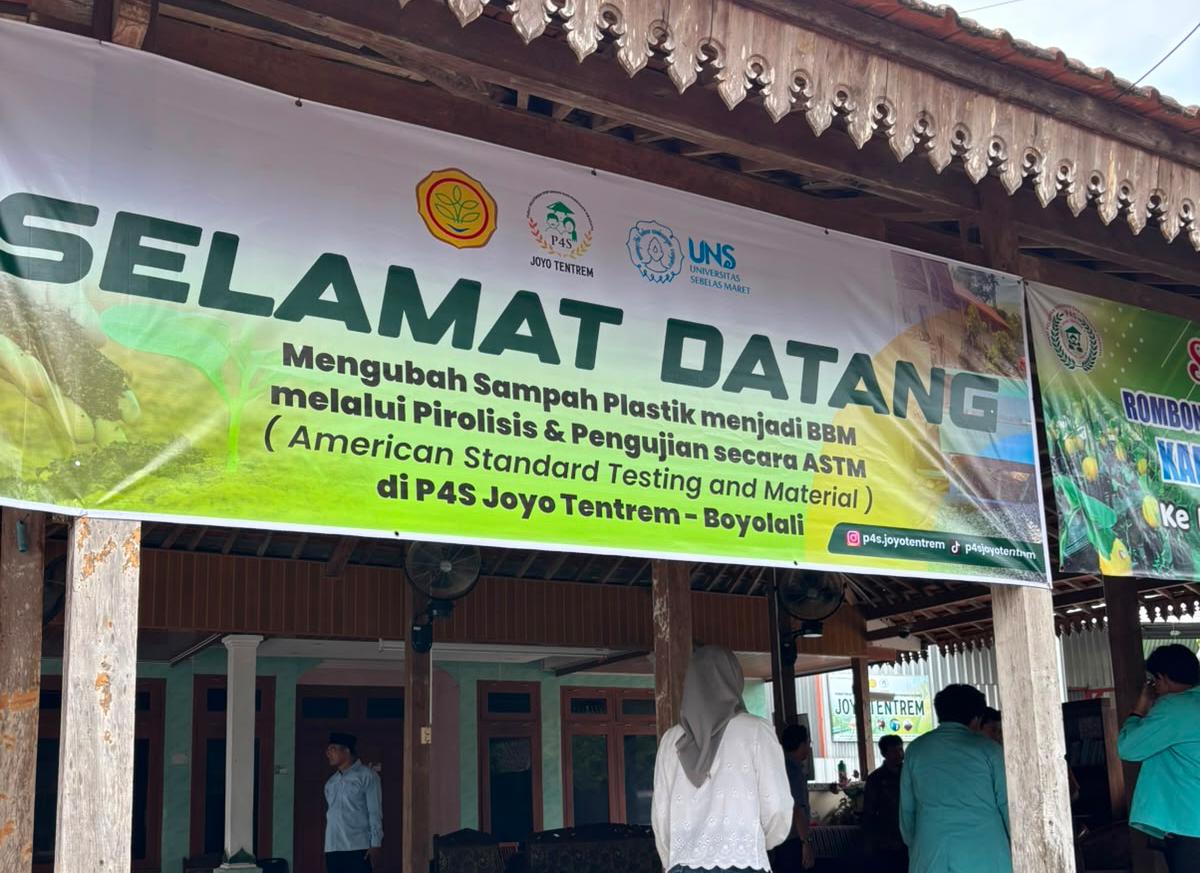
Universitas Sebelas Maret (UNS) Surakarta officially commenced a research and community service programme at the Joyo Tentrem Self-Sufficient Agricultural and Rural Training Centre (P4S) in Tempursari, Sambi District, Boyolali Regency, Central Java, on Friday (13/6). The initiative, themed ‘Plastic Waste Processing Through Pyrolysis and ASTM Product Testing’, began with a field survey by a team of UNS lecturers and students prior to the official launch. The programme is run by the UNS Solid State Chemistry and Catalysis Research Group, led by Nurcahyo as Head of Community Service. The implementation team also includes Fitria Rahmawati, Yuniarwan Hidayat, Eddy Heraldy, and Khoirina Dwi Nugrahaningtyas. In addition to the research lecturers, the activity involves UNS students as part of the implementation of learning, research, and community service. The series of programmes is scheduled to run until October 2026. In her remarks, Fitria Rahmawati, who serves as UNS Vice-Rector for Academic Affairs, emphasised that the activity is a tangible manifestation of the implementation of the Tri Dharma of Higher Education, particularly in the aspects of research and community service. ‘We hope this activity will not only produce data and scientific findings, but also have a positive impact on the community, especially in the development of waste management technology and the empowerment of the agricultural sector,’ she said. Meanwhile, the Chairman of P4S Joyo Tentrem, Wisnu Wijaya, expressed appreciation for the trust placed by UNS in his institution as a location for research, community service, and a learning facility for students. According to Wisnu, synergy between universities and the community is an important factor in producing innovations that can provide broad benefits for various sectors. ‘We hope this collaboration can continue in the future, both in the development of agricultural knowledge and skills and in the development of technology to overcome the problem of plastic waste and other types of waste which are currently very crucial issues,’ he stated. On the same occasion, Wisnu also invited students to play a role in increasing the younger generation’s interest in the agricultural sector, which he believes has great potential for Indonesia’s future. ‘Currently, young people’s interest in the agricultural sector is still relatively low, even though Indonesia has enormous potential in land resources. We hope students can become agents of change who are able to invite the younger generation to love and develop the agricultural sector again,’ he added. The Head of the UNS Community Service Team, Nurcahyo, explained that the entire series of research and community service will run until October 2026. During the initial activity, he also provided direction to students regarding the programme implementation mechanism, the research methods used, task distribution, and the targets to be achieved during the activity. The main focus of this research is the development of pyrolysis technology as a solution for processing plastic waste into alternative fuel with higher beneficial value. The processed products will later be tested using ASTM (American Society for Testing and Materials) standards to scientifically determine their quality and characteristics. Through this research, it is hoped that technological innovations will emerge that can help reduce the problem of plastic waste while creating opportunities to increase economic value for the community. From P4S Joyo Tentrem, the activity was attended by Wisnu Wijaya as Chairman of P4S Joyo Tentrem, along with Badrus Zaman and Ali Hufran, who are members of the P4S Joyo Tentrem Advisory Board. Towards the closing of the event, Badrus Zaman provided motivation to the students involved in the programme. He expressed hope that students would not only excel academically but also be able to make real contributions to solving various problems faced by the community. Badrus also encouraged students to continue developing creativity, innovation, and social awareness so that the knowledge gained during their studies can be realised into works that are beneficial for society and the environment. This collaboration between universities, the community, and the agricultural sector is expected to produce various sustainable innovations that support environmental management, strengthen national food security, and enhance community economic empowerment through the utilisation of technology and local wisdom.