
Unpad Students Transform Tilapia Scales into Sodium-Ion Battery Material
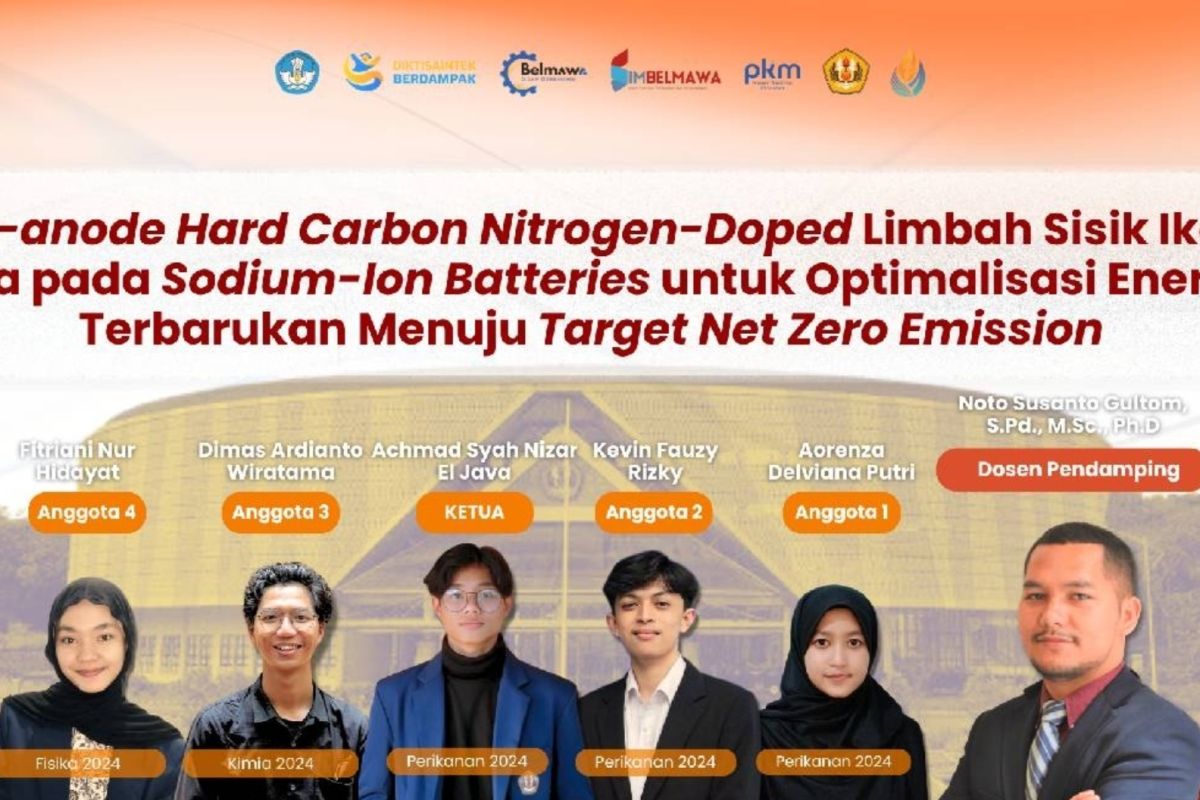
Students belonging to the Exacta Research Team of the Student Creativity Programme (PKM-RE) at Padjadjaran University have processed tilapia scale waste into hard carbon, serving as an alternative anode material for sodium-ion batteries.
The research team, consisting of Achmad Syah Nizar El Java, Aorenza Delviana Putri, Kevin Fauzy Rizky, Dimas Ardianto Wiratama, and Fitriani Nur Hidayat, under the supervision of lecturer Noto Susanto Gultom, introduced this innovation to address the accumulation of fishery waste and to seek renewable energy storage materials to replace lithium.
Speaking in Bandung on Wednesday, Noto Susanto explained that the selection of tilapia scales was based on their collagen content, which is rich in natural nitrogen.
“Through the concept of in-situ self-doping nitrogen, the process of enriching nitrogen in the anode material can be sourced directly from biomass without requiring external chemical doping agents,” he said.
Initial results show that all samples produced a turbostratic carbon structure with wider interlayer spacing compared to graphite. The HC-800 sample recorded the most prospective structural performance and reversibility for the development of sodium-ion batteries.
Technically, while the HC-600 sample produced the highest initial discharge capacity of 111.61 mAh g⁻¹, it also had the lowest Initial Coulombic Efficiency (ICE) at 37.8 per cent. Electrochemical Impedance Spectroscopy (EIS) testing also confirmed the superiority of HC-800, which recorded the lowest charge-transfer resistance of 384.4 Ω and the lowest Warburg impedance of 433.8 Ω s⁻¹/² compared to other temperature samples.
This research, which integrates the principles of circular economy and energy independence, is next targeted towards completing surface chemical characterisation via XPS testing, as well as testing power storage stability for up to 50 charging cycles.