
Unpacking the Economic Strength of Java’s Six Provinces: Who Is the Real Powerhouse?
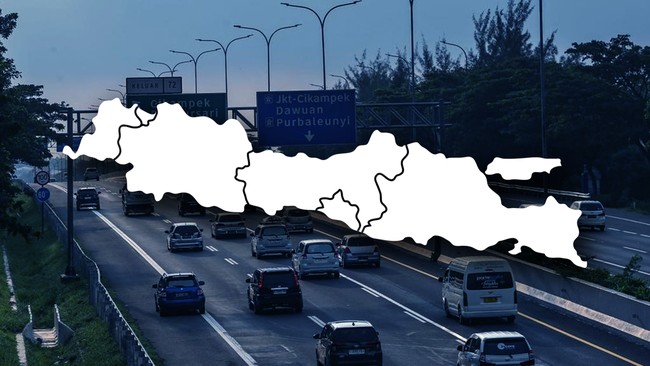
Jakarta, CNBC Indonesia — Java continues to play an outsized role in Indonesia’s economy. Government, industrial, trade and financial activities are concentrated on the island, which remains the country’s main economic support amid continued global uncertainty. Its economy is far larger than that of any other region in Indonesia.
Based on calculations using gross regional domestic product (GRDP) at current prices for the island’s six provinces, Java’s economy reached about Rp3,724.20 trillion in the third quarter of 2026.
Statistics Indonesia (BPS) says Java accounts for around 56.05% of the national economy. Sumatra, in second place, contributes 22.55%.
Three of Java’s six provinces — Jakarta, East Java and West Java — account for about 77% of the island’s total economy. Jakarta has the largest economy, followed by East Java and West Java.
However, in terms of economic growth, West Java outpaced Jakarta and all the other provinces. Each province has a different economic strength: Jakarta relies on trade and services; West Java and East Java have large industrial bases; and Yogyakarta is supported largely by consumption, education and tourism.
Jakarta
Despite its relatively small area, Jakarta, the national capital, is naturally Indonesia’s largest centre for business and finance.
Its economy was worth Rp1,069.06 trillion in the third quarter of 2026, equivalent to 28.71% of Java’s total economy.
Trade and services are Jakarta’s main strengths. Wholesale and retail trade accounted for 18.12% of GRDP, followed by construction at 11.17%.
Financial and insurance services grew strongly, by 10.86%, in line with Jakarta’s role as the national financial centre. Accommodation and food services also expanded, by 9.57%.
On the expenditure side, investment, measured by gross fixed capital formation (GFCF), grew by 5.44% amid continued urban infrastructure development. These activities helped Jakarta’s economy grow by 5.87% year on year.
East Java
While Jakarta is a financial and business centre, East Java’s economy is more heavily based on industry and trade.
The province’s GRDP reached Rp953.79 trillion in the third quarter of 2026, making it Java’s second-largest economy. This was equivalent to about 25.61% of the island’s total output.
East Java has long been an important production and trading centre, linking economic activity between regions, including with eastern Indonesia.
Its economic structure reflects this role: manufacturing accounted for 31.22% of output. Wholesale and retail trade contributed 18.15%, while agriculture, forestry and fisheries accounted for 11.62%. East Java therefore relies not only on industry but also on trade and primary-sector production.
Despite the importance of these sectors, tourism- and consumer-related activities recorded the fastest growth. Accommodation and food services grew by 12.39%, while health and social work activities increased by 9.81%.
This points to the growing contribution of services to East Java’s economy, although manufacturing remains its main strength.
Investment also performed well. GFCF in East Java rose by 8.69%, one of the highest rates in Java. Together, these factors helped the province’s economy grow by 5.82% year on year.
With its large economic base, East Java was also Java’s second-largest contributor to the island’s growth, adding 1.49 percentage points.
West Java
Unlike Jakarta, which relies heavily on services and finance, West Java’s main strength lies in factories and manufacturing. Industrial areas in places such as Bekasi, Karawang and Purwakarta play an important role in national manufacturing.
Its extensive production activity brought West Java’s GRDP to Rp844.54 trillion in the third quarter of 2026. The province was Java’s third-largest economy, accounting for about 22.68% of the island’s total.
But West Java stands apart from the other provinces in one respect: it recorded Java’s fastest economic growth, at 5.89% year on year.
This performance was underpinned by manufacturing, which accounted for 40.67% of the province’s economy. Nearly half of West Java’s output therefore depends on manufacturing activity.
In the third quarter of 2026, manufacturing grew by 4.98% and contributed 2.09 percentage points to West Java’s economic growth.
Economic activity in the province extends beyond industrial estates. Social activities, including travel, trade and services, also provided a boost.
Accommodation and food services surged by 14.54%, followed by public administration at 14.46% and transport and storage at 13.61%. The strong growth in transport and storage is significant because industry depends on distribution networks to move raw materials and finished products.
Investment was also robust. West Java’s GFCF grew by 8.85%, the highest rate among Java’s six provinces. This indicates that capital formation continues to expand and could help sustain production capacity in the coming period.
Although its economy remains smaller than those of Jakarta and East Java, West Java has shown that a large industrial base can go hand in hand with investment growth and expanding services.
Central Java
Central Java’s economy reached Rp542.49 trillion in the third quarter of 2026, equivalent to 14.57% of Java’s total.
As in West Java and East Java, manufacturing remains the foundation of the economy, with a 34.05% share. Wholesale and retail trade contributed 13.58%, followed by agriculture at 12.17% and construction at 12.10%.
Despite the strength of industry, the fastest growth came from hotels and restaurants. Accommodation and food services surged by 14.06%, partly supported by the 31st National Musabaqah Tilawatil Quran (MTQ) in Semarang in September 2026, which attracted about 190,303 visitors.
Increased public activity was also reflected in wholesale and retail trade, which grew by 8.29%.
On the expenditure side, investment measured by GFCF grew by 5.43% year on year. Although this was slower than the 9.61% recorded in the first quarter and 8.84% in the second, investment in Central Java continued to expand.
The investment trend is notable as Central Java increasingly attracts factory relocations and expansions from other areas, particularly West Java and Banten. More competitive labour costs are one reason companies are moving or expanding production facilities there.
The development of industrial estates, including Kendal Industrial Park (KIK) and the Batang Industrialopolis Special Economic Zone (SEZ), has also strengthened the province’s investment appeal.
By September 2026, Kendal Industrial Park had attracted 143 investors, with cumulative investment totalling Rp197 trillion. Seventy-two companies were already fully operational. The Central Java provincial government is also preparing to develop 12 new industrial estates to expand manufacturing and attract further investment.
With a large industrial base, growing industrial estates and continuing activity in trade and services, Central Java’s economy grew by 5.83% year on year in the third quarter of 2026.
Banten
As a buffer region for Jakarta, Banten’s strengths lie in industry, trade and urban development. Its economy was worth Rp258.17 trillion, or about 6.93% of Java’s total.
Areas including Tangerang, Serang and Cilegon are important centres of industrial activity in the province.
In the third quarter of 2026, however, public administration recorded the fastest growth, surging by 15.69%. Construction also grew strongly, by 11.46%, reflecting increased building activity.
Accommodation and food services grew by 11.02%, while investment measured by GFCF rose by 6.82%.
Banten’s economy consequently expanded by 5.72% year on year. Although this was the slowest growth rate in Java, it remained above the national average.
Yogyakarta
Yogyakarta’s economy grew by 5.79% year on year in the third quarter, broadly in line with growth in the larger provinces.
Unlike the other provinces, the economy of the Special Region of Yogyakarta (DIY) is more closely tied to consumption, education and tourism.
Its GRDP reached Rp56.15 trillion in the third quarter of 2026, the smallest in Java, with a share of about 1.51%. Even so, economic activity continued to expand at a solid pace.
Water supply, waste management, wastewater treatment and recycling recorded the fastest growth, at 10.95%. Accommodation and food services, however, played a larger role in driving the economy, growing by 10.25%.
This highlights the importance of tourism, hotels and restaurants to Yogyakarta’s economy.
On the expenditure side, household consumption remained dominant, accounting for 60.49%, while investment measured by GFCF grew by 4.72%.
Source: jawawa.id (https://jawawa.id/newsitem/unpacking-the-economic-strength-of-javas-six-provinces-who-is-the-real-powerhouse-1793962257)
Originally published by CNBC Indonesia (https://www.cnbcindonesia.com/research/20261106104238-128-782924/bongkar-kekuatan-ekonomi-6-provinsi-di-jawa-siapa-raja-sebenarnya), translated from Indonesian