
UNM Students Train PKK Women to Turn Kitchen Waste into Soap and Hand Sanitiser
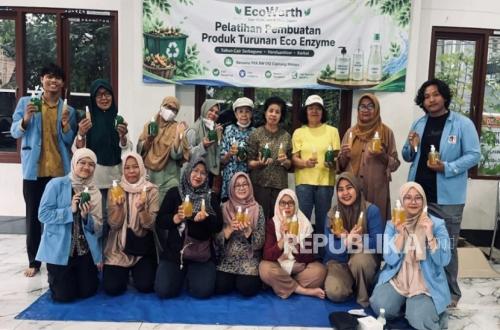
JAKARTA - The EcoWorth Student Creativity Programme in Community Service (PKM-PM) team held a training session on producing eco-enzyme-based multipurpose soap and hand sanitiser for members of the PKK in RW 012, Cipinang Melayu, Makasar District, East Jakarta.
The event, held on Wednesday (24/6/2026) at the RW 012 Hall in Cipinang Melayu, East Jakarta, formed part of a community empowerment programme aimed at improving residents’ skills in processing organic waste into environmentally friendly household products that are both useful and potentially a source of income.
The PKM-PM EcoWorth team is led by Nazwa Syifa Fitriani, with members Raka Muhammad Setia, Shahnaz Hafiza Bilqis and Nasywan Abhinaya, under the supervision of Johan Hendri Prasetyo as the accompanying lecturer.
The training began with a presentation on the benefits of eco enzyme, a fermented organic waste product that can be used for various household needs. Participants were then introduced to the equipment and materials used, followed by a demonstration of product making and hands-on practice in producing eco-enzyme-based multipurpose soap and hand sanitiser.
Participants were divided into several groups so they could follow each stage directly, from preparing ingredients, mixing according to the formulation, through to the packaging process. In addition to technical skills, participants gained insight into the opportunities for developing eco-friendly products as a community-based enterprise.
Nazwa Syifa Fitriani, head of the PKM-PM EcoWorth team, said the activity aimed not only to reduce organic waste but also to open up economic opportunities for the community.
“Eco enzyme is not only beneficial for managing organic waste, it can also be processed into a variety of household products with added value. Through this training, we hope PKK members can practise the production process independently and even develop it into a sustainable business opportunity,” said Nazwa.
She said the choice of multipurpose soap and hand sanitiser as products was based on the high public demand for practical, environmentally friendly cleaning products.
“If managed well, from the production process and packaging through to marketing, these products have the potential to be marketed and bring economic benefits to the community,” she said.
On this occasion, the head of the PKK in RW 012 Cipinang Melayu, Ive Sulistiah, expressed appreciation for the training, which used hands-on practice methods that were easy for participants to understand.
“This training has been a new experience for us. Not only did we learn how to process eco enzyme, but we also discovered that organic waste can be turned into products that are useful and have economic value. We hope this knowledge can be applied and shared with other residents,” said Ive.
Johan Hendri Prasetyo, the accompanying lecturer for PKM-PM EcoWorth, stressed that the programme was a concrete implementation of the role of students in solving community problems through innovation.
“The PKM-PM programme is a vehicle for students to apply their knowledge directly within the community. Through EcoWorth, students are not only educating people about organic waste management but also accompanying communities so they can produce products that are useful, economically valuable and sustainable,” he said.
Through sustained mentoring, the PKM-PM EcoWorth team will also provide follow-up training on developing eco-enzyme derivative products, brand identity, packaging design, calculating the cost of production (HPP), and digital marketing strategies so the products can compete in the market.
“This programme is expected to raise public awareness of the importance of organic waste management based on the circular economy while encouraging the emergence of environmentally friendly household enterprises,” he said.
As a Digital Business Campus, Universitas Nusa Mandiri continues to encourage students to deliver innovations with a direct impact on society through research, community service and empowerment activities based on technology and entrepreneurship.
“This step is part of UNM’s commitment to producing graduates who are not only academically excellent but also capable of becoming agents of change who offer real solutions for the environment and society,” he said.