
UNM Lecturer Research Secures Kemdiktisaintek Grant to Develop Early Detection Technology for Digestive Diseases
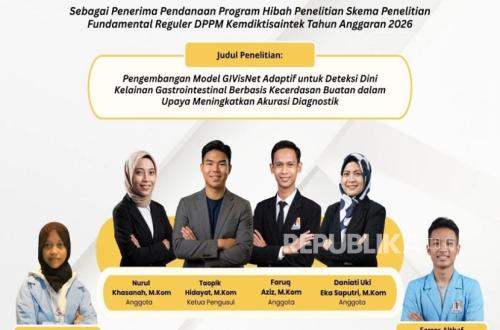
Nusa Mandiri University (UNM), known as a Digital Business Campus, has achieved a significant milestone in national research. A team of UNM lecturers has successfully secured funding from the 2026 Regular Fundamental Research Grant Programme provided by the Directorate of Research and Community Service (DPPM) under the Ministry of Higher Education, Science, and Technology (Kemdiktisaintek). The project focuses on innovative research utilising Artificial Intelligence (AI) within the healthcare sector.
Led by Taopik Hidayat, the research is titled ‘Development of the Adaptive GIVisNet Model for Early Detection of Gastrointestinal Abnormalities Based on Artificial Intelligence to Improve Diagnostic Accuracy’. This research represents a tangible contribution from UNM towards supporting the development of digital health technologies, which are increasingly vital in the era of digital transformation.
By leveraging Artificial Intelligence and medical image analysis, the study aims to develop the Adaptive GIVis.VisNet model to assist in the early detection of various gastrointestinal tract abnormalities. The technology is expected to improve diagnostic accuracy, accelerate the disease identification process, and serve as a decision-support system for medical personnel to provide more effective and targeted healthcare services.
The research team includes lecturers Nurul Khasanah, Faruq Aziz, and Daniati Uki Eka Saputri, alongside students Siti Zainab Amri from the Data Science programme and Farros Althaf from the Informatics programme. This collaboration between faculty and students embodies the implementation of the ‘tridarma perguruan tinggi’ (the three pillars of higher education), integrating education, research, and innovation.
Lead researcher Taopik Hidayat explained that the research is designed to provide technology-based solutions to support the improvement of healthcare quality in Indonesia. “The use of Artificial Intelligence in healthcare has great potential to assist medical professionals in performing early detection more quickly and accurately. Through the development of the Adaptive GIVisNet model, we hope to produce an innovation that not only contributes scientifically but also provides real benefits to society and the healthcare world,” said Taopik.
Meanwhile, the Head of the Institute for Research and Community Service (LPPM) at UNM, Andi Saryoko, expressed his appreciation for the team’s success in obtaining national research grant funding. He noted that this achievement demonstrates the growing quality of the research culture within Nusa Mandiri University. “Securing funding from the 2026 Regular Fundamental Research Grant Programme is proof that UNM lecturers are capable of producing high-quality, innovative research that is relevant to societal needs. At LPPM, we will continue to encourage technology-based research, including Artificial Intelligence, which produces not only scientific publications but also real solutions for various sectors, particularly healthcare,” he stated in a release.
He added that the involvement of students is a crucial part of training a new generation of academics and young researchers with research, innovation, and competitive capabilities at both national and international levels. As a Digital Business Campus, UNM remains committed to strengthening a research ecosystem oriented towards digital technology development, multidisciplinary collaboration, and the downstreaming of research results to address societal challenges through impactful innovation.