
UNM Data Science Graduate's Research Published in Q1 International AI Journal
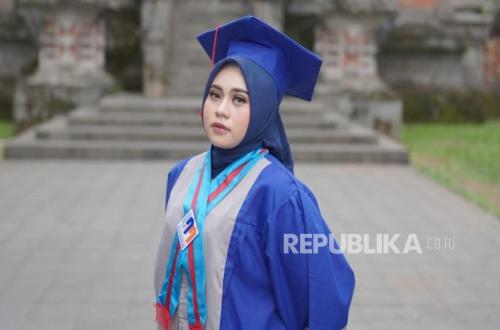
Universitas Nusa Mandiri (UNM), as a Digital Business Campus, has once again achieved international recognition. This proud milestone comes from the Data Science Study Programme, following the success of one of its graduates, Desi Masdin Dama, who successfully published her final thesis research in the reputable Q1 international journal, Artificial Intelligence and Applications.
The scientific article, titled ‘Fine-Tuning IndoBERTa for Indonesian Digital News Sentiment Classification’, serves as evidence that student academic work is not merely a graduation requirement but is capable of providing real contributions to the advancement of science and technology on a global scale.
This publication demonstrates the quality of education and research being continuously developed by Universitas Nusa Mandability to produce competitive digital talent ready to face the challenges of the Artificial Intelligence (AI) era.
Desi’s research focused on developing an AI model based on IndoBERTa to improve the accuracy of sentiment classification in Indonesian-language digital news. The research arose from the need for a sentiment analysis model more relevant to the characteristics of news language, which tends to be formal and complex, unlike the social media data commonly used in similar studies.
Working alongside a research team, Desi collected and annotated approximately 1,300 national news articles and subsequently performed the fine-tuning process on the IndoBERTa model. The resulting model achieved an accuracy rate of up to 98 per cent, effectively bridging the adaptation gap between social media data and digital news data.
This success was supported by experience gained through the Internship Experience Program (IEP), a flagship programme of Universitas Nusa Mandiri featuring a scheme of three years of study and one year of industrial internship. During this programme, Desi interned as a Data Analyst for Business Development Service at PT Sadhana Ekapraya Amitra.
This industrial experience strengthened her data analysis, problem-solving, and understanding of data utilisation in business decision-making, which served as essential preparation for completing her research.
“The internship programme provided real-world experience in processing and analysing data to solve industrial problems. That experience was immensely helpful when conducting my research and developing AI-based solutions,” said Desi.
She added that publishing in a Q1 international journal was a highly valuable experience for honing research skills and expanding academic horizons globally.
“This research teaches us that artificial intelligence technology must be built based on real needs. We strive to provide solutions that can help understand public sentiment through digital news more accurately,” Desi stated.
Notably, the results of this research extend beyond scientific publication. The developed model has been implemented into a real-time news analysis system, which has the potential to support the development of Natural Language Processing (NLP) research in Indonesia.
The Head of the Data Science Study Programme at Universitas Nusa Mandiri, Tati Mardiana, appreciated this achievement as tangible proof of the success of a curriculum that integrates academic learning, industrial experience, and need-based research.
“The publication of final thesis results in a Q1 journal shows that Data Science students at Universitas Nusa Mandiri are not only capable of completing their academic studies but also producing high-quality scientific work that contributes to the advancement of science and technology. This also proves the effectiveness of the Internship Experience Program in preparing students for global challenges,” Tati said in a press release received on Tuesday.
According to Tati, through a learning scheme that combines academic and industrial experience, students are able to connect theory with real practice, thereby producing relevant and impactful innovations.
“As a Digital Business Campus, UNM remains committed to providing a learning ecosystem that encourages the birth of superior, innovative, and internationally competitive digital talent. Desi Masdin Dama’s achievement is proof that the integration of education, industrial experience, and research can produce graduates ready to bring Indonesian work to compete on the world stage,” she concluded.