
Unlocking Kepri's Economic Potential: Tifatul Asks 'Why Always Bali?'
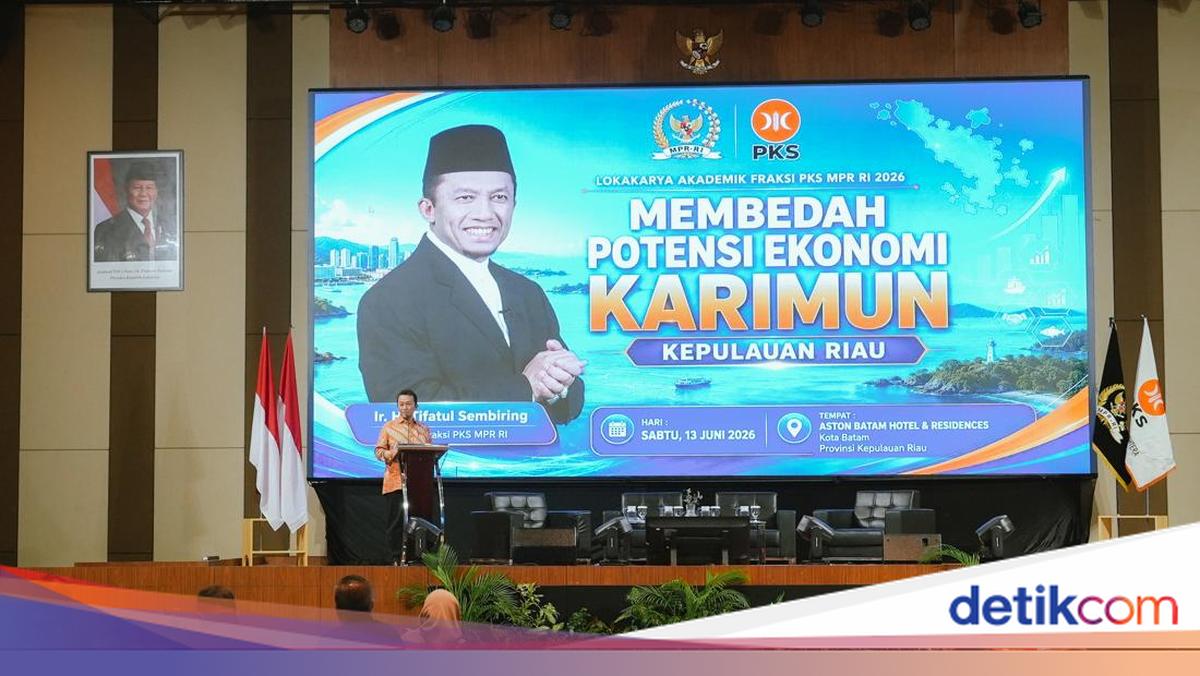
The Chairman of the Prosperous Justice Party (F-PKS) faction in the Indonesian People’s Consultative Assembly (MPR RI), Ir Tifatul Sembiring, has proposed the concept of ‘Ekonomi Utara’ (Northern Economy) as a new strategy to drive national economic growth. He conveyed this during the F-PKS MPR RI Academic Workshop 2026, themed ‘Dissecting the Economic Potential of Karimun, Riau Islands’, in Batam, Kepulauan Riau (Kepri). During the event, Tifatul outlined the opportunities of the Northern Economy concept. According to Tifatul, government attention has so far been too heavily focused on the southern region. He argued that if Indonesia’s economy is to advance, the northern region must be developed earnestly and more seriously. “Why always Bali? Bali is already full, Bali has already developed on its own, it is even over-touristed,” Tifatul stated on Monday (15/6/2026). “What about Indonesia’s other regions? Why are they not being developed?” he continued. Tifatul explained that tourists visiting Bali mostly come from Australia and New Zealand. Combining the populations of both countries, Australia has around 27 million people and New Zealand around 5.5 million, making a total of only about 32.5 million people. According to Tifatul, this number is far smaller than the potential market population in the northern region. “Imagine the human potential in the North. China alone has about 1.43 billion people, India about 1.45 billion, ASEAN more than 600 million, not to mention Japan, Korea, Russia, and other countries,” Tifatul said. “The number of people alone is more than 3 billion. Not to mention the economic size of the North, GDP, and so on,” he added. Tifatul cited data from China’s National Bureau of Statistics (NBS), noting that in 2025, China’s GDP reached US$19.6 trillion. Meanwhile, according to the International Monetary Fund (IMF), India’s GDP reached US$4.13 trillion, Japan’s US$4.38 trillion, and South Korea’s US$1.86 trillion. He also noted that according to Trading Economics, China’s foreign exchange reserves in December 2025 amounted to US$3.358 trillion, demonstrating the strength of the world’s economic giants. Therefore, Tifatul believes Indonesia must not only look to the southern region. He argued that if Indonesia wants to advance economically, the potential opportunities of the Northern Economy must be jointly developed, including in tourism, trade, and services. Tifatul named several regions that could become important parts of northern economic development, including Aceh, North Sumatra, Kepri, North Kalimantan, North Sulawesi, North Maluku, and Papua. These areas, he continued, face directly towards countries with a combined population of more than 3 billion people. Tifatul also noted that Karimun, in the Riau Islands, holds a strategic position due to its proximity to the Malacca Strait, one of the world’s busiest shipping lanes. According to Tifatul, more than 95% of ships crossing from the Pacific Ocean to the Atlantic, and vice versa, pass through this vital route. He observed that so far, only Singapore has reaped significant economic benefits from the flow of ships traversing the Malacca Strait. “Here lies the very strategic Malacca Strait. All this time, Singapore has taken the most profit from the passing ships,” Tifatul explained. “Singapore’s container throughput in 2024 alone reached 41.12 million TEUs in one year, and because the Strait of Hormuz is closed, it has now risen further to 65 million TEUs. One TEU is equivalent to one 20-foot container,” he continued. Tifatul added that by comparison, the Batu Ampar Port in Batam still handles less than 1 million TEUs per year. “Compare that with Batu Ampar in Batam, which only handles around 797 thousand TEUs a year, not yet reaching 1 million TEUs. They are many times over,” Tifatul remarked. “Even though Singapore is a small country, it can utilise this strategic route,” he continued. According to Tifatul, if transport connections in Indonesia’s northern region are built, people will certainly be more attracted to visit the area. Moreover, the northern regions of Indonesia also possess natural beauty that is no less stunning than Bali. “If the transport connections are good, of course people will flock to come. In terms of natural beauty, the northern regions are no less beautiful,” Tifatul said. “There is Lake Toba, Sabang, beaches in Aceh like Lhoknga, Lake Singkarak, Lake Maninjau, Bunaken, Raja Ampat, and North Maluku,” he elaborated. Meanwhile, Kepri is positioned as the northern gateway to Indonesia. Batam is only about 40 minutes from Singapore, while Karimun is also close to the Malacca Strait and has the opportunity to take a role in servicing the container sector, port services, and ship refuelling. “The Riau Islands are the northern gateway. Batam is only about 40 minutes from Singapore,” Tifatul said. “Beside it is Karimun, which is also strategic and closer to the Malacca Strait. Karimun can take a share, for example in container services or refuelling for passing ships,” he added. Tifatul stressed that Karimun’s development should be directed towards sectors that quickly deliver economic impact, particularly tourism. He cited that in 2024, Indonesia’s tourism foreign exchange earnings were only around Rp64 trillion, while Malaysia’s had reached approximately Rp406 trillion. According to Tifatul, these figures show that tourism is a strategic sector that needs to be seriously developed because it can generate direct money circulation through tourist spending. “Focus on sectors that can quickly boost Karimun’s economy, especially tourism, culinary, hotels, entertainment, transport, and connectivity. Where many people come, there money circulates,” Tifatul stated. “Karimun must have something that can be marketed digitally, have distinctive cuisine, attractive areas, tourist villages, that can be marketed. If there is something that needs to be fought for with the central government, including revenue sharing and port development.”