
UNJ and Alumni Association Collaborate to Promote Green Campus and Formulate Jakarta's Future
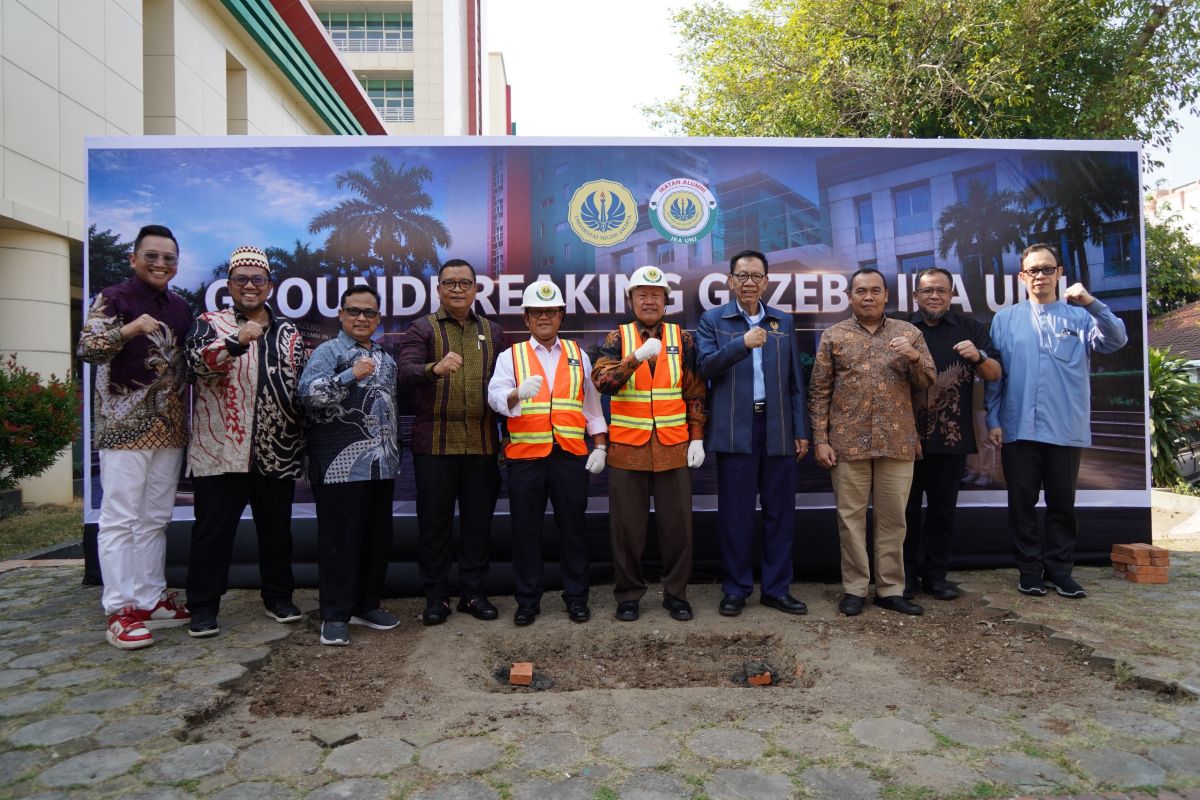
Universitas Negeri Jakarta (UNJ) and the UNJ Alumni Association (IKA UNJ) have strengthened their strategic collaboration through the “Alumni Gathering and Groundbreaking of the IKA UNJ Gazebo” held on Friday, 10 July 2026. Facilitated by the Office of the Vice-Rector for Academic Affairs, Student Affairs and Alumni, the event marked an important moment for cementing ties between alumni and their alma mater whilst affirming a shared commitment to developing campus facilities that are environmentally friendly, sustainable and beneficial to the academic community.
The series of events began with the groundbreaking of the IKA UNJ Gazebo, located in the Open Theatre (Terbuk) area of UNJ Campus A. The construction of this facility represents a tangible contribution by alumni towards improving the quality of the student learning environment, and forms part of efforts to realise the green campus concept currently being developed by UNJ.
The foundation-laying ceremony was attended by UNJ Rector Prof. Komarudin, Chairman of the IKA UNJ Central Board Sugeng Suparwoto, Chairman of the UNJ Board of Trustees (MWA) Prof. Nizam, university leadership, alumni administrators, lecturers, students and various other stakeholders.
Sugeng Suparwoto, Chairman of the IKA UNJ Central Board, said the gazebo’s construction is a first step in the many contributions alumni will continue to make to their alma mater. According to him, the gazebo will provide a comfortable open space for students to study, hold discussions, complete assignments and carry out various academic activities more flexibly.
“This gazebo will be a place for students to be active. It will later be equipped with Wi-Fi facilities so students can study anywhere within the campus environment,” said Sugeng, who is also Deputy Chairman of Commission XII of the House of Representatives (DPR RI).
He emphasised that the gazebo’s construction is not merely about providing a physical facility, but also symbolises alumni involvement in supporting UNJ’s transformation towards a greener, more inclusive and sustainable campus.
Sugeng revealed that his awareness of the importance of environmental issues grew stronger after attending an international climate change forum in Paris. According to him, the world currently faces serious challenges caused by global warming, driven by fossil fuel use and suboptimal environmental management.
For this reason, IKA UNJ is committed to supporting various initiatives aligned with the green campus and zero waste campus concepts.
“IKA UNJ will continue to support efforts to make the campus green and zero waste. Waste must be managed properly, and can even be processed into useful products, including as co-firing fuel,” he explained.
According to Sugeng, waste management must be a shared concern as it is one of the main urban challenges, including in Jakarta. He views the university as holding a strategic position as a centre of education, research and innovation capable of producing science-based solutions to environmental problems.
He hopes UNJ can become the primary reference for research in waste management, renewable energy and various innovations supporting sustainable development.
“UNJ must be Jakarta’s lighthouse. If there is a problem requiring thought and research, then UNJ must be the reference,” he asserted.
Beyond the gazebo construction, IKA UNJ also plans to introduce various follow-up programmes supporting green campus development. One initiative being prepared is the installation of a solar power (PLTS) based lighting system as a symbol of the shared commitment towards a more environmentally friendly campus.
Sugeng emphasised that all these contributions embody the spirit of IKA UNJ, captured in the organisation’s tagline: “Alumni for Alumni, Alumni for the Alma Mater, and Alumni for Others.”
Meanwhile, UNJ Rector Prof. Komarudin expressed his appreciation for the continued support and contributions given by alumni to the university’s progress. According to him, the gazebo construction is tangible proof that the relationship between alumni and their alma mater does not end at graduation, but continues to evolve through collaborations that benefit the next generation.
“This afternoon we are once again gifted a contribution from IKA UNJ in the form of a gazebo that will become a centre of intellectual activity for students,” said Prof. Komarudin.
He hopes the facility can become a productive space supporting students’ learning whilst strengthening academic culture within the campus environment.
Furthermore, the Rector affirmed that UNJ continues to improve the quality of educational infrastructure to support the university’s transformation into a globally reputable higher education institution with an impact on society.
According to him, synergy between UNJ, IKA UNJ, the Jakarta Provincial Government and various other strategic partners is an important factor in accelerating the university’s development.
Prof. Komarudin also revealed that UNJ is continuing to push for strengthened campus infrastructure, including sports facilities and other academic support facilities. Despite having more limited facilities compared to some other universities, UNJ has still managed to achieve proud accomplishments at national and regional levels.
He hopes that support from various parties will further strengthen UNJ’s position as a centre of education, research, innovation and community service that makes a tangible contribution to the development of Jakarta and Indonesia.
The gazebo’s construction will be followed by a monitoring and maintenance system involving various elements of the university community so that the facility can be used optimally and sustainably. Going forward, IKA UNJ also plans to build several additional gazebos around the campus as part of its ongoing support for developing a comfortable and productive academic environment.
After the groundbreaking ceremony, proceedings continued with an Alumni Gathering on the theme “The Role of UNJ as an Impactful and Globally Reputable Campus in Jakarta’s Development”, held at the Latief Hendraningrat Hall, UNJ Campus A.
In the discussion session, Chairman of the UNJ Board of Trustees (MWA) Prof. Nizam highlighted the importance of university independence in managing education financing. He explained that UNJ’s transformation into a Legal Entity State University (PTNBH) opens up greater opportunities to develop various sustainable funding sources.
One strategy considered important is the development of an endowment fund, which allows the university to gain long-term benefits without reducing the principal funds collected.
“Through the raising of endowment funds, it is hoped that UNJ will become increasingly independent, strong and able to produce outstanding human resources through close collaboration between alumni and the alma mater,” he said.
Meanwhile, architect and urban observer Marco Kusumawijaya discussed Jakarta’s challenges in becoming a global city in his presentation entitled “Jakarta 500 Years: History, Identity and the Transformation of a Global City”. He highlighted various urban problems, particularly the provision of decent and affordable housing for the public.
According to Marco, beyond financing issues, housing regulations also need to be designed so they can meet people’s needs without creating new burdens.
“Policy must create opportunities for urban growth and accommodate people’s needs, especially in the aspect of housing in Jakarta, which is a basic human right,” he said.
He also offered the concept of mutual cooperation (gotong royong) based housing through cooperatives as one alternative for tackling the challenges of housing provision in Jakarta.
Through this event, UNJ and IKA UNJ reaffirmed the importance of collaboration between alumni, universities, government and society in building an impactful educational ecosystem. This synergy is expected not only to strengthen campus development, but also to encourage the emergence of ideas, innovations and tangible contributions to the development of a more sustainable Jakarta and Indonesia.
Source: jawawa.id (https://jawawa.id/newsitem/unj-and-alumni-association-collaborate-to-promote-green-campus-and-formulate-jakartas-future-1783709429)
Originally published by Media Indonesia (https://mediaindonesia.com/humaniora/909745/kolaborasi-unj-dan-ika-dorong-kampus-hijau-serta-rumuskan-masa-depan-jakarta), translated from Indonesian