
University Research Must Address Challenges from Climate Change to Artificial Intelligence
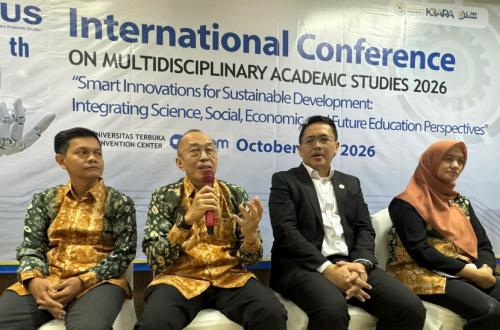
TANGERANG SELATAN — Climate change, educational inequality, economic transformation and advances in artificial intelligence (AI) are among the global challenges that require research drawing on multiple disciplines. Universities are seen as needing to develop studies that can produce solutions to these issues and provide a basis for science-based public policy.
Mohammad Fauzan Adziman, Director General of Research and Development at the Ministry of Higher Education, Science and Technology, said a multidisciplinary approach should underpin the development of university research. Research should not be conducted in isolated sectors, he said, but should connect different fields of knowledge to address society’s needs.
“International conferences such as this one show how multidisciplinary academic studies should already be at the heart of research development,” Fauzan said at a press conference for the 5th International Conference on Multidisciplinary Academic Studies (ICOMUS) 2026 at Universitas Terbuka (UT) in South Tangerang on Thursday (22 October 2026).
Fauzan stressed that universities should develop research as a source of ideas and solutions to a range of problems. Research should therefore not be seen merely as a budgetary burden or cost centre, but also as a source of input for policymaking.
Mery Noviyanti, head of the UT Institute for Research and Community Service’s Centre for Scientific Research, said the complexity of global problems meant that an approach based on a single discipline was no longer adequate. Climate change, technological development and socio-economic issues are interconnected and require collaboration across disciplines.
“There are global challenges, particularly climate change, educational inequality, economic transformation and technological development, including AI, and these cannot be solved through a single discipline,” Mery said.
Research involving science, technology, social sciences and economics can provide a more comprehensive understanding of an issue, she said. Such collaboration is needed so that research not only explains problems but also offers possible solutions.
“That is why different disciplines are needed, for example science, technology, social sciences and economics. By working together, they can more readily address these challenges,” Mery said.
Meanwhile, Hendrian, UT’s vice-rector for research, partnerships and business, said a multidisciplinary approach made it possible to conduct more comprehensive research. Involving different fields of knowledge, he said, could increase the benefits of research for society.
“I see multidisciplinary research as comprehensive in nature, so that the research we produce will have a genuine impact,” Hendrian said.
Hendrian said UT was working to develop research partnerships on an ongoing basis. Collaboration among academics is expected to produce research whose benefits are increasingly measurable and relevant to society’s needs.
Through ICOMUS 2026, UT is bringing together academics from 11 universities, including Universitas Indonesia, Universitas Diponegoro, UIN Sunan Gunung Djati and the Indonesian Institute of the Arts (ISI) Yogyakarta. The collaboration provides a forum for exchanging ideas and developing research across a range of disciplines.
The research collaboration is expected to inform the formulation of science-based public policy. Multidisciplinary research is also expected to support the achievement of the Sustainable Development Goals (SDGs) by 2030.