
University of Indonesia students design energy-efficient room cooling prototype
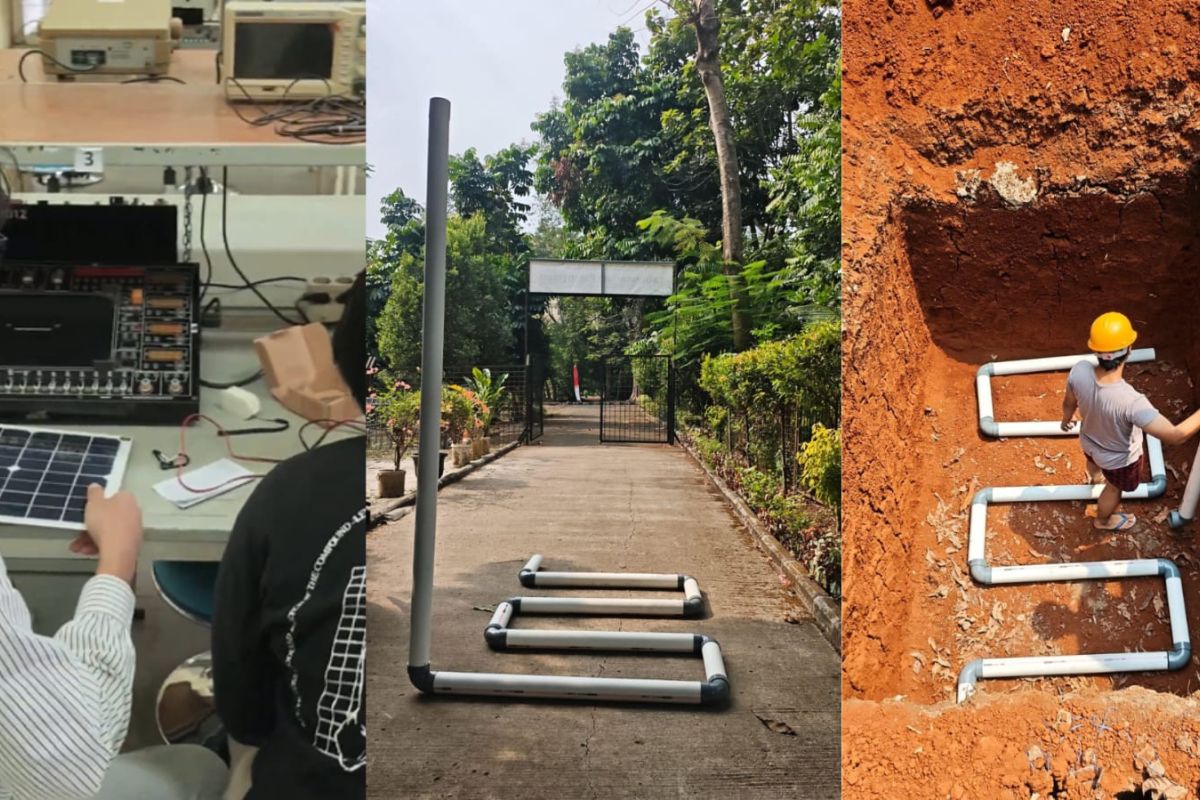
“We designed this system to be adaptive. When the outside air temperature rises, circulation needs also increase. Under conditions of higher solar intensity, the solar panels can generate more power to support the ventilator’s operation.”
Depok (ANTARA) - Five students from the University of Indonesia (UI) have developed ADEM (Adaptive Energy-efficient Microclimate System), a room cooling system prototype that combines the stability of underground temperatures with solar power, enabling significant energy savings.
“The principle of ADEM exploits the temperature difference between surface air and the soil temperature. By cooling the air before it enters the room, the load on active cooling systems can be reduced,” said UI team leader Abdurrasyid Dzaki Amir in Depok on Tuesday.
The innovation was designed as a more energy-efficient alternative for room cooling, particularly for buildings in tropical regions such as Indonesia, where cooling demand is high.
The team, led by Abdurrasyid Dzaki Amir, combines a heat-exchange mechanism with the ground, solar-powered ventilation, and an automatic control system within a single cooling system.
ADEM works by exploiting the relatively stable soil temperature at a certain depth. Outside air is channelled through a network of PVC pipes buried underground and arranged in a serpentine pattern.
To maintain air circulation, ADEM is equipped with a ventilator turbine driven by a DC motor powered by solar panels. This system ensures airflow is maintained even in low-wind conditions.
At the same time, temperature sensors at the inlet and outlet measure temperature changes in real time and send the data to an ESP32 microcontroller, which adjusts the ventilator’s operation according to environmental conditions.
“We designed this system to be adaptive. When the outside air temperature rises, circulation needs also increase. Under conditions of higher solar intensity, the solar panels can generate more power to support the ventilator’s operation,” said Abdurrasyid.
The use of solar energy in the ventilation system also forms part of efforts to reduce energy demand from conventional electricity sources.
Abdurrasyid developed ADEM together with Satria Erlangga Munggaran, Michael Gianvittorio Siringoringo, Steven Anthony Suhartoyo, and Muhammad Rayhan Pasha Nuruddin.
The five students are from the Physics undergraduate programme at UI’s Faculty of Mathematics and Natural Sciences (FMIPA). ADEM was developed under the guidance of Syahril Siregar S.Si, M.Sc, Ph.D, a lecturer in the FMIPA Physics Department.