
University Helps Purbalingga Residents Develop Honey Pineapples and Prevent Landslides
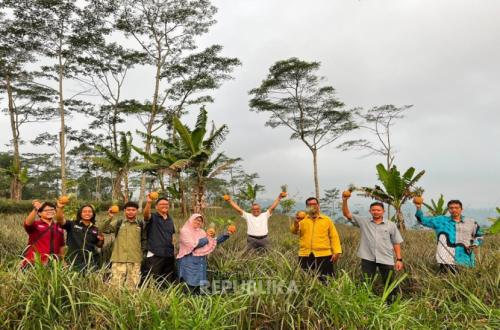
PURBALINGGA — The development of honey-pineapple farming in Siwarak Village, Karangreja District, Purbalingga Regency, Central Java, is being pursued alongside efforts to protect the environment and reduce landslide risks. The village’s agricultural potential is being developed through guidance on cultivation and product processing, while land conditions are being addressed through conservation plans and environmental monitoring.
The effort is part of the 2026 Social Collaboration for Community Development (Kosabangsa) programme, run by Universitas Perwira Purbalingga (UNPERBA) and Universitas AKPRIND Indonesia. The programme, supported by the Ministry of Higher Education, Science and Technology through its Directorate of Research and Community Service, also includes measures to strengthen clean-water management.
Afif Hendri Putranto, the programme’s head at UNPERBA, said that developing the village’s potential should take account of both residents’ economic needs and environmental conditions.
“Village potential needs to be developed in an integrated way. Honey-pineapple farming has the potential to become a source of income for residents, while clean-water management and landslide-risk mitigation are important to support the sustainability of community life,” Afif said.
For the agricultural work, the programme team is partnering with the Berkah Sekar Abadi Women Farmers Group (KWT). Guidance will focus on improving honey-pineapple cultivation, diversifying processed products, improving production hygiene and packaging, business management and digital marketing.
UNPERBA team member Victor Bintang Panunggul said honey-pineapple development must consider both productivity and land conditions. The guidance therefore also covers cultivation practices suited to local conditions, including soil and water conservation.
In addition to increasing agricultural output, the programme aims to boost the products’ added value through processing and packaging. Its proposal sets a target of increasing the number of processed products by at least 30 per cent from the baseline. Progress will be evaluated against initial data and the results of the activities.
Siwarak’s location on the slopes of Mount Slamet also makes environmental management a priority. The programme plans to develop an Internet of Things (IoT)-based early warning system (EWS) to monitor environmental indicators associated with potential ground movement and rainfall.
Dr Samuel Kristiyana, a member of the mentoring team from Universitas AKPRIND Indonesia, said information about local conditions was needed to support disaster-risk reduction planning. Geophysical studies will help inform understanding of the area’s characteristics, including conditions related to potential water sources and landslide risks.
Alongside technology-based monitoring, conservation measures are planned using coir mesh to help control erosion, as well as planting vetiver grass and avocado trees in suitable locations. The approach combines technology with conservation measures tailored to local environmental conditions.
The monitoring and early warning system is designed to provide information to residents. Its effective use will nevertheless require public awareness, equipment maintenance and clear procedures for responding when warnings are received.
The 2026 Kosabangsa programme also involves PAMSIMAS Tirta Jaya as a partner in strengthening clean-water management. Support includes managing facilities, monitoring water quality and building the capacity of operators. The programme plans to introduce a water-quality monitoring system using data transmission technology based on the General Packet Radio Service (GPRS).
Through the collaboration, UNPERBA and Universitas AKPRIND Indonesia hope to increase the economic value of residents’ agricultural produce through honey-pineapple businesses, while promoting more sustainable land and environmental management. Community involvement is essential to ensure that activities and technologies introduced through the programme can be managed and maintained after the universities’ support ends.
Source: jawawa.id (https://jawawa.id/newsitem/university-helps-purbalingga-residents-develop-honey-pineapples-and-prevent-landslides-1793631092)
Originally published by Republika (https://news.republika.co.id/berita/tnvhoh349/kampus-dampingi-warga-purbalingga-kembangkan-nanas-madu-dan-cegah-longsor), translated from Indonesian