
University Graduates Still Unemployed, Binawan University Strengthens Global Workforce Connections
The high unemployment rate among higher education graduates remains a homework for the education sector in Indonesia. The Central Statistics Agency (BPS) recorded an open unemployment rate of 6.23 per cent among higher education graduates (Diploma IV, Bachelor’s, Master’s, and Doctoral) as of February 2025. The government also stated that around 1.01 million higher education graduates have yet to be absorbed by the labour market.
This situation underscores the importance of strengthening the link between universities and the needs of the business and industrial worlds through adaptive, competency-based education with international networks.
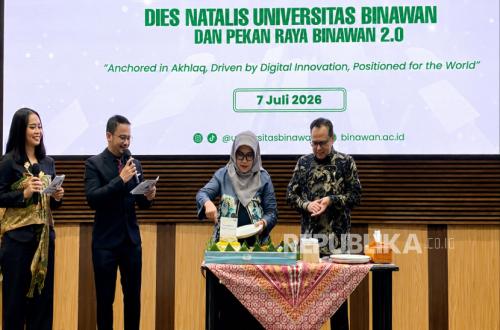
Binawan University believes these challenges must be answered by improving graduate quality, collaborating with industry, and opening career access to the global level. At its 25th Dies Natalis celebration, carrying the theme ‘Anchored in Akhlaq, Driven by Digital Innovation, Positioned for the World’, the university reaffirmed its commitment to building higher education that produces not only competent graduates, but also ones ready to compete in the international job market.
According to a tracer study, 93 per cent of Binawan University graduates obtained employment within six months of graduating. This achievement is supported by more than 100 active collaborations with universities, hospitals, government institutions, professional organisations, and industry partners both at home and abroad.
These collaborations form the foundation for industry needs-based curriculum development, improved research quality, academic exchanges, and expanded career access for students and alumni.
The university’s international network is also reflected in its alumni’s achievements. To date, more than 2,000 Binawan University alumni have worked in various countries, particularly as professional nurses in Australia, Asia, Europe, and the Middle East. In 2026, the university will again dispatch alumni to work in Austria and Australia as part of efforts to broaden employment opportunities for Indonesian professionals in the global market.
In addition to strengthening graduates’ competitiveness, Binawan University is also enhancing its academic capacity. In 2026, the university attained Main Cluster status for Research and Innovation Capacity and added seven doctorate-holding lecturers to strengthen the quality of education and research.
Chairman of the Binawan Foundation, Said Saleh Alwyni, said that over the past 25 years, Binawan University has strived to maintain a balance between character formation, technological mastery, and readiness to face the demands of the working world.
“Twenty-five years is not merely the passage of time, but a journey of building trust and delivering benefits through education. We are grateful that Binawan University continues to grow while upholding akhlaq (moral character) as its main foundation, while also adapting to technological developments and the needs of the working world. Going forward, we want ever more Binawan graduates to contribute, both in Indonesia and across the world,” he said.
Acting Rector of Binawan University, Prof. Henny Suzana Mediani, said that improving graduate absorption, strengthening research capacity, and the widening of international work access demonstrate the importance of collaboration between the university and various stakeholders.
“The success in raising graduate absorption to 93 per cent, the increase in doctorate-holding lecturers, the rise in research capacity to the Main Cluster, and the broadening of international career opportunities are indicators that Binawan University continues to move in the right direction. We will continue to strengthen the quality of education, produce relevant research, and build graduates who excel not only academically, but also possess character, global competence, and the ability to adapt to change,” she said.
Vice Rector for Governance, Resources, and Strategic Partnerships at Binawan University, Farouk Abdullah Alwyni, said the transformation undertaken in recent years is part of efforts to strengthen the connection between higher education and the world of work.
According to him, since its founding, Binawan University has been directed towards building an educational ecosystem integrated with industry needs at both national and international levels, while remaining grounded in the values of akhlaq and digital innovation.
Meanwhile, Chairman of the Binawan University Board of Trustees, Prof. Tri Hanggono Achmad, believes universities bear a greater responsibility than merely producing graduates.
“Dies Natalis is not just a celebration of an institution of higher education growing older. More than that, Dies Natalis is a moment to evaluate how far a university is able to produce quality graduates, generate innovation through research, build the character of the younger generation, and deliver solutions for society. An excellent university is one capable of delivering real impact for the development of the nation and civilisation,” he said.
Entering its 25th year, Binawan University declared it will continue to strengthen international collaboration, improve research and innovation capacity, and expand global employment opportunities as part of efforts to enhance the competitiveness of Indonesia’s human resources.