
University Conducts Disaster Communication Socialisation to Mitigate Tidal Flooding in Penjaringan
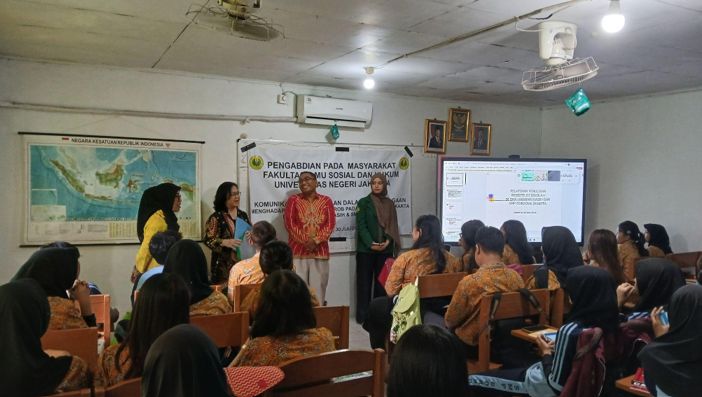
The Faculty of Social and Legal Sciences, State University of Jakarta (FISH-UNJ), organised a Community Service Programme (P2M) in the Penjaringan area, North Jakarta, on Thursday (30/07/2026). The activity involved a team of lecturers from the Departments of Communication Science and Geography at UNJ, alongside students, focusing on the theme ‘Disaster Communication in Facing the Threat of Tidal Flooding’.
Prior to this event, Focus Group Discussions (FGD) had been conducted with the local government and community to gather information regarding disaster conditions and mitigation efforts in Penjaring. During the opening ceremony, the Head of the P2M Team, Dr E. Nugrahaeni P., M.Si., expressed appreciation for the participants’ enthusiasm, particularly the students’ eagerness to learn.
Prof. Dr Cahyadi Setiawan, acting as a keynote speaker, emphasised that the material provided should benefit the community, especially the younger generation. He noted that understanding tidal flooding is crucial as it is closely linked to the land subsidence occurring in coastal regions.
The programme involved gathering data on the tidal flood conditions faced by residents in Penjaringan. As a coastal area, the community faces significant threats from tidal surges caused by rising sea levels, which disrupt daily activities. Local students shared that their homes are frequently affected due to their proximity to the sea. While the presence of water pumps has helped reduce the duration of flooding, some areas previously experienced stagnant water for up to a week.
The flooding also impacts local infrastructure. H. Chairil Anwar, Head of the Salahudin Foundation, explained that tidal waters often enter school grounds, forcing the institution to raise its building levels on four separate occasions. Beyond physical damage, the prolonged flooding creates environmental issues, such as increased mosquito populations, which raises the risk of Dengue Fever (DBD).
Through this community service initiative, the UNJ team of lecturers and students sought to understand the experiences and needs of the community. The findings will be used to determine how disaster communication can more effectively convey information regarding risks and preparedness. The ultimate goal is to foster a more disaster-aware community through collaboration between academics, the government, and local residents.