
Universities Serve as Spaces for Future Discussion
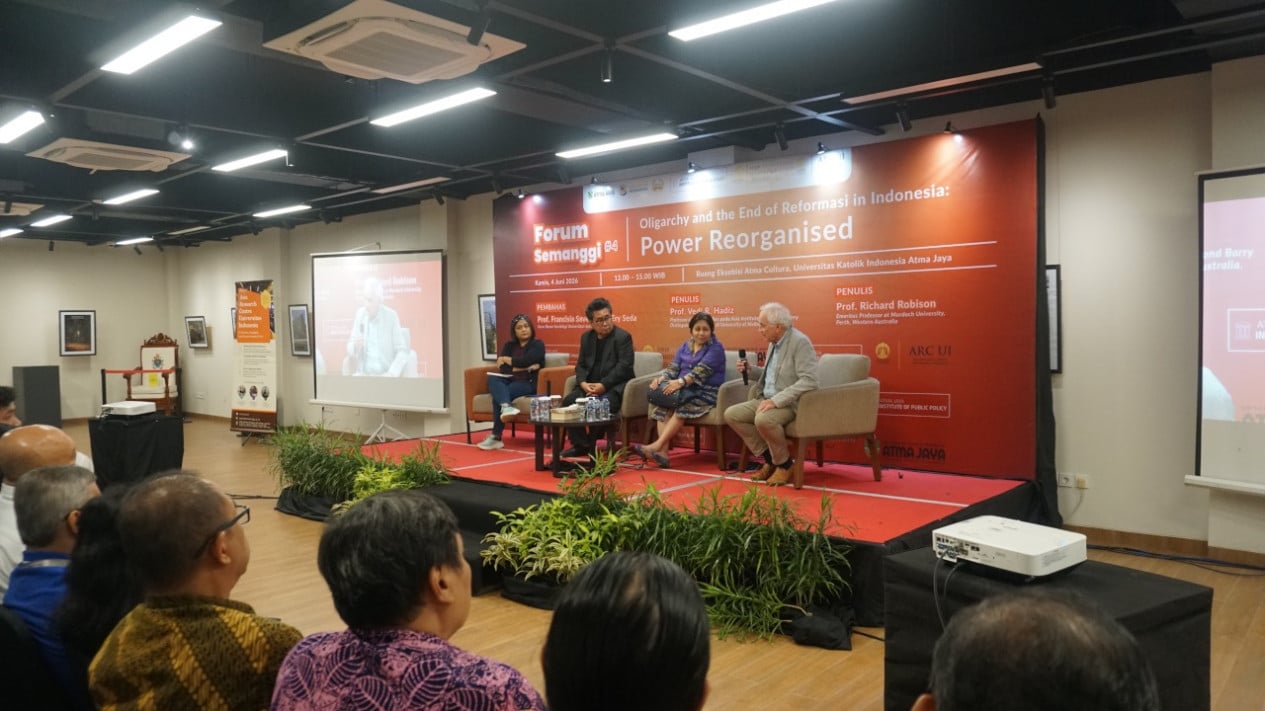
Amidst the rapid flow of information and ongoing social changes, universities are considered to maintain a vital role as spaces for dialogue to discuss various public issues openly and constructively. This view was presented during the Semanggi Forum #4, organised by the Atma Jaya Institute of Public Policy (IPP) of Atma Jaya Catholic University of Indonesia, in collaboration with the Department of Sociology and the Asia Research Centre at the University of Indonesia.
The event, held at the Semanggi Campus, featured academics from both domestic and international institutions to discuss developments in democracy, politics, and public policy in Indonesia. The Executive Director of IPP Unika Atma Jaya, Salvatore Simarmata, stated that the forum is part of an effort to expand public discussion spaces so that the community can understand various social and political developments more comprehensively. “We organised this forum to gain a clearer view of ongoing developments so that we can better understand public issues,” he said.
According to Simarmata, academic discussion serves as an important medium to bring together diverse views and perspectives regarding the challenges currently faced by society. The Semanggi Forum #4 featured several prominent academics, including Professor of Asian Studies at the University of Melbourne, Vedi R. Hadiz; Emeritus Professor at Murdoch University, Richard Robison; and Professor of Sociology at the University of Indonesia, Francisia Saveria Sika Ery Seda.
During the session, speakers discussed Indonesia’s political development after more than two decades of the Reformation era and the various dynamics accompanying it. The discussion did not focus solely on the past, but also on how society can understand ongoing changes more holistically. Vedi explained that his latest book is an expansion of research previously published in 2004, noting that Indonesia’s development over the last two decades presents many new and interesting dynamics to study. “This book is an effort to update the analysis regarding Indonesia’s political changes and the various dynamics developing after the Reformation,” said Vedi.
Meanwhile, Richard Robison noted that the journey of the Reformation has brought significant changes to national and state life, ranging from constitutional amendments and political system shifts to the implementation of decentralisation, which remains a key part of Indonesia’s current democratic development.