
Universities Must Adapt to AI Disruption
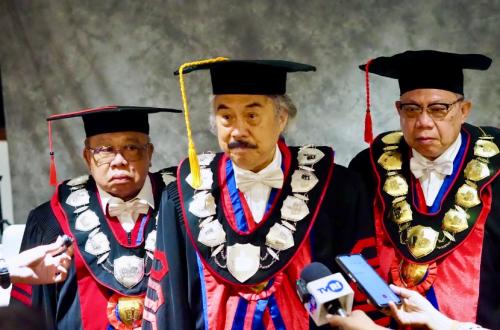
The development of artificial intelligence (AI) is pushing universities to accelerate digital transformation and adjust their learning systems in order to produce graduates who are adaptable to changes in the world of work. Beyond technology adoption, stronger regulation and improved human resource competencies are also seen as essential in facing digital disruption.
This was emphasised by the Chair of the Unkris Senate and Head of the Unkris Foundation’s Board of Trustees, Gayus Lumbuun, during a graduation ceremony at Universitas Krisnadwipayana (Unkris) attended by 1,300 graduates at the Jakarta Convention Centre (JCC) on Wednesday (22/7/2026). The ceremony covered the 65th Bachelor’s programme, the 29th Master’s programme, and the 13th Doctoral programme.
Gayus Lumbuun said universities must continuously improve institutional quality and prepare students for developments in AI.
“Unkris is currently striving to raise the quality of the institution, including in the process towards achieving superior accreditation. Institutional renewal continues so the university can compete at national and international levels,” said Gayus, according to a press release on Thursday (23/7/2026).
According to Gayus, the development of AI will be an important part of the Industrial Revolution 5.0, so universities need to prepare graduates who are adaptive to technological change. At the same time, he believes these developments must be matched by adequate regulation, including the drafting of cyber laws and digital judiciary mechanisms.
“We need cyber law and a digital justice system capable of fairly adjudicating various violations in the fields of technology and artificial intelligence,” he said.
Unkris Rector Ali Johardi said digital transformation on campus is being carried out through the development of academic systems, administration, student services, and technology-based learning. According to him, this transformation is accompanied by expanded international cooperation, including with several universities in Russia, Japan, and the United States.
“Organisations that survive are those that are adaptive, innovative, and able to turn challenges into opportunities through the use of technology,” he said.
The Head of LLDIKTI Region III, Henry Togar Hasiholan, viewed digital transformation as not merely about the use of new technology, but also about changes in mindset and work culture. According to him, industry now increasingly needs human resources capable of critical thinking, problem-solving, and integrity.
“What industry is looking for today are those who can be problem solvers, have integrity, and can manage work in new ways,” he said.
At the ceremony, Unkris graduated 1,300 students, comprising 962 bachelor’s graduates, 329 master’s graduates, and 9 doctoral graduates.