
Universitas Terbuka's Open Education Model Gains Global Recognition in THE Rankings
Universitas Terbuka (UT) has recorded a significant achievement in the Times Higher Education (THE) Sustainability Impact Ratings 2026, with its highest scores across five Sustainable Development Goals (SDGs). The data, published on 24 June 2026, places UT in an increasingly competitive global landscape. The THE Sustainability Impact Ratings measure the contribution of higher education institutions worldwide to the 17 UN SDGs. This year, THE evaluated 1,603 universities from 116 countries or regions.
UT’s best performance was in SDG 16: Peace, Justice and Strong Institutions, where it ranked in the 201-300 band globally. It also achieved rankings in SDG 4: Quality Education (401-600), SDG 17: Partnerships for the Goals (601-800), SDG 5: Gender Equality (401-600), and SDG 6: Clean Water and Sanitation (401-600). These results demonstrate that UT’s contribution is not limited to a single area, but spans institutional governance, expanding access to quality education, fostering partnerships, promoting equality, and caring for environmental sustainability.
In the context of modern higher education, this achievement shows that reputation is also built through tangible public benefit. UT’s top position in SDG 16 highlights the importance of institutional governance in building trust. As a public open university, UT continues to strengthen principles of accountability, transparency, and service quality. This is particularly relevant as higher education today is demanded to be credible, open, and responsive to societal needs.
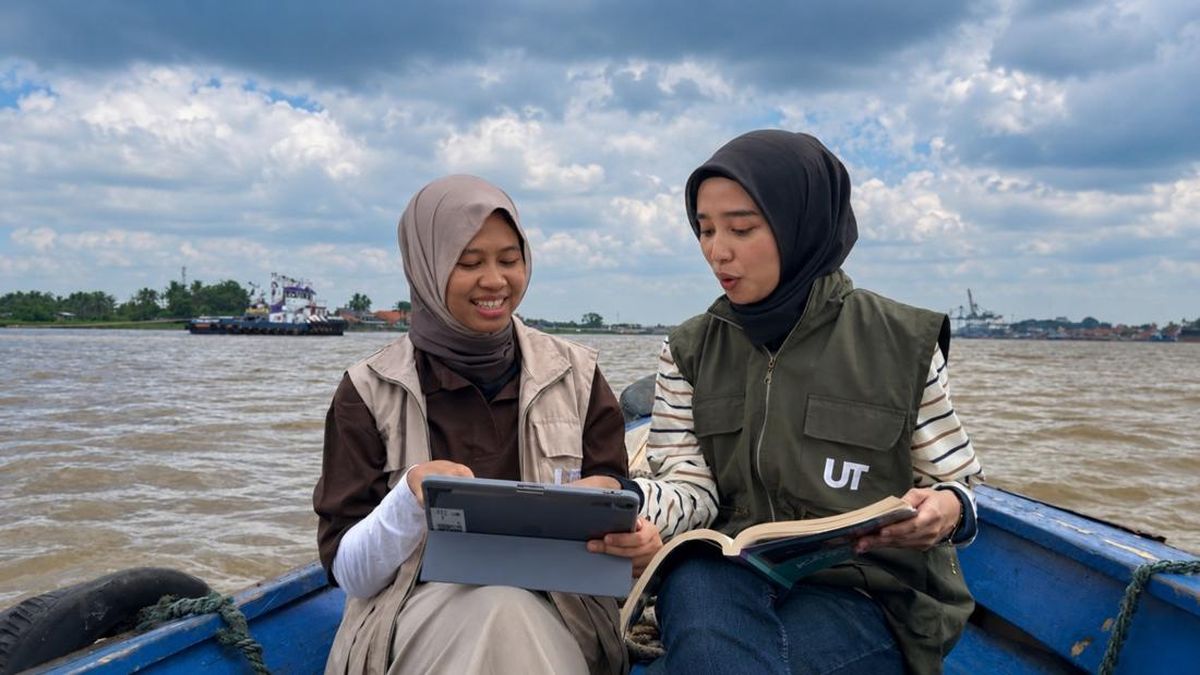
Furthermore, the achievement in SDG 4 is closely tied to UT’s core identity. Since its inception, UT has existed to open access to higher education for those unable to follow conventional lecture patterns. Through its open and distance learning system, UT provides a flexible learning space for school graduates, workers, teachers, civil servants, entrepreneurs, parents, and learners across various regions. For distance learners, the classroom can be a computer screen after work hours, a teacher’s home in a remote area, moments between family activities, or during the routine of someone reshaping their future. This makes higher education closer to real life and more accessible to people of all ages, professions, regions, and socio-economic backgrounds.
These achievements are part of a major leap for UT in this year’s rankings. Overall, UT rose from the 1001-1500 global band in 2025 to the 801-1000 band in 2026. This increase also surpassed the targets set in UT’s Strategic Plan, reflected in the rise of its overall score from 51.8 in 2025 to 56.9 in 2026. Another significant leap was the increase in the number of SDGs in which UT participated, from five in 2025 to all 17 in 2026, meaning its contribution is now comprehensively mapped across all development goals.
This recognition in the THE Sustainability Impact Ratings 2026 strengthens UT’s position as an open university that builds its reputation through tangible benefits and real impact for society. Amidst the public’s need for flexible, credible, and quality higher education, UT stands as an increasingly relevant choice for today’s learners. Ultimately, this achievement points to the direction of higher education that is most needed today: open, adaptive, close to community life, and capable of providing wider opportunities, just as UT does. From physical and digital spaces to the farthest corners of the country, UT expands the meaning of a campus as a learning ecosystem that comes closer to those who wish to grow and play a role in Indonesia’s future.