
Unisba Promotes Impactful Research and Academic Collaboration Through SPeSIA and 2nd VISION 2026
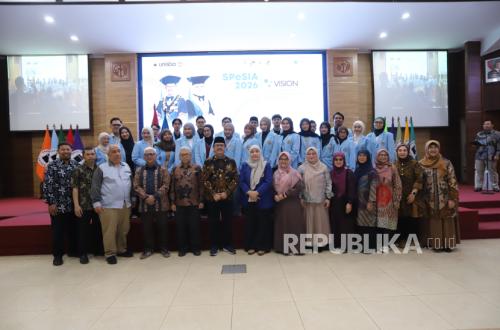
Universitas Islam Bandung (Unisba) is strengthening its role as an impactful university through research development, knowledge dissemination, and the expansion of academic collaboration at national and international levels. This commitment was realised through the Seminar Penelitian Sivitas Akademika (SPeSIA) 2026 Batch II and the 2nd VISION 2026.
Carrying the theme ‘Strengthening the SDGs Through Impactful Research in the Era of Artificial Intelligence’, the event was held both offline at the Unisba Main Hall and online on Tuesday (11/8/2026).
The implementation of SPeSIA 2026 Batch II and 2nd VISION 2026 involved several universities as co-hosts, namely Universitas Bhakti Kencana, Politeknik Al Islam Bandung, Politeknik Pajajaran, Universitas Muslim Indonesia (UMI) Makassar, and Universitas 17 Agustus Samarinda. The international event also involved Holy Child College from the Philippines as an organising partner.
Unisba Rector Harits Nu’man said SPeSIA has been continuously developed from an internal Unisba research forum into a broader space for students to present and disseminate their research findings. According to him, the involvement of various universities in SPeSIA and VISION shows that the forum is not only an academic space at the internal level, but is also beginning to develop into a bridge for collaboration at national and international levels.
“SPeSIA must become a platform for students who have ideas and research results, particularly from their final assignments, as well as a space to learn how to disseminate research findings,” he said.
He added that the experience of conducting research and presenting the results to the public is an important provision for students when entering the professional world and contributing to society.
“Not only researching, but also disseminating the research results. When they go into the field, their thinking framework is already structured and they have a picture of how the research results can be communicated and provide a contribution to society,” he said.
In the context of Unisba graduate characteristics, the Rector emphasised the importance of students developing the values of mujahid, mujtahid, and mujaddid (3M). Research is one form of actualising students’ thinking abilities, while research results are expected to become a renewal that benefits society.
He also highlighted the use of Artificial Intelligence (AI) in the academic process. According to him, AI can be used as a tool to accelerate the writing and development of scientific work, but it must not replace students’ thinking abilities and academic responsibility.
“Do not let yourselves become AI graduates, graduates produced through Artificial Intelligence. Those studying here are not robots, but you. AI is only a tool,” he said.
Meanwhile, Unisba Vice Rector for Learning and Student Affairs, Asnita Frida B. R. Sebayang, said SPeSIA is a regular Unisba agenda as a space for disseminating research results from the academic community across various fields of science. Meanwhile, the 2nd VISION is part of Unisba’s efforts to strengthen internationalisation through a scientific forum involving students from various countries.
“SPeSIA is a space for cross-disciplinary research dissemination, while VISION is a platform for internationalisation and scientific dialogue among students from various countries,” she said.
Overall, SPeSIA and 2nd VISION 2026 produced 1,152 articles, consisting of 1,085 national research articles and 67 international articles. At SPeSIA 2026, 1,085 research articles were produced by Unisba students from various faculties.
The Faculty of Communication Sciences produced 182 articles, the Faculty of Pharmacy and Science 158 articles, the Faculty of Tarbiyah and Teacher Training 148 articles, and the Faculty of Economics and Business 139 articles.
Furthermore, the Faculty of Psychology produced 100 articles, the Faculty of Engineering and the Faculty of Sharia each produced 96 articles, the Faculty of Law 50 articles, the Faculty of Da’wah 40 articles, and the Faculty of Medicine 9 articles.
Meanwhile, the 2nd VISION 2026 produced 67 international articles consisting of 41 articles in the social sciences and humanities and 26 articles in science and technology. The event also involved participants from the Philippines through cooperation with Holy Child College as an organising partner.
According to Asnita, international forums can also expand networks and enhance the academic reputation of universities. The exchange of ideas with academics and students from various countries is expected to open up opportunities for future research collaboration.
To broaden access to research results, SPeSIA and 2nd VISION articles are directed to have a Digital Object Identifier (DOI) so that they are easier to find, access, and use as references.
The articles are also directed to enter various indexing channels, such as Google Scholar and Garuda, and have the opportunity to be published through the Bandung Conference Series (BCS) and accredited Sinta scientific journals managed by Unisba.
Dissemination of research results is also carried out through digital media, particularly TikTok, as a means of publishing video presentations and educational content from participants to expand the reach of knowledge dissemination.
The SPeSIA 2026 Batch II and 2nd VISION 2026 activities featured a keynote speaker, Professor of the Faculty of Economics and Business (FEB) Unisba, Prof. Dr. Ima Amaliah, S.E., M.Si. In her presentation, Ima discussed the role of AI in accelerating the achievement of the Sustainable Development Goals (SDGs).
As a form of appreciation, Unisba awarded presenters with the best articles in each faculty. The University Best Presenter and Article award was won by Mesya Febriana from the Faculty of Communication Sciences with a score of 970 for an article entitled ‘The Relationship between the TOSS TBC Programme Campaign and Awareness of Tuberculosis’ (A Correlational Study of the Relationship between the TOSS TBC Programme Campaign and Awareness of Tuberculosis on the Instagram Platform of the Ministry of Health of the Republic of Indonesia @kemenkes_ri).
In addition, awards were also given in the Educational Content category. Of the six winners, first place was won by Ranisa Cahyaning Asri from the Faculty of Communication Sciences.
At the 2nd VISION 2026, awards were given in the categories of The Best Presenters and The Best Papers. First place for The Best Presenters was won by Haya Nailah Ramadhaniah from the Statistics Study Programme, Faculty of Pharmacy and Science.
Meanwhile, first place for The Best Papers was won by M. Nadzir Soleh from the Mathematics Study Programme, Faculty of Pharmacy and Science, for an article entitled ‘Breast Cancer Classification Based on Gene Expression Data Using Singular Value Decomposition’.
Source: jawawa.id (https://jawawa.id/newsitem/unisba-promotes-impactful-research-and-academic-collaboration-through-spesia-and-2nd-vision-2026-1786521244)
Originally published by Republika (https://news.republika.co.id/berita/tjnb0a368/unisba-dorong-riset-berdampak-dan-kolaborasi-akademik-lewat-spesia-dan-2nd-vision-2026), translated from Indonesian