
UNISA Bandung Lecturers' Appropriate Technology Helps Kremes Simadu UMKM Boost Production
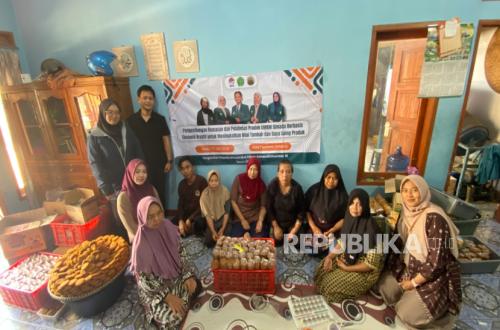
After years of relying on manual production processes, the Kremes Simadu micro, small, and medium enterprise (UMKM) in Pasirhuni Village, Bandung Regency, has begun to transform. This was achieved after the business received assistance from the Community Service (PkM) team of Universitas ’Aisyiyah (UNISA) Bandung through the application of appropriate technology. The assistance helped the business owner increase production capacity by up to 40 per cent while opening opportunities to meet wider market demand.
Kremes Simadu was founded by Yuningsih and her husband by processing sweet potatoes into a crispy snack typical of Pasirhuni Village. After her husband passed away, Yuningsih continued the home-based business with several workers as a means of supporting and raising her three children. For years, the production process was carried out manually, from peeling and slicing the sweet potatoes to frying and packaging the products. This condition limited production capacity, especially when demand increased.
“Previously everything was manual, from slicing to frying. When orders were high, we were overwhelmed,” Yuningsih recalled on Friday (14/8/2026).
Change began to be felt after Kremes Simadu received assistance from the UNISA Bandung PkM team through a programme applying appropriate technology in the form of a sweet potato chopping machine. The programme is a community service activity funded by the Ministry of Higher Education, Science, and Technology (Kemendiktisaintek) for 2026 and was implemented from April to August 2026.
The programme was chaired by Minhajuddin, S.IP., M.Sos, a lecturer and Head of the International Trade Study Programme at UNISA Bandung. In its implementation, Minhajuddin was accompanied by Nurul Aziz Pratiwi, MM and Delfta Tunjung Baswarani.
The assistance did not only focus on the use of production equipment but also included strengthening business governance. The PkM team provided introduction, training, testing, and evaluation of the appropriate technology so that Kremes Simadu workers could operate and maintain the equipment independently.
“We were assisted by the team from UNISA Bandung, from the introduction of more efficient production equipment to business management assistance,” said Yuningsih.
Minhajuddin explained that the application of appropriate technology is an important need for food-processing UMKMs that still rely on manual production processes. According to him, improving production efficiency must be done without eliminating the taste quality or the distinctiveness of local products that form the business identity.
“Food-processing UMKMs like Kremes Simadu have great potential, but are often constrained on the production side. Through this programme, we introduced equipment that can speed up the production process without sacrificing taste quality and the distinctiveness of local products,” said Minhajuddin.
The results of the assistance showed an increase in production capacity of up to 40 per cent compared to before the programme began. This increase allows Kremes Simadu to respond to greater market demand while opening opportunities to expand product distribution beyond Pasirhuni Village.
In addition to production capacity, the application of appropriate technology also helped streamline working time. Processes that previously took hours can be shortened, giving business owners more room to develop other aspects such as marketing and product packaging.
Pasirhuni Village is known as one of the sweet potato producing centres in Bandung Regency. Some residents depend on income from the agricultural sector and tuber-based food processing. However, limited access to production technology has been one of the challenges for local UMKMs in increasing their business capacity and competitiveness.
Therefore, the assistance provided by the UNISA Bandung PkM team was directed so that the technology provided would not stop at the handover of equipment. Business owners were also equipped with the ability to operate and maintain the technology sustainably.
“We do not want this assistance to stop at the handover of equipment; the most important thing is that the community is truly able to use and maintain the technology sustainably,” said Minhajuddin.
This PkM programme is part of the university’s contribution to encouraging the use of technology for UMKMs at the village level. For the UNISA Bandung PkM team, the assistance is also a form of synergy between academics and business actors in encouraging increased productivity and competitiveness of businesses based on local potential.
Going forward, assistance for Kremes Simadu will be carried out continuously so that the capacity improvements achieved can continue to develop. The UNISA Bandung PkM team also hopes that a similar assistance model can be applied to other UMKMs in Bandung Regency through collaboration with village governments and related parties.
For Kremes Simadu, this support is a new step to develop a business that has so far relied on manual production processes. From a home-based business inherited and run with limited equipment, Kremes Simadu now has the opportunity to grow more productively and reach a wider market.