
Unique herbivorous dinosaur Pegomastax africanus has tusks and spiny body
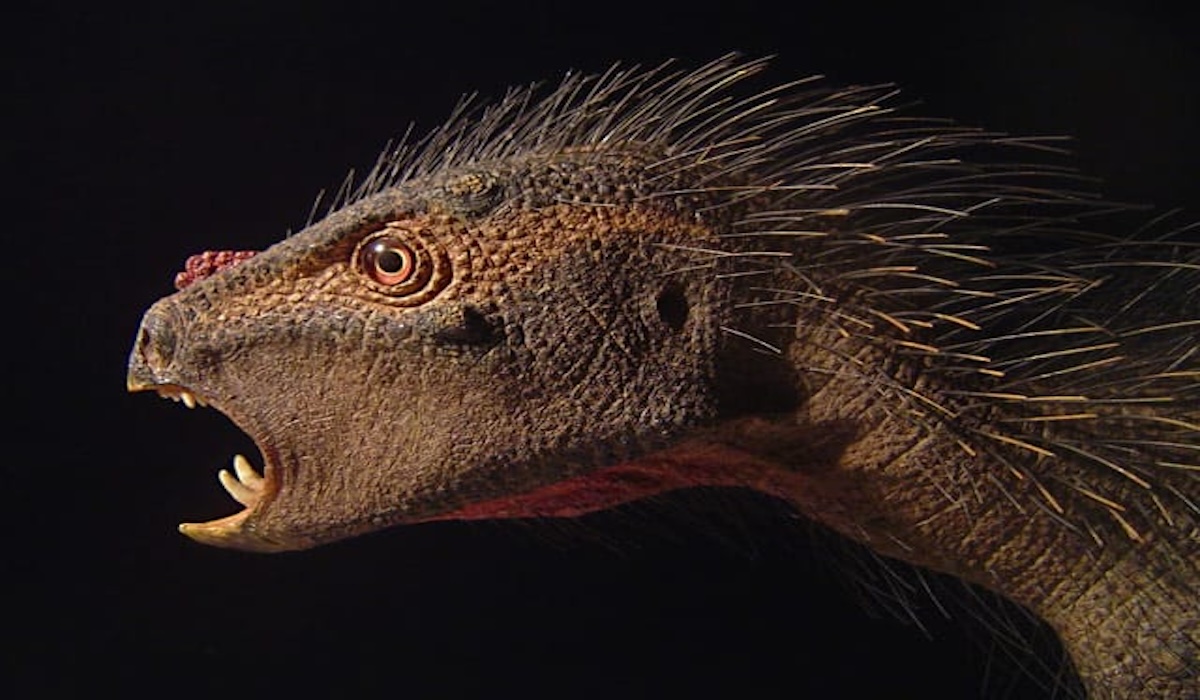
Researchers have identified Pegomastax africanus, a unique herbivorous dinosaur smaller than a cat that lived around 200-190 million years ago during the Early Jurassic period. The dinosaur has attracted attention from the palaeontological world due to its unusual physical features, including a parrot-like beak, sharp tusks, and a body covered in quill-like feathers.
The fossil of Pegomastax africanus was first recognised by palaeontologist Paul Sereno from the University of Chicago while examining fossil collections at Harvard University. Although the tiny jaw specimen, less than 2.5 centimetres long, was excavated in South Africa in the 1960s, its identity as a new species was only confirmed and published in the journal ZooKeys in 2012.
“I immediately realised it was a previously unknown species,” said Paul Sereno in his report on the jaw discovery.
Morphologically, Pegomastax africanus belongs to the heterodontosaurid family. Despite having a pair of intimidating sharp tusks, experts confirmed it was a plant-eater. The tusks are believed to have served as defensive tools against predators or for male competition over mates, rather than for hunting prey.
Recent research has also revealed differences in the evolution of heterodontosaurids between northern and southern regions during the breakup of the Pangaea supercontinent. Southern species like Pegomastax have more complex high-crowned teeth compared to northern relatives such as Tianyulong confuciusi, found in China.
The unique combination of small size, tusk-like weapons, and quill-covered body makes Pegomastax africanus one of the most eccentric discoveries in the history of herbivorous dinosaur evolution.
Recent studies have shown that herbivorous dinosaurs did not eat indiscriminately but used their front teeth to select specific plant parts.
Scientists discovered a T. rex tooth embedded in the skull of an Edmontosaurus dating back 66 million years. This rare find reveals predator-prey interactions at the end of the Cretaceous period.
Tyrannosaurus rex (T-Rex) is known as the most feared apex predator of the dinosaur era, with its incredibly powerful jaws making it seemingly invincible.
Fossils of Iani smithi, a herbivorous dinosaur from North America, reveal a crucial transitional period millions of years ago during global climate change.
Researchers and palaeontologists have long studied the phenomenon of large body sizes in sauropods, the long-necked dinosaur group that includes Titanosaurus.