
UNG Students Use Cuttlefish Bones to Make Hand Sanitiser
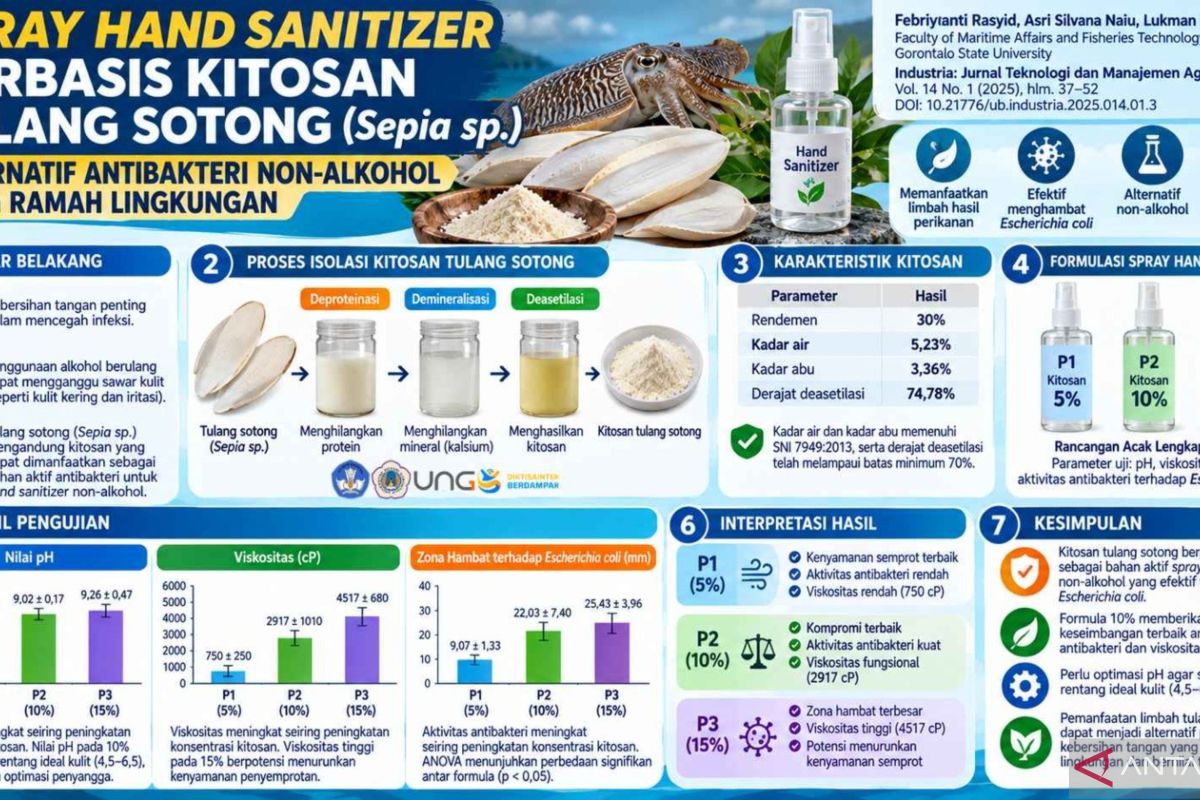
Gorontalo (ANTARA) – Students at Gorontalo State University (UNG) have innovated by using cuttlefish bones (Sepia sp.) as a raw material for hand hygiene products.
“We use cuttlefish bones, which are processed into chitosan, a compound attracting interest in the development of various products, including hygiene products,” said Febriyanti Rasyid, a student at UNG’s Faculty of Maritime Affairs and Fisheries Technology, in Gorontalo on Tuesday.
Febriyanti, Asri Silvana Naiu and Lukman Mile have turned this fisheries by-product, which has not been optimally used, into a value-added raw material.
Chitosan from cuttlefish bones is used as an active ingredient in a hand sanitiser spray, and its ability to inhibit Escherichia coli (E. coli) bacteria was tested.
The bacteria are among the microorganisms that can cause health problems if pathogenic strains enter the body through an appropriate route.
The chitosan was formulated at three concentrations: 5 per cent (P1), 10 per cent (P2) and 15 per cent (P3). The three formulas were tested for pH, viscosity and antibacterial activity against E. coli. The results showed that antibacterial activity increased as the chitosan concentration rose.
The team hopes the research will inspire broader ideas about making use of fisheries resources.
According to Febriyanti, using chitosan from non-crustacean sources such as cuttlefish also expands the range of natural materials that can be studied for different applications.
She said the research indicates that cuttlefish bones could be a source of chitosan for hand sanitiser spray formulations with antibacterial activity against E. coli in laboratory testing.
“Beyond developing a hygiene product formulation, this research shows how fisheries by-products can provide a starting point for scientific innovation,” she said.
“With further research and adequate safety testing, chitosan from cuttlefish bones could be developed further as a value-added ingredient in industries based on fisheries resources,” Febriyanti said.