
UNG Students Develop Eco-Friendly Adsorbent to Tackle Liquid Waste
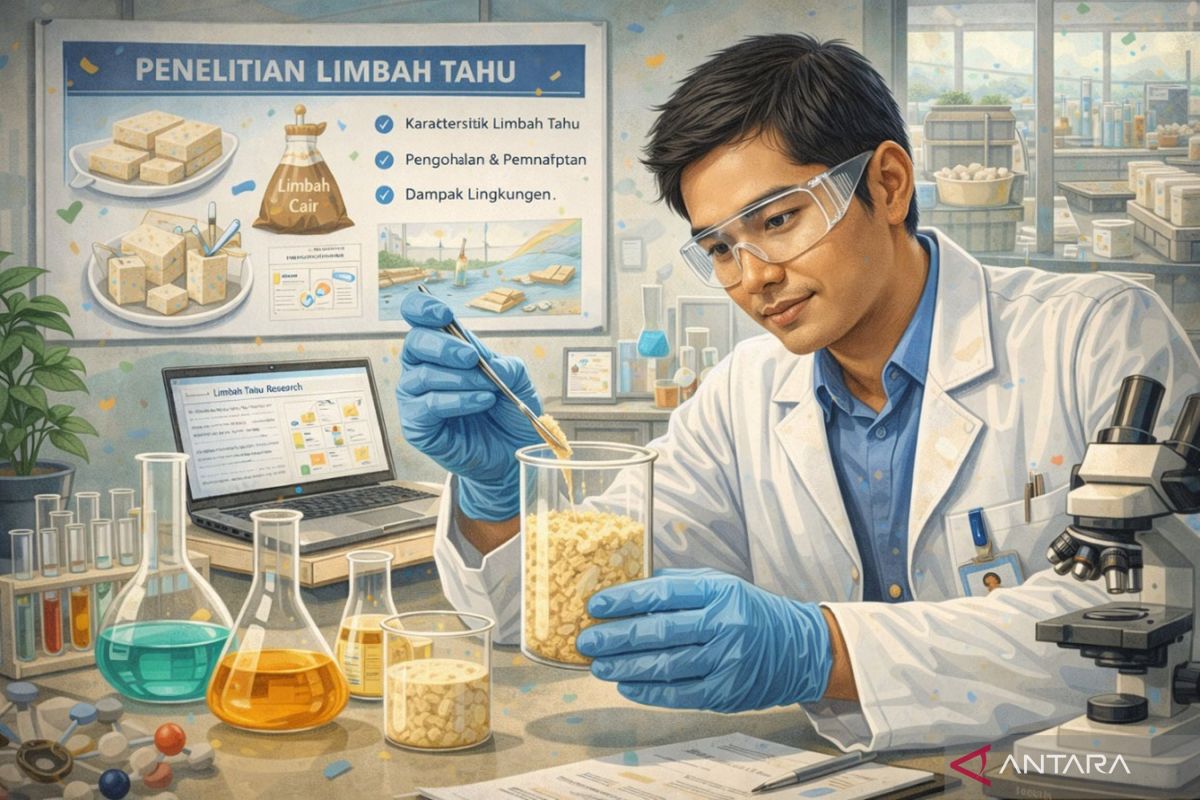
Gorontalo (ANTARA) - Students at Universitas Negeri Gorontalo (UNG) have developed an eco-friendly adsorbent to treat liquid waste, particularly from the tofu production industry.
Young research team leader at UNG, Nola Charmelita Bagenda, said in Gorontalo on Wednesday that the tofu industry is the economic lifeblood of communities in many parts of Indonesia, including Gorontalo.
Unfortunately, Nola said, behind the savoury appeal of this protein product lies a serious environmental challenge: liquid waste with a high organic content.
Without adequate treatment, this waste causes pungent odours and damages river ecosystems due to elevated levels of Biological Oxygen Demand (BOD) and Chemical Oxygen Demand (COD).
Nola said the team succeeded in synthesising a composite material from fly ash and zeolite as an effective yet economical adsorbent medium for the waste.
The research, titled ‘Synthesis and Application of a Fly Ash-Zeolite Composite as an Adsorbent Medium for BOD and COD Reduction in Tofu Industry Liquid Waste’, was carried out under the Student Creativity Programme for Exact Sciences Research (PKM-RE) scheme.
“We conceived this through the PKM-RE scheme,” said Nola.
The research adopts a circular economy approach by utilising fly ash, a waste product from industrial coal combustion, combined with zeolite to produce a composite material with high adsorption capacity.
The approach is compelling because it uses one form of waste to tackle another pollution problem.
Fly ash, which has long been underutilised, is processed into a functional material capable of adsorbing organic pollutant compounds in tofu liquid waste.
“Through the synthesis of the fly ash-zeolite composite, the resulting adsorbent has been proven capable of significantly reducing BOD and COD values, thus holding potential to curb water pollution,” she said.
Beyond its effectiveness, the technology is considered more economical and easy for small and medium-sized enterprises to apply.
The use of industrial waste as raw material keeps production costs relatively low while adding value to a material previously regarded as worthless.
As such, the innovation is oriented not only towards environmental protection but also towards economic sustainability.
The research findings are expected to offer an alternative eco-friendly liquid waste treatment technology, helping the tofu industry meet regulatory wastewater quality standards while preserving aquatic ecosystems.
“The development of adsorption technology based on local materials has the potential to be replicated in various regions with similar industrial characteristics,” said Nola.
The research also supports government efforts in pollution control and water quality management, in line with the Sustainable Development Goals (SDGs), particularly the aspects of clean water and sanitation and sustainable industry.
This innovation stands as proof of the role students can play in delivering applicable scientific solutions to real problems in society.