
UNG installs water quality and object detection devices in Botubarani Sea
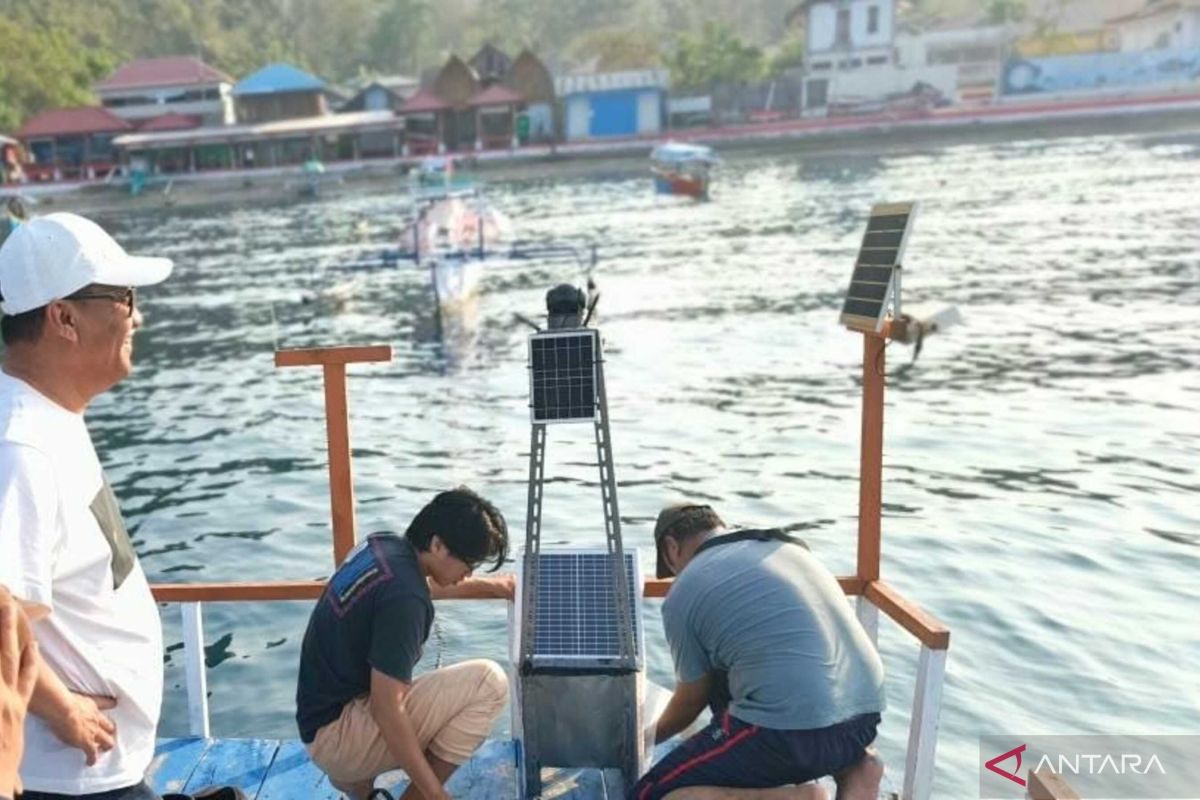
Gorontalo (ANTARA) - A research team from Universitas Negeri Gorontalo (UNG) has installed water quality and object detection devices in the Botubarani Sea area, Bone Bolango Regency, Gorontalo Province.
UNG researcher Dr Mohamad Hidayat Koniyo stated in Gorontalo on Sunday that the installation is part of a research project funded through the RIIM BRIN-LPDP multi-year scheme, involving partners from the Bone Bolango Department of Tourism, Youth, and Sports (Disparpora).
The installation of these two devices is intended to generate continuous water condition data over a one-year period.
The collected time-series data is expected to provide information regarding the marine environmental conditions, while simultaneously supporting the management of marine tourism activities in the Botubarani area, specifically whale shark interaction tourism.
Hidayat noted that one of the primary benefits of this research is to assist tourists and tourism operators in making informed decisions regarding snorkelling and diving activities with whale sharks.
Information regarding water quality and the presence of objects in the waters, he said, can serve as a key consideration for tourists before engaging in marine activities.
The data generated by the devices also holds potential for broader applications.
He explained that the one-year record of water conditions can be used to study the appearance patterns of whale sharks and various other marine organisms.
The data is also expected to help identify the patterns of jellyfish appearances, which, under certain conditions, can disturb tourist comfort by causing skin irritation.
The emergence of marine organisms is closely linked to the environmental conditions of the waters that support their life cycles.
“With the availability of periodic water quality data, the relationship between water conditions and the appearance of these organisms can be studied further,” he said.
According to him, beyond marine biota, this detection system also has the potential to generate information regarding human activities in the Botubarani waters.
The collected data can be used to identify the presence or frequency of plastic waste, agricultural runoff, the density of tourist boats, visitor activities, and the appearance of various other marine animals.
He revealed that object detection technology allows various objects and activities visible in the water to be recorded and processed into datasets.
“Based on object detection, such as seawater colour, moving animals, tourist activities, and others, it will produce datasets that can be developed for classification and prediction research,” said Hidayat.
The continuously collected datasets are a vital component in the development of data-driven research.
With a one-year recording available, researchers can analyse patterns of change in water conditions and detected objects over time.
This research is expected to provide a database for more informative marine tourism management.
Hidayat disclosed that the generated data is not only useful for research purposes but also has the potential to serve as supporting material for managers and stakeholders in monitoring water conditions and tourism activities in Botubarani.