
Unexpected! The Fate of Bantargebang's Mountain of Waste by 2028
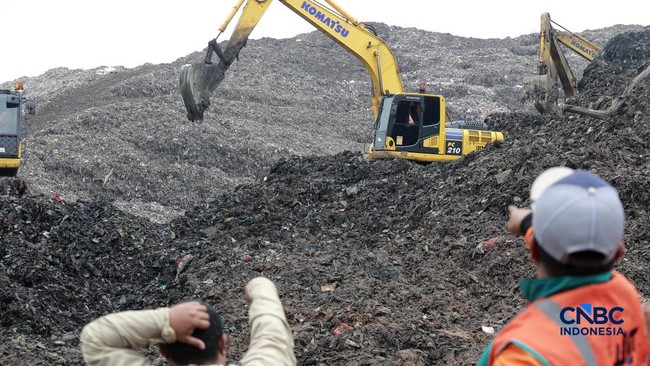
Coordinating Minister for Food Zulkifli Hasan (Zulhas) has revealed the government’s target to resolve Indonesia’s waste problem, which is considered to be in a state of emergency, including the Bantargebang Integrated Waste Treatment Plant (TPST) area that has long been a symbol of the national waste management crisis. Zulhas stated that the government aims to resolve half of the national emergency waste problem by 2027, with the remainder to be completed by 2028. Specifically for Bantargebang, the government is targeting its resolution by 2028 through the Waste Processing into Electrical Energy (PSEL) project. “Alhamdulillah, we can now resolve half of the emergency cases by 2027 and the other half by 2028. God willing, this October we will launch the first of what we call PSEL, processing waste into electrical energy,” Zulhas said during CNBC Indonesia’s Economic Update 2026 on Tuesday (23/6/2026). He explained that the project will cover 72 districts/cities, which will be grouped into several agglomeration areas. Priority locations include the Bantargebang area, Tangerang, Bandung, and Palembang. “It will be in 72 districts/cities, but we are merging them into over 20 agglomerations. Such as Bantargebang, also in Tangerang, Bandung, and others, including Palembang,” he said. According to Zulhas, the government will rely on incinerator technology, which is currently used in many countries to process waste into energy. The technology is claimed to be capable of significantly reducing waste piles without causing harmful pollution. “It uses the latest technology; all countries now use it, called an incinerator. The waste can be completely processed, and the technology is proven clean, not producing any toxins,” he clarified. Zulhas further emphasised that Bantargebang is a primary focus for the government due to the significant environmental impact caused by the open waste management model that has been in place. “Bantargebang, God willing, can be resolved by 2028,” he asserted. According to Zulhas, Indonesia is currently in a state of waste emergency. He assessed that the problem has persisted for a long time and has caused various impacts, ranging from environmental pollution to public health threats. “Yes, our waste situation is an emergency. The Bantargebang model exists in almost every city. It claims victims, produces emissions, damages rivers, ruins land, pollutes our seas with waste, not to mention microplastics that can cause cancer. The damage is extraordinary, and this has been going on for so long without a resolution,” Zulhas remarked. He also revealed that the slow resolution of the waste problem was previously triggered by convoluted licensing processes. Based on a government evaluation, only two waste processing project permits were issued over 11 years. “We know that previously, to resolve the waste issue, only two permits were issued in 11 years. It was complicated, messy, and going in circles. During those 11 years, I studied why the waste problem couldn’t be overcome? It was complicated,” he said. He described the lengthy bureaucratic process that investors had to navigate to process waste into energy. “If I wanted to solve this waste problem as an entrepreneur, turning waste into energy, I would need a permit from the regent and the Regional House of Representatives. If it involved two regencies, I would need permits from the governor and the provincial House of Representatives. Just getting to that point, the entrepreneur would already have a stroke. It’s messy,” Zulhas said. Consequently, the government is now simplifying regulations to accelerate the construction of waste processing facilities. “President Prabowo asked, how do we solve this waste problem? How can we become a developed country if we can’t even manage our waste? I said it’s simple, Sir, we just need to tidy up the regulations. So I was appointed as the head of the Waste Task Force. I tidied up the regulations first, cutting the complicated ones,” he said. Besides PSEL, the government is also preparing other technologies such as Refuse Derived Fuel (RDF) and pyrolysis for areas with smaller waste volumes, as incinerators would be less economical there. The government is targeting the completion of waste management in offices, markets, shopping centres, schools, and restaurants by 2029. “The key is that we will resolve waste management in places like offices, markets, malls, and schools by 2029,” he stated. According to him, the success of this programme will be a crucial foundation for national food security, as a healthy environment is a prerequisite for sustainable food production. “If the environment is damaged, how can we want sustainable food? If the environment is good, the rivers are good, the land is good, the people are good, everything is good, then we can have sustainable food,” he concluded.