
Undip Hosts ICOSEG 2026, Strengthening Global Collaboration for Sustainable Development
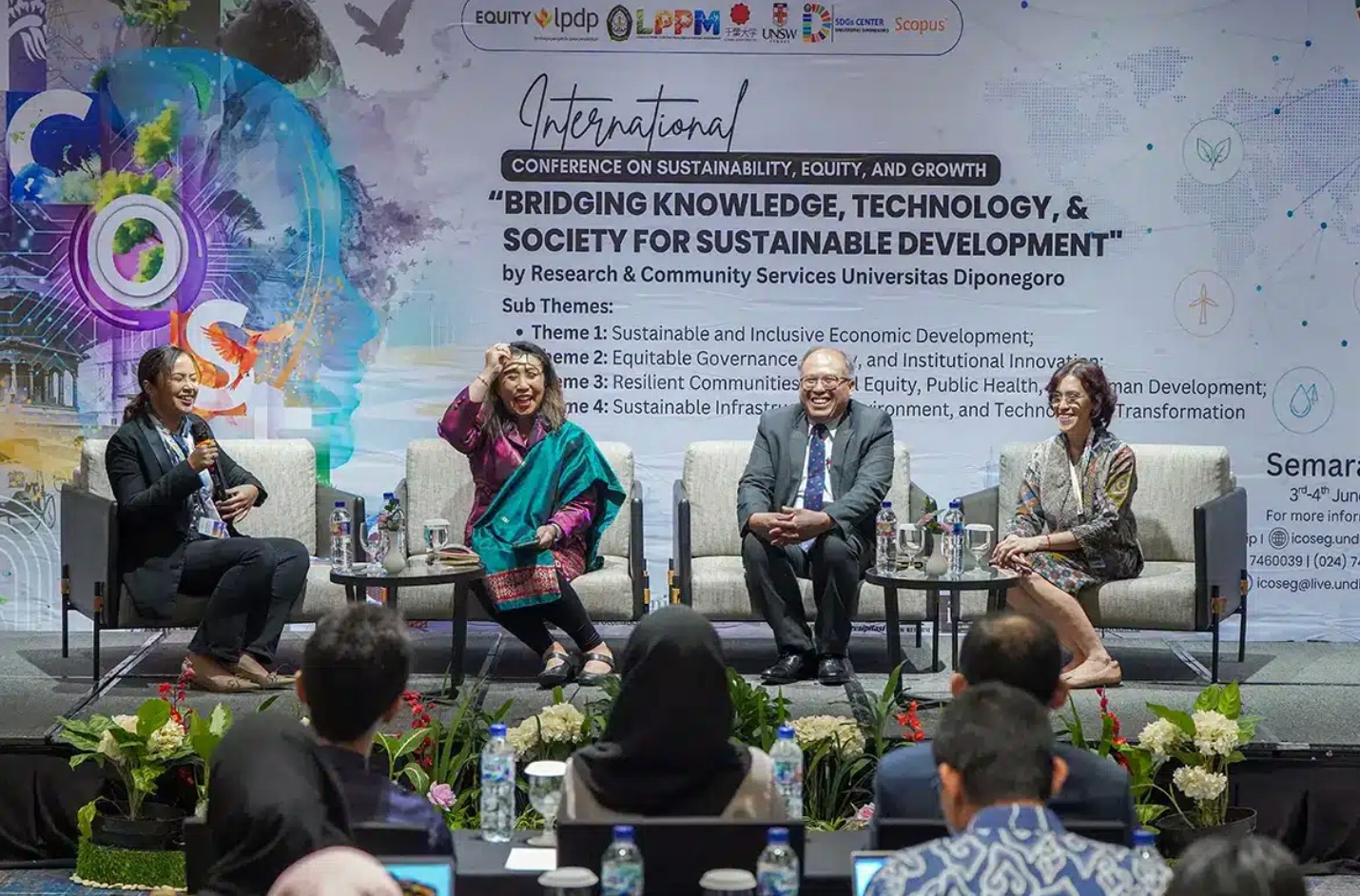
Diponegoro University (Undip), through its Institute for Research and Community Service (LPPM), successfully organised the International Conference on Sustainability, Equity, and Growth (ICOSEG) 2026. The international conference, themed ‘Bridging Knowledge, Technology, and Society for Sustainable Development’, took place on 3–4 June 2026 in the Kapuas Grand Ballroom at Hotel Aruss Semarang. The global forum brought together researchers, academics, practitioners, industry representatives, students, and policymakers from home and abroad.
The event was officially opened by the Head of Undip’s LPPM, Prof. Dr. Ing. Ir. Suherman, S.T., M.T. In his remarks, he stated that ICOSEG 2026 represents a shared commitment to strengthening global collaboration and promoting the role of research and innovation for sustainable development. According to him, sustainable development is no longer solely about environmental issues but also encompasses social dimensions, equitable governance, technological progress, and economic resilience.
‘Sustainable development must be understood as a shared agenda that requires cross-disciplinary, cross-institutional, and cross-border collaboration to produce solutions that are adaptive, inclusive, and have a real impact on society,’ said Prof. Suherman.
Prof. Suherman affirmed that universities have a vital role not only as centres of knowledge production but also as catalysts for transformative solutions that deliver tangible benefits to society. Through research, scientific collaboration, and community service, higher education institutions are expected to actively contribute to shaping a more sustainable, inclusive, and just future. ‘Universities must not stop at producing knowledge but must be able to translate research into innovation and real contributions to solving societal problems,’ he added.
‘It is hoped that ICOSEG 2026 can encourage productive academic exchange, inspire future collaborations, and generate impactful research for sustainable, inclusive, and resilient development across various regions and communities,’ Prof. Suherman added.
Echoing this sentiment, the Chair of ICOSEG 2026, Dr. Anang Wahyu Sejati, stated that ICOSEG 2026 serves as a strategic platform to strengthen cross-disciplinary dialogue, academic exchange, and innovative collaboration in addressing various global development challenges.
‘We hope that ICOSEG 2026 can become a space for learning, collaboration, and a shared purpose in producing real contributions for a more sustainable, equitable, and resilient future. Amidst the increasingly interconnected issues of sustainability, social equality, technological transformation, and environmental resilience, collaboration between academics, practitioners, industry, and policymakers is becoming ever more critical,’ said Dr. Anang.
The implementation of ICOSEG 2026 involved two renowned international university partners, namely Chiba University of Japan and The University of New South Wales (UNSW) of Australia, and was fully supported by the Enhancing Quality Education for International University Impact and Recognition (EQUITY) Programme through Endowment Fund for Higher Education (DAPT) funding from LPDP.
Guided by moderator Chely Novia Bramiana, Ph.D., ICOSEG 2026 featured three international experts: Prof. Minako Sakai, Ph.D. from UNSW Canberra, Prof. Josaphat Tetuko Sri Sumantyo, Ph.D. from Chiba University, and Prof. Bulan Prabawani, S.Sos., M.M., Ph.D. from Undip’s SDGs Center.
Prof. Minako Sakai, Ph.D. from UNSW Canberra opened the scientific presentations by highlighting the importance of social infrastructure and community participation in realising inclusive development, particularly amidst social disruption and demographic changes. Reflecting on policy shifts in Japan, she emphasised that the focus of regional development in the modern era is now shifting from merely pursuing absolute population growth towards expanding the ecosystem of participation, where urban communities and educational institutions can remain connected and contribute to the sustainability of rural areas without having to reside there permanently. This transformation demonstrates how social capital and collective engagement can be adapted to respond to regional inequality and strengthen post-disaster community resilience.
Meanwhile, Prof. Josaphat Tetuko Sri Sumantyo, Ph.D. from Chiba University presented the crucial role of cutting-edge technological innovation in mitigating environmental crises and global disasters. Through the development of Circularly Polarized Synthetic Aperture Radar (CP-SAR) technology embedded in various platforms such as unmanned aerial vehicles (UAVs) and microsatellites, earth observation can be conducted in all weather conditions, both day and night. The integration of AI-based disaster mitigation remote sensing data and Digital Twin modelling serves as a key pillar in delivering precise disaster prediction systems, rapid emergency medical responses, and urban planning designs that are resilient to external shocks.
Prof. Bulan Prabawani, S.Sos., M.M., Ph.D. from Undip’s SDGs Center underscored the urgency of reforming governance, given that the majority of global Sustainable Development Goal (SDG) targets are currently not on track towards 2030 due to structural challenges and polycrisis. She introduced the Sustainability Governance Continuum (SGC) approach as a strategic framework that positions sustainability not as a rigid final target, but as a continuous governance process across political and administrative periods. By strengthening the pillars of institutional alignment, governance capacity, accountability architecture, and long-term learning, SGC is expected to consolidate collaborative steps to accelerate the achievement of the SDGs.