
Undip develops modern environmentally friendly rice fields
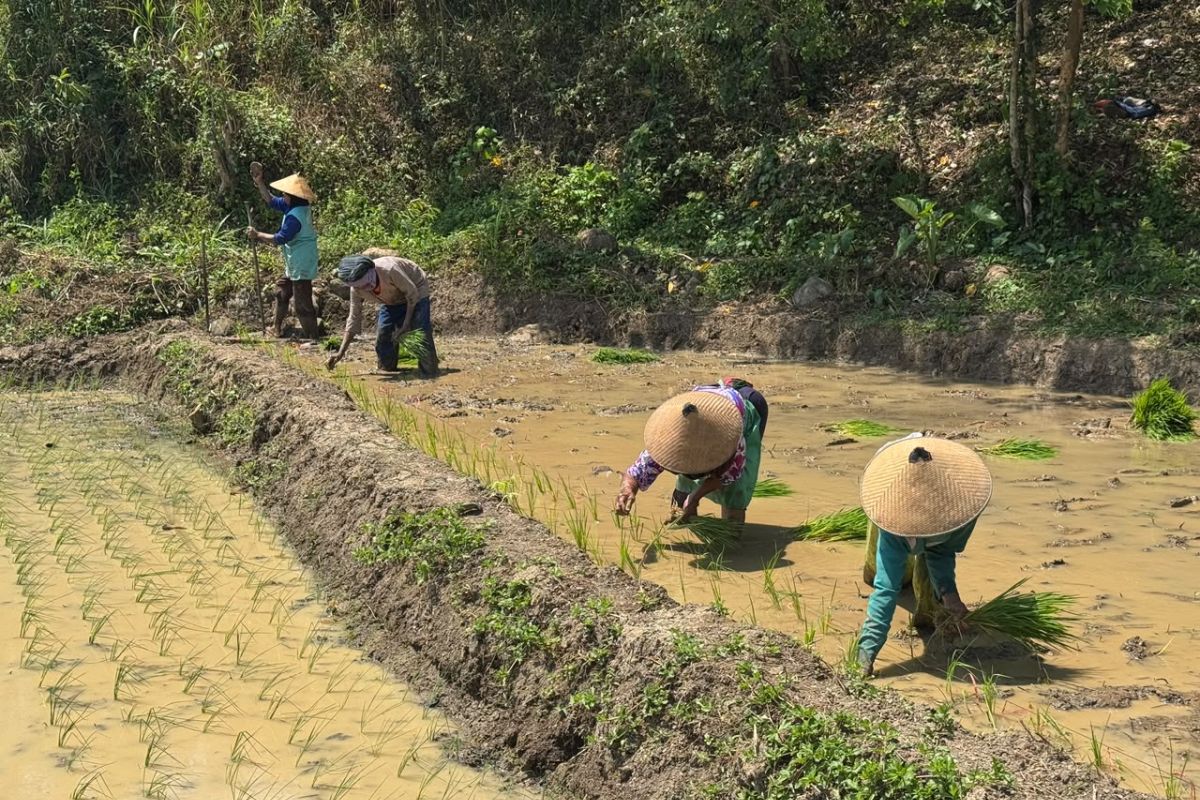
Diponegoro University Semarang has developed a modern rice field model based on appropriate technology and environmental friendliness in the Undip Special Purpose Forest Area (KHDTK), Penggaron, Semarang, Central Java.
Head of KHDTK Undip Prof. Dr. Ir. Sri Puryono said on Wednesday that the innovation was developed on rice field land that had been abandoned for around 5-6 years.
He explained that the modern rice field concept prioritises appropriate technology, is environmentally friendly, and reduces dependence on fossil fuels.
The rice field development currently covers around two hectares of land that has been cultivated and begun to be planted with rice.
The irrigation system utilises six solar panels with a capacity of around 60 cubic metres per hour, operated from 09.00 to 16.00 Western Indonesia Time.
“To support water availability, we have also built a hydraulic pump that can operate for 24 hours,” said the former Regional Secretary of Central Java.
He hopes the programme will become a field laboratory for testing the application of sustainable agricultural technology, while also increasing the productivity of the area.
The water source for the rice fields comes from a river that, based on test results, is not contaminated with heavy metals, while the soil acidity level has been measured in the pH range of 7-8, which is considered suitable for rice cultivation.
In the initial stage, the rice varieties planted are Inpari (Irrigated Rice Inbred) and Inpago, which are superior upland rice varieties suitable for planting on dry land.
Furthermore, he said, Undip is developing superior varieties from crossing Rojolele with rice varieties from Japan.
The development will also be continued with trials of red rice rich in nutrients and fibre suitable for people with diabetes.
“It is hoped that this trial can succeed and produce optimally to become a model for productive, efficient, and environmentally friendly agricultural development,” he said.
Meanwhile, Undip Vice Rector II for Planning, Finance, Assets, Business and Household Affairs Dr. Warsito Kawedar emphasised that the development of modern rice fields in KHDTK Penggaron is not only directed at producing agricultural products.
The area is expected to develop into a centre for learning and research, particularly as an agricultural laboratory.
According to him, the existence of productive agricultural land in the KHDTK area can also be developed in an integrated manner with natural tourism potential, one of which is the concept of forest edu-ecotourism.
“It is hoped that the Undip KHDTK area in Penggaron can develop into forest edu-ecotourism,” he said.