
Understanding Water Bombing: Technology, Mechanism, and Its Role in Firefighting
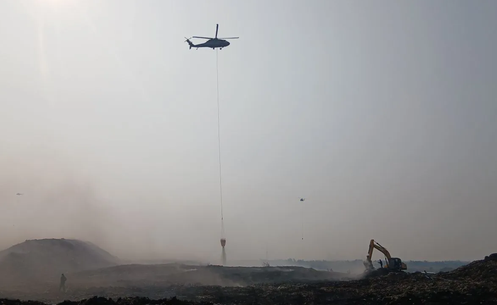
In efforts to tackle forest and land fires (karhutla) or large-scale blazes such as those at landfill sites (TPA), the term water bombing often emerges as the primary solution. This technique becomes the mainstay when ground access is difficult or when the fire spreads at a speed impossible for personnel on the ground to chase.
By definition, water bombing is an aerial fire suppression technique involving the release of large quantities of water or chemical retardant from aircraft or helicopters. In Indonesia, the National Disaster Management Agency (BNPB) frequently deploys this fleet to address fire crises in various regions.
Water bombing operations are not merely about dropping water from a height. There are technical and tactical procedures that must be followed to ensure the effort is effective and efficient. The main mechanisms are as follows:
The aerial fleet collects water from the nearest source such as lakes, rivers, reservoirs or the sea. Fixed-wing aircraft usually perform scooping (collecting water while flying low over the water surface), whilst helicopters use the dipping method, submerging a water bag (bambi bucket) suspended beneath the helicopter’s fuselage.
Before releasing the water, the pilot coordinates with the ground team or uses thermal drone technology to identify hotspots. This is essential so that the water lands right at the heart of the fire or along its path of spread to create a wet barrier.
Once over the target, the pilot releases the tank valve or water bag. Flying altitude and speed greatly determine the water dispersal pattern. If too high, the water may evaporate before reaching the ground; if too low, the water pressure could endanger personnel below or damage building structures.
There are two main categories of fleet used in water bombing operations.
A real implementation of water bombing was recently seen in the handling of the fire at the Jatiwaringin landfill in Mauk, Tangerang Regency. BNPB deployed four water bombing helicopters to subdue the flames burning the vast rubbish heaps.
The operation’s success was marked by the cessation of aerial operations after thermal drone monitoring showed no remaining active fire points. However, after the water bombing, the crucial stage that must follow is dampening and cooling. This aims to keep the temperature in the lower layers of the waste low and moist, preventing the fire from reigniting due to trapped methane gas.
Although highly effective, water bombing faces a number of technical and operational challenges.
Water bombing is a vital instrument in fire disaster management in Indonesia. However, this technology is not a stand-alone solution. The success of suppression operations, such as the one at the Jatiwaringin landfill, is the result of collaboration between the aerial attack and the hard work of ground teams such as Manggala Agni and BPBD in carrying out containment and area cooling.
Is the water used mixed with chemicals?
It depends on requirements. Foam or retardant is sometimes used to increase extinguishing power and prevent the fire from reigniting.
Why is water bombing often carried out in the morning or evening?
Usually because of visibility factors and more stable wind conditions compared to midday, as well as to avoid turbulence from hot air above the fire location.
BNPB has officially halted water bombing helicopter operations at the Jatiwaringin landfill in Tangerang. The focus has shifted to cooling and dampening the rubbish heaps.
The assistance will be submitted to the central government through the National Disaster Management Agency (BNPB).
The two water bombing aircraft are aid from BNPB that landed in Jambi City on Saturday (26 July).
Riau Regional Police are continuing to investigate the motives of the suspects behind the forest and land fire incident.
BNPB deployed five water bombing helicopters to extinguish forest and land fires in Riau.