
Understanding Various Investment Instruments for a Better Future
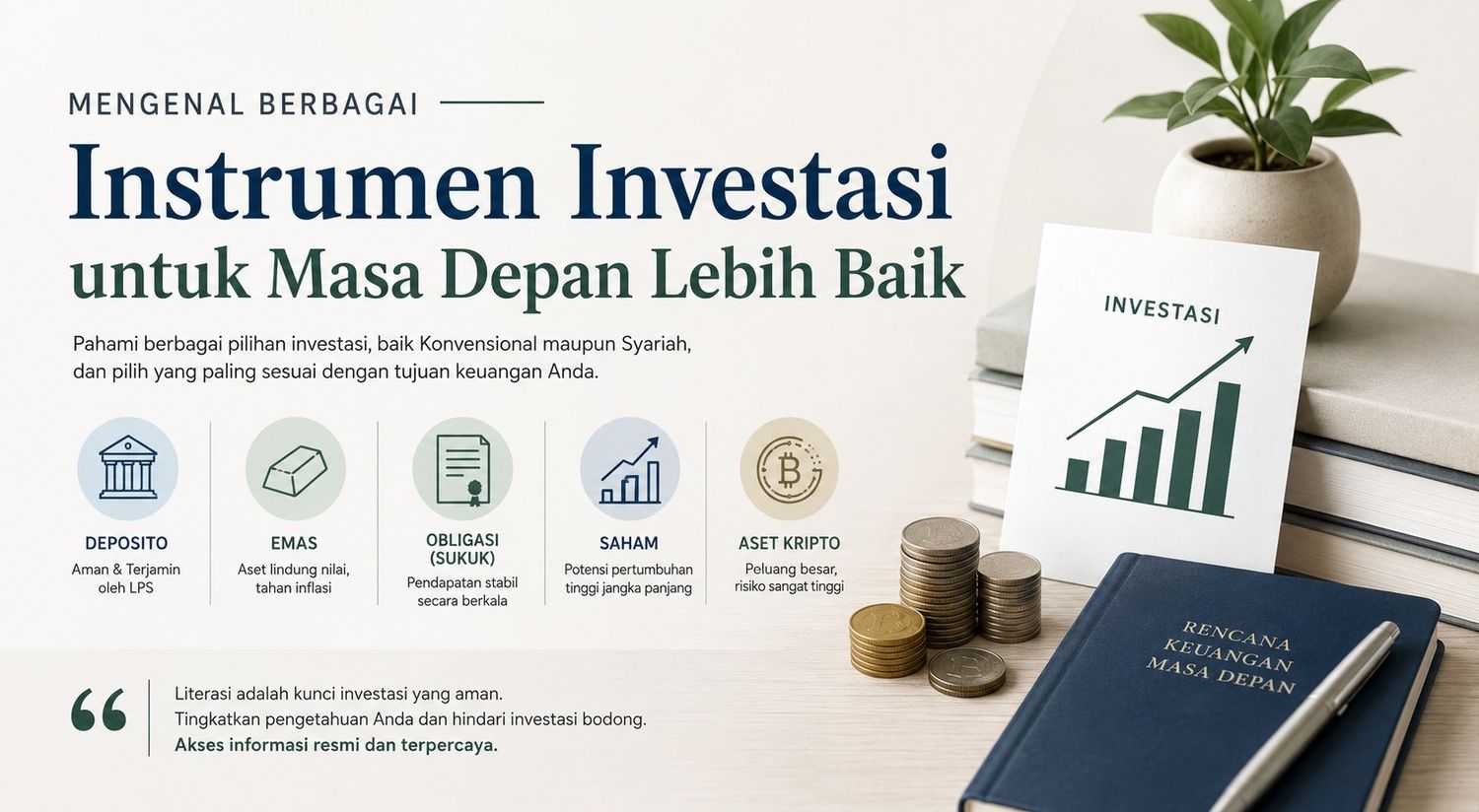
Amidst current economic dynamics, investing is no longer just an option but a necessity. Simply put, investing is the act of allocating funds today with the expectation of gaining added value or profit in the future. The primary goal is to protect wealth from the erosion of value caused by inflation. Before starting, understanding the basic principles and various instruments is crucial.
Understanding Conventional and Sharia Principles
Before choosing a specific instrument, it is important to know that investment in Indonesia is broadly divided into two main management principles:
Conventional Investment: Refers to the general economic system without specific religious restrictions. Profits are typically earned through interest, coupons, or capital gains. Funds can be invested in all legally recognised business sectors in Indonesia.
Sharia Investment: Adheres to Islamic law and is strictly supervised by the National Sharia Board (DSN). This system avoids elements of “MAGHRIB” – Maysir (gambling), Gharar (uncertainty/deception), and Riba (interest). Its profit mechanism uses Nisbah (profit-sharing), lease, or sale-purchase schemes. Furthermore, fund placement is restricted to issuers or companies whose core business is halal, thus avoiding sectors like conventional banking, tobacco, or alcohol.
Understanding Investment Instruments
After grasping these two principles, here are five of the most common investment instruments found in the market, most of which are available in both conventional and Sharia-compliant options:
- Deposits
Deposits are banking products where funds are stored and cannot be withdrawn for a fixed period (e.g., 1, 3, 6, or 12 months). In return, the bank offers a higher interest rate compared to regular savings accounts. A Sharia-compliant Mudharabah deposit is also available for those avoiding interest.
Risk Profile: Very low and highly secure, especially as they are guaranteed by the Indonesia Deposit Insurance Corporation (LPS) up to a certain limit.
Suitability: Ideal for beginners who prioritise capital security and do not require immediate access to their funds.
- Gold
Gold is historically known as a safe-haven asset. The mechanism is straightforward: investors purchase physical gold, store it securely, and anticipate a price increase over time. Digital gold platforms now exist to simplify purchasing without the need for physical storage. Gold has proven resilient in maintaining its value, particularly during economic crises or surging inflation.
Risk Profile: Low to medium. Prices can fluctuate in the short term but tend to rise over the long term.
Suitability: Suitable for wealth preservation goals.
- Bonds
Bonds are debt securities issued by governments or corporations seeking funding. By purchasing a bond, an investor essentially lends money to the issuer. In return, the investor receives periodic coupon payments and the return of the principal amount at maturity. The Sharia-compliant alternative is a Sukuk, which is not a debt instrument but a certificate of proportional ownership of a tangible asset. Because it represents asset ownership, returns to Sukuk investors come from lease payments (ujrah) or profit-sharing from the asset’s utilisation, thus avoiding riba.
Risk Profile: Medium. Government bonds carry a near-zero default risk, whereas corporate bonds have a higher default risk due to the greater credit risk of corporations compared to sovereign states.
Suitability: Appropriate for investors seeking predictable periodic cash flow akin to passive income.
- Stocks
Stocks represent ownership in a publicly listed company. Profits are derived in two ways: through dividends, which are a share of the company’s profits, and through capital gains from an increase in the stock’s market price. For Sharia-compliant stocks, listing requirements go beyond a dedicated index; strict criteria from the National Sharia Board of the Indonesian Ulema Council (DSN-MUI) must be met. These criteria include:
The company’s core business activities must not contradict Sharia principles (e.g., free from gambling, interest-based financial institutions, and the production of haram goods).
Total interest-based debt compared to total assets must not exceed 45%.
Total non-halal income (such as interest from conventional bank deposits) must not exceed 10% of total revenue.