
Understanding the US Project Freedom in the Strait of Hormuz: Trump's Noble Mission or...
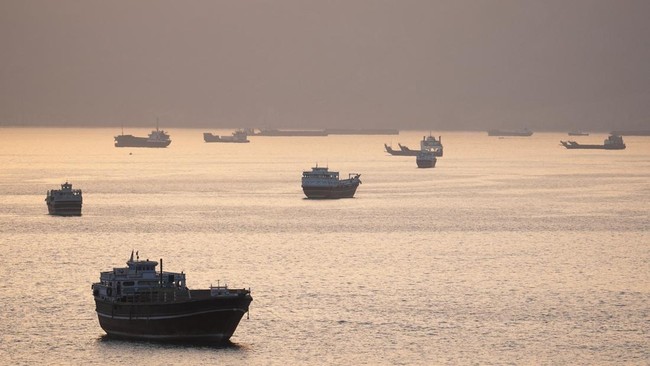
US President Donald Trump has announced that the United States will help “guide” ships stranded due to Iran’s closure of the Strait of Hormuz.
Citing a BBC report on Tuesday (5/5/2026), the Strait of Hormuz has remained largely blocked since the US and Israel launched airstrikes on Iran, which Tehran retaliated by closing the crucial waterway through which 20% of the world’s oil and liquefied natural gas supplies pass.
Just one day after the announcement, limited clashes were reported to have broken out again. The US stated it had attacked several small Iranian vessels, while Iran reportedly launched a series of its own retaliatory strikes. This operation, titled “Project Freedom,” is now under global scrutiny regarding whether it will trigger the resumption of large-scale hostilities or not.
What Did Trump Say?
In a post on the Truth Social platform on Sunday, President Trump stated that the US has been requested by countries “from around the world” to help free their ships “locked in the Strait of Hormuz” and which are “innocent neutral parties.” In response, the US will “guide their ships safely out of this restricted waterway.”
“This ship movement is solely intended to free people, companies, and countries that have done absolutely nothing wrong - they are victims of circumstance,” Trump said.
Trump added that this step is a “humanitarian gesture on behalf of the United States, Middle Eastern countries, but specifically, the country of Iran.” According to him, many of those ships “are starting to run out of food and all other necessities for large crews to remain on board in a healthy and hygienic manner.”
What Is Iran’s Response?
Although Trump claimed the operation is also in Iran’s interest, Tehran firmly rejected that narrative. Iran insists it has full control over the Strait of Hormuz and threatens to attack “any foreign armed forces” that attempt to approach or enter, especially the aggressive US military.
Major General Ali Abdollahi emphasised that safe passage through the strait must be coordinated with Iran “in all circumstances.” In line with that, Iran’s Foreign Minister Abbas Araghchi posted sharp criticism on social media platform X on Tuesday.
“The events in Hormuz make it clear that there is no military solution to the political crisis. Project Freedom is Project Deadlock,” Araghchi wrote.
How Is the US Military Implementing Trump’s Plan?
Based on data from the International Maritime Organization (IMO), an estimated 20,000 seafarers and 2,000 ships have been trapped in the Gulf since the war with Iran began. US Central Command (Centcom) stated it has deployed guided-missile destroyers, more than 100 aircraft, unmanned platforms, and 15,000 military personnel to support the operation.
Centcom Commander Admiral Brad Cooper explained that attack helicopters supporting the mission have been used to sink six small Iranian vessels targeting civilian ships. He also issued a stern warning to anyone attempting to disrupt the operation.
“We will shoot any Iranian vessel deemed to be interfering with broader efforts to help ships pass through the area,” Cooper said firmly.
Former US defence official Mick Mulroy opined that Project Freedom will likely focus on providing air cover and defence against missile or drone attacks, rather than just physical escorting. However, he doubts its effectiveness due to trust factors from shipping insurance companies regarding the security of the route.
Are Ships Starting to Pass Through?
On Monday afternoon, Centcom claimed that US destroyers had operated in the Gulf to support Project Freedom and successfully helped two US-flagged merchant ships cross the Strait of Hormuz safely. Shipping company Maersk confirmed that one of its vessels successfully exited the Gulf with US military escort, but Iran’s Islamic Revolutionary Guard Corps denied that any ships had successfully passed.
Middle East expert Grant Rumley assessed that securing the route for all ships in the Gulf would be extremely difficult and would likely require stronger kinetic military options.
“I think the general consensus is that the resumption of hostilities is a matter of when, not if,” Rumley said.
Did Iran Fire on US Warships?
Several hours after the operation began, the Iranian military claimed to have fired on an enemy destroyer, but Centcom denied claims of a US ship being directly hit by missiles. Nevertheless, Centcom acknowledged that Iran did fire cruise missiles at warships and US-flagged commercial vessels, as well as using drones against commercial ships.
In his latest post, Trump accused Iran of having “fired several shots” at unrelated countries, which triggered US retaliatory strikes on small Iranian vessels. The United Arab Emirates (UAE) reported that an Adnoc state oil company tanker was targeted by two drones while crossing the strait, but there were no casualties in the incident. Trump also mentioned a suspected attack that hit a South Korean cargo ship anchored in waters near the UAE.