
Understanding the Flores Back-Arc Thrust, Cause of the M7.7 NTT Earthquake and Its Potential Hazards
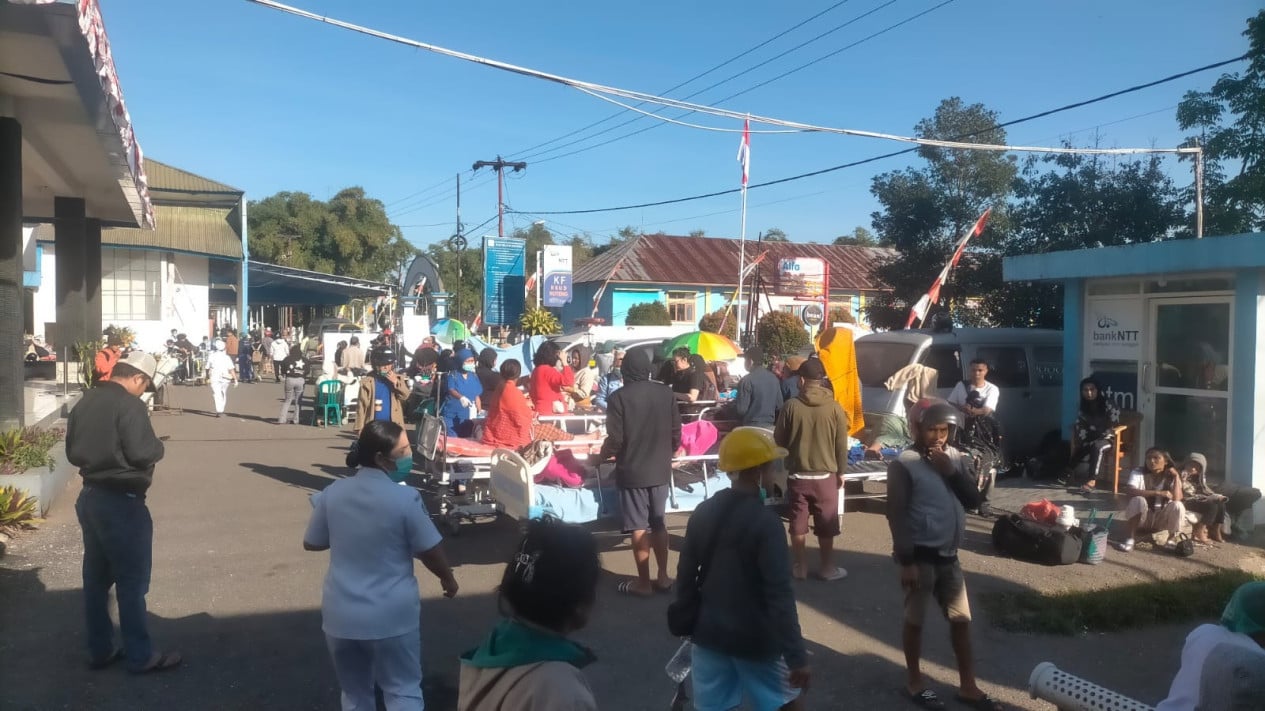
A magnitude 7.7 earthquake shook the northern region of East Nusa Tenggara (NTT) on Saturday morning, 15 August 2026. According to the Meteorology, Climatology and Geophysics Agency (BMKG), the earthquake was caused by activity along the Flores Back-Arc Thrust.
“This is an earthquake mechanism caused by the Flores back-arc thrust fault,” said BMKG Director of Earthquakes and Tsunamis Wijayanto during a press conference in Jakarta on Saturday.
According to him, this fault has the potential to generate earthquakes of magnitude 7.8 to 7.9. He noted that in 1992 a magnitude 7.5 earthquake occurred, causing severe damage at the time.
“From the existing history, in 1992 there was a magnitude 7.5 event. The damage was extraordinary back then. So, it has been more than 30 years and it has occurred again. We will continue to monitor aftershock activity,” Wijayanto said.
What is the Flores Back-Arc Thrust?
The Flores Back-Arc Thrust is an active thrust fault formed behind the Flores volcanic arc. This fault extends along the seabed from the north of Flores Island to the northern Lombok Sea. It is the most active fault in the back-arc region, with activity exceeding that of the Java Back-Arc Thrust. The fault accounts for approximately 90 percent of total earthquake activity occurring in the Nusa Tenggara islands.
Meanwhile, Professor Irwan Meilano, a professor at ITB’s Faculty of Earth Sciences and Technology and an earthquake and cadastre expert, explained that the area where the earthquake occurred is part of the Flores Back-Arc, a region with significant seismic activity. According to Irwan, the area has a history of large earthquakes, including a magnitude 6.6 event in 2009 and a series of earthquakes north of Lombok in 2018.
“If we recall 2018, for example, north of Lombok, there were large earthquake ruptures above magnitude six,” he said.
He explained that academic studies used in compiling the national earthquake map also show that parts of the region still have seismic potential.
“There are still sections that have not yet produced earthquakes. We do not hope for that to happen, but based on academic research from Pusgen, the national earthquake study centre that produced Indonesia’s current national earthquake map, the earthquake potential is not something we hope for but it still exists in that region,” he said.
Source: jawawa.id (https://jawawa.id/newsitem/understanding-the-flores-back-arc-thrust-cause-of-the-m7-7-ntt-earthquake-and-its-potential-hazards-1786816239)
Originally published by VIVA.co.id (https://www.viva.co.id/berita/nasional/1921750-mengenal-flores-back-arc-thrust-penyebab-gempa-m77-ntt-dan-potensi-bahayanya), translated from Indonesian