
Understanding the Architecture of Political Language within Economic Figures
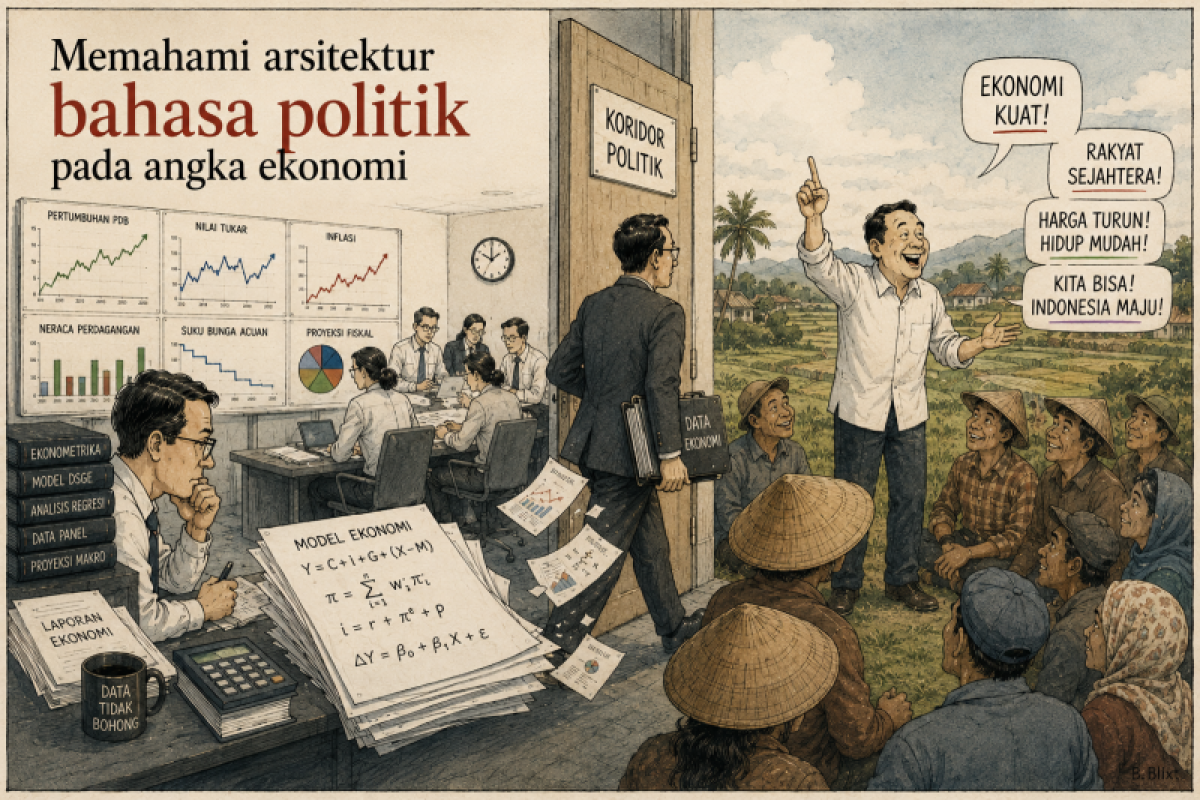
Measuring the quality of political language against academic textbook standards is a misguided approach. Political language is not intended for scientific debate in seminar rooms. In the working papers of economists or the infographics of financial institutions, the world is measured through precise figures: Gross Domestic Product growth, exchange rate graphs, and complex inflation calculations. In sterile meeting rooms, economic formulae reign supreme. Everything must be measurable, data-driven, and leave almost no room for misinterpretation.
However, once that complex economic data leaves the room, traverses the corridors of power, and is declaimed before millions of people in open spaces, the laws of economic science suddenly fade. The science claimed to be precise must confront a much older law: mass communication and the management of public psychology. For those accustomed to textual thinking, statements from public leaders that simplify global economic affairs often trigger instant responses. Accusations, cynicism, and conclusions arise that the highest decision-makers do not understand the underlying issues. ‘How can macro-economic matters with systemic impacts be simplified so easily?’ is roughly the grievance that frequently appears on social media timelines.
Is this truly a sign of misunderstanding? Or perhaps our analysis is too naive? Judging a politician’s words through the lens of a university textbook is an absolute error. What the public perceives as a ‘slip of the tongue’ or ‘simplification’ is, in fact, often a highly mature linguistic calculation. It serves as a linguistic emergency brake, intentionally pulled to control the most dangerous enemy in any economic crisis: collective panic. In the field of political communication, there is a known strategy called ‘strategic ambiguity’. The essence is simple: a leader is under no obligation to deliver a doctoral-level lecture to their people. Their primary duty is to ensure that mass psychology remains calm and that the wheels of society continue to turn.