
Understanding the 2026 Academic Ability Test (TKA) for Primary and Junior High School: Complete Guide
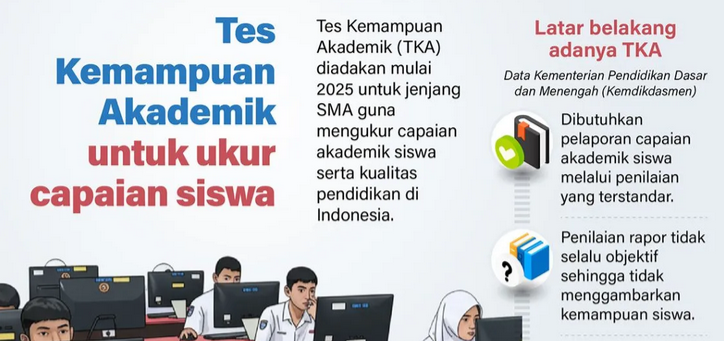
As the 2026 academic year approaches, the Academic Ability Test (TKA) remains a crucial instrument for mapping student potential, both for internal evaluation and selection into elite schools at primary and junior high levels. Understanding the structure and purpose of this test is vital for parents and students to prepare effectively.
The Academic Ability Test (TKA) is a psychometric tool designed to assess intellectual potential and cognitive abilities considered essential for academic success. Unlike achievement tests that measure learned content, TKA focuses on logical reasoning, critical thinking, and problem-solving skills.
For the 2026 academic year, TKA for primary and junior high schools typically serves several key purposes. Despite varying difficulty levels according to age, the test generally covers three main domains:
Verbal reasoning: Assessing students’ ability to understand words and relationships between them. Question types include:
Numerical reasoning: Measuring logical thinking using numbers and basic mathematical concepts, such as:
Visual reasoning: Evaluating the ability to manipulate visual objects and recognise patterns, often the most challenging section as it is not formally taught in classrooms.
The 2026 Academic Ability Test (TKA) for primary and junior high schools is not merely a numerical exam but a reflection of students’ critical thinking potential. With proper preparation and a solid understanding of the material, students can approach this test with confidence to achieve their desired educational path.
Is TKA the same as an IQ test?
TKA shares similarities with IQ tests in measuring cognitive abilities, but it is specifically focused on skills relevant to academic success.
When is the best time to start preparing for TKA?
Ideally, preparation should begin three to six months before the test date to gradually develop logical thinking skills.
Is TKA the sole factor in school admission?
This depends on individual school policies. Typically, TKA results are combined with school reports, non-academic achievements, and interview outcomes.