
Understanding NbS: BOPPJ’s Programme to Protect Java’s North Coast
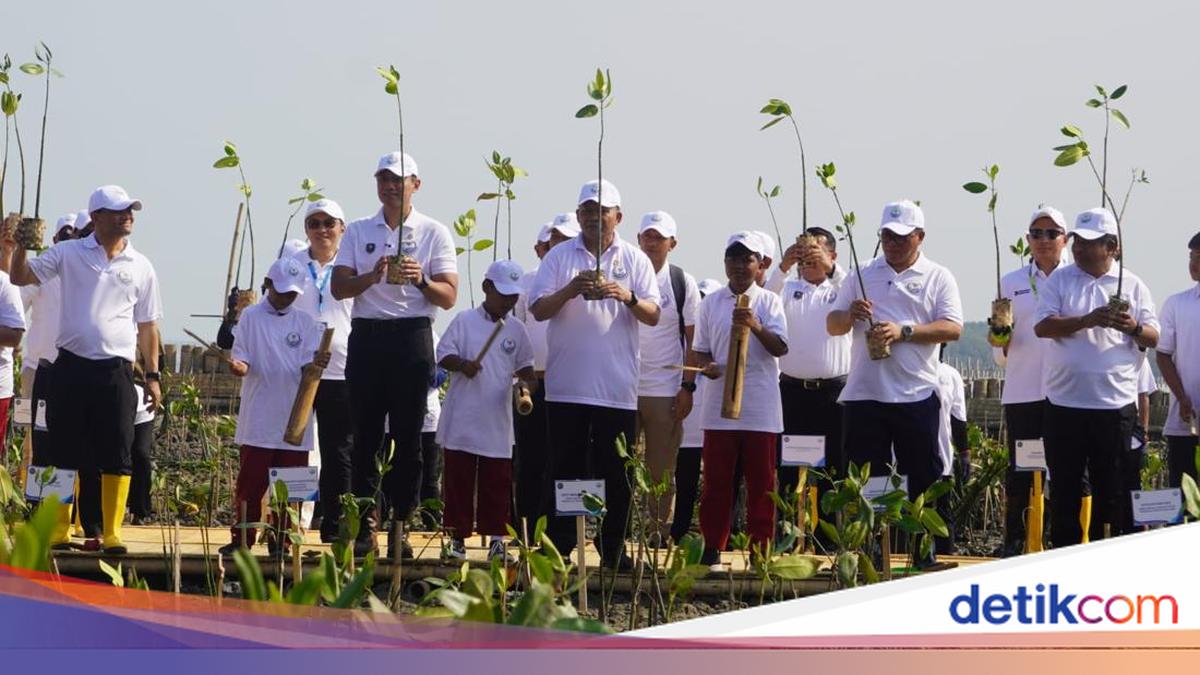
Over recent decades, the coastline along Java’s north coast has changed significantly, affecting the balance of coastal ecosystems as well as the social and economic conditions of local communities. The Nature-Based Solution (NbS) programme is one proposed way to restore the sustainability of coastal communities’ living spaces.
The problems affecting Java’s north coast have drawn serious attention from President Prabowo Subianto. Protecting the area is seen as an urgent task and part of efforts to safeguard civilisation, particularly in coastal areas.
The government subsequently established the North Java Coast Management Authority (BOPPJ) under Presidential Regulation No. 77 of 2025. The non-structural body is responsible for managing preparations, planning, construction and development in the coastal areas of Java’s north coast.
“BOPPJ is expected to coordinate the integrated and sustainable management of protection for Java’s north coast, prioritising ecological protection,” the authority said in a statement on Tuesday (20 October 2026).
BOPPJ has planned 15 development management segments along Java’s north coast. The segments extend from Serang in Banten to Gresik in East Java, using a hybrid approach that includes mangrove breakwaters, coastal embankments and sea walls.
BOPPJ’s NbS programme is designed around the use of mangrove breakwaters. This approach prioritises the rehabilitation of coastal ecosystems along Java’s north coast, particularly mangroves.
“This concept operates as a layered protection system. On the outermost layer, offshore breakwaters reduce wave energy while trapping sediment,” the authority said.
“Behind them, a mangrove belt grows as a natural buffer. Further inland, coastal embankments protect residential areas and local businesses,” it added.
In broad terms, NbS combines mangrove restoration with the use of wave barriers. The demonstration site for the protection approach is in Timbulsloko village, Sayung district, Demak regency.
Timbulsloko was selected because its coastline is eroding at an average rate of 279 metres a year, the highest along the entire North Java Coast. The problem is compounded by land subsidence of 10–20 centimetres a year in parts of Sayung.
The extreme erosion has destroyed thousands of hectares of fish ponds, settlements and mangrove forests, and submerged several villages in Sayung district. If left unchecked, cumulative subsidence at the worst-affected points could exceed one metre over 15–20 years.
The NbS demonstration project in Timbulsloko combines mangrove restoration with HexBRIck wave barriers, an innovation developed by the National Research and Innovation Agency (BRIN). BOPPJ head Didit Herdiawan Ashaf said he hoped other areas facing similar conditions would adopt the same concept.
“Given the current conditions, we hope the surrounding affected areas and other areas with similar characteristics can receive the same kind of intervention,” Didit said.
The HexBRIck wave barriers used in Timbulsloko are precast hexagonal concrete blocks designed to control erosion, coastal abrasion and soil instability, particularly in coastal, riverside and muddy areas.
Their hexagonal shape allows the blocks to interlock, forming a stable and flexible structure that can reduce the energy of waves and water flows while still allowing water infiltration and vegetation to grow.
Timbulsloko residents are directly involved in casting and installing the HexBRIck blocks as a form of community empowerment. Their involvement is intended to provide not only economic benefits but also technical skills and a sense of ownership of local coastal protection efforts.
The programme is expected to stabilise Timbulsloko’s coastline by reducing erosion and tidal flooding as sediment accumulates and mangroves grow behind the breakwater.
The multi-stakeholder collaboration model is also expected to be replicable in other sections of Java’s north coast and to open up opportunities for sustainable funding, including through the potential development of blue carbon.
However, Didit acknowledged that coastal areas along Java’s north coast have different characteristics. BOPPJ will study those differences before applying the NbS programme in other locations.
“Elsewhere, the approach may not be the same because each area has its own particular characteristics. We need to study that together,” Didit said.
Didit also said the coastal protection programme had been discussed with local communities. He stressed that the activities of fishers and fish farmers would not be disrupted.
“We are also using this programme as an opportunity to talk with people about social integration during construction. We will not close everything off,” Didit said.
“We will not close everything off. I mean that places used to support economic activity and livelihoods—whether at sea or in fish ponds—will remain accessible,” he added.