
Understanding Biofloc and RAS: Technologies for Optimising Modern Fish Farming
Advances in aquaculture technology are prompting businesses to seek methods that can increase productivity. The main focus is on optimising water use and maintaining the quality of the farming environment.
Two technologies now widely adopted in modern aquaculture are biofloc (Biofloc Technology/BFT) and the Recirculating Aquaculture System (RAS).
“Both offer different approaches to maintaining water quality and managing aquaculture waste,” said Bambang, from the marketing team at PT Maha Tirta Utama, on Monday (12 October 2026).
PT Maha Tirta Utama is the official Indonesian distributor of air pumps made by Jakarta-based PT Yasunaga Indonesia.
Bambang explained that biofloc uses the activity of microorganisms to process organic waste. RAS, meanwhile, uses a treatment system that allows pond water to be reused after filtration.
“Although they operate differently, both technologies have one important requirement: an adequate supply of oxygen and sufficient circulation,” he said.
How biofloc technology works
Biofloc technology uses microorganisms to manage waste from uneaten feed and fish faeces. Bacteria use carbon sources and nitrogen to form clusters of microbial biomass known as flocs.
The process works as follows:
Feeding and waste production: Uneaten feed and fish faeces add to the organic load in the water.
Microorganisms process the waste: Bacteria use carbon sources and nitrogen compounds to form microbial biomass in a controlled way.
Aeration maintains oxygen levels: Air is supplied to the pond to meet oxygen requirements and keep the flocs moving so they do not readily settle.
Fish growth is managed: The biofloc system helps maintain water quality and supports nutrient utilisation during the rearing period.
Main components of an RAS
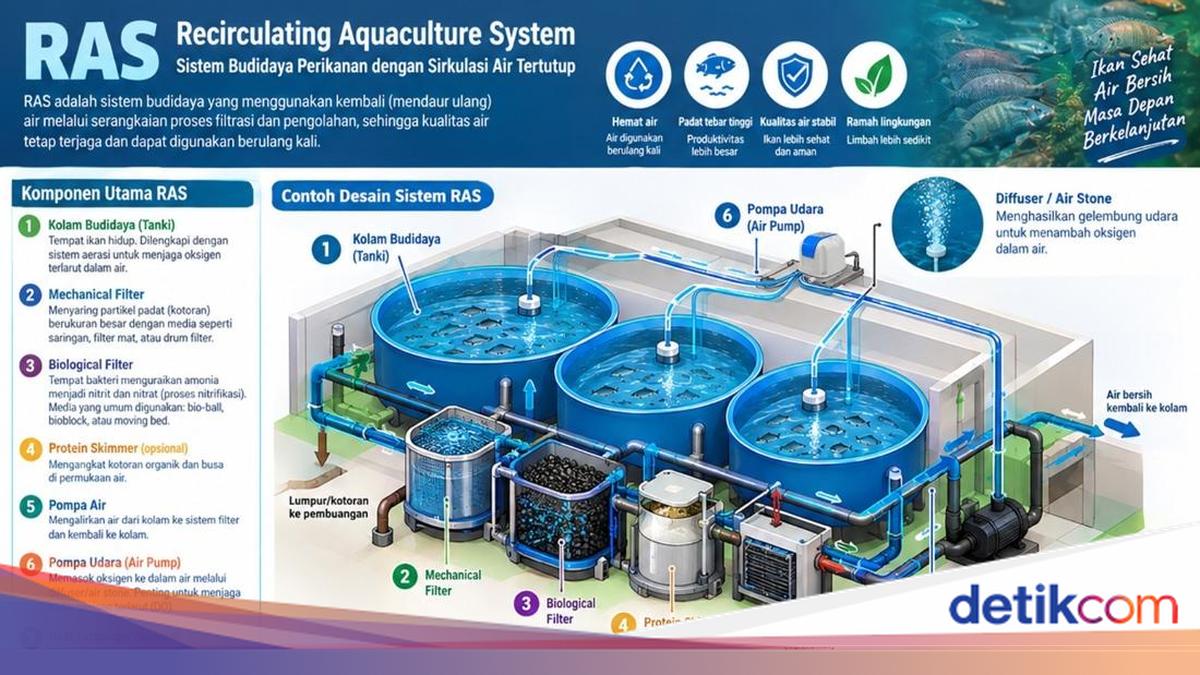
RAS, by contrast, treats water from the pond through several filtration units before returning it for reuse. Its purpose is to reduce the need for continuous water replacement.
An RAS generally consists of several main components:
Rearing pond: The fish habitat, with water quality and stocking density matched to the system’s capacity.
Mechanical filter: Separates solid fish waste and uneaten feed so they do not continue circulating.
Biofilter: Provides a habitat for microorganisms that help convert ammonia into nitrate.
Aeration and oxygenation: Meet the oxygen requirements of fish and the microorganisms in the biofilter.
Water circulation pump: Moves water from the pond through the treatment units and back again; its function differs from that of an air pump.
Bambang said biofloc and RAS can, in fact, be combined.
“However, the design needs to take the characteristics of the flocs into account, because excessive solids removal can discard the microbial biomass that the system is intended to retain,” he explained.
Why air pumps are vital components
Air pumps are essential to both systems for several operational reasons:
Maintaining dissolved oxygen: Fish and microorganisms—in biofloc systems and biofilters alike—need oxygen for biological processes.
Keeping flocs suspended: Air movement helps keep the water circulating so flocs do not settle on the pond floor.
Supporting RAS processes: It helps filtration and circulation components operate smoothly.
Maintaining stability: It helps prevent sharp drops in oxygen levels in ponds with high stocking densities.
How to choose the right air pump
Choosing an air pump should not be based solely on pond size. Users should also consider several technical factors:
Oxygen demand: This depends on the fish species, biomass, amount of feed and microbial activity.
Air capacity: The pump must meet the system’s needs under actual operating conditions.
Operating pressure: This is affected by diffuser depth and pipe resistance.
Operating pattern: The pump must be suitable for continuous operation.
Power consumption and maintenance: These are important for operating-cost efficiency and ease of obtaining replacement parts.
To meet these needs, PT Yasunaga Indonesia offers various air-pump models using linear diaphragm technology. Some models are designed to be oil-free, quiet and low-vibration.
“Yasunaga offers a range of models to suit users’ needs. The pump type should be selected according to the air flow required at the actual operating pressure,” Bambang said.
Ultimately, successful aquaculture still requires regular monitoring of water parameters such as temperature, pH and ammonia.
“Success in fish farming is not just about feeding the fish, but also about maintaining water quality and oxygen supply at all times,” Bambang concluded.