
Under Scrutiny After Violent Protests, Are French Police Europe’s Most Brutal?
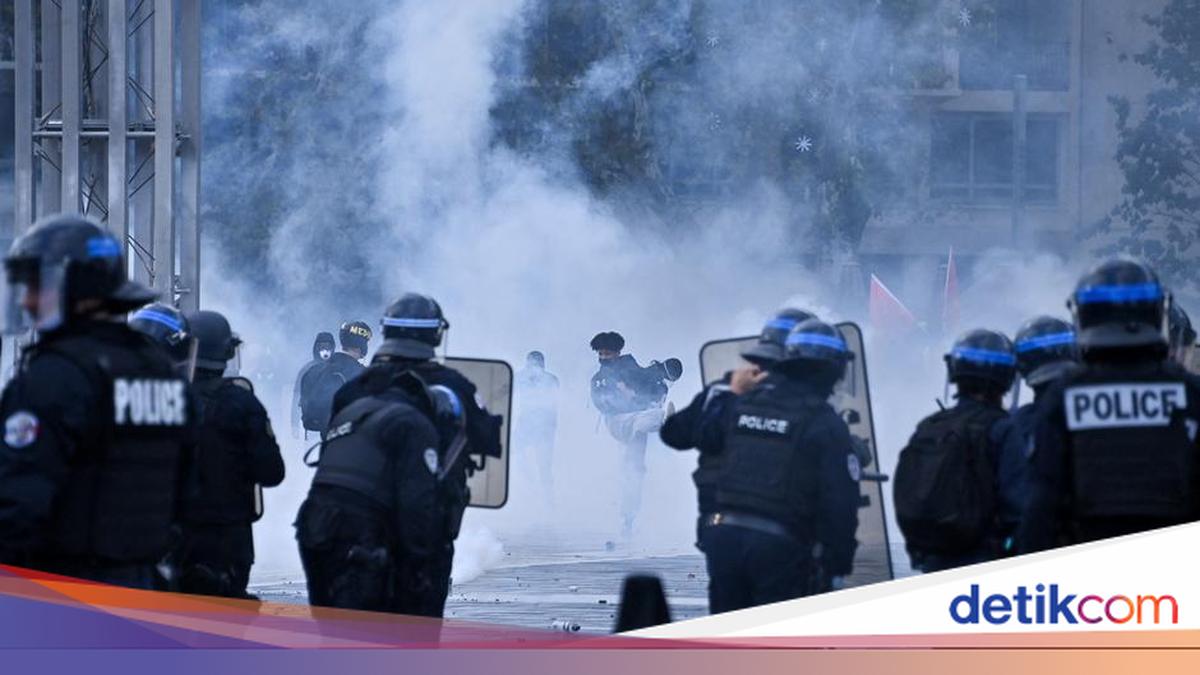
Videos alleging police violence have gone viral on French social media amid a wave of demonstrations across the country. One video appears to show officers beating a man until he falls, then dragging him away unconscious. Another shows a police officer suddenly grabbing a young man from behind for no apparent reason and dragging him by the neck.
In another video, a young woman is seen being dragged away with her arms twisted as she screams in pain. The videos have not been independently verified.
French police have again come under criticism from human rights organisations, not only for their handling of demonstrations but also for their use of stun grenades and rubber bullets against protesters. France is one of the European countries whose police are most heavily armed. During student protests over the past several weeks, several teenagers suffered life-changing injuries. One lost a hand in an explosion, another lost sight in one eye, while a third suffered a broken jaw.
Protests spread across France
More than half a million people took to the streets in France on Saturday. Most demonstrated peacefully against cuts to public services and the rising cost of living, while supporting students’ demands for better conditions at school.
However, some rioters took advantage of the demonstrations to set buildings on fire, loot shops and throw various objects at police. This made the work of police and other emergency workers at the scene more difficult.
The weekend demonstrations followed a series of protests by secondary-school students. They blockaded school buildings to protest against staff shortages and deteriorating school facilities in need of repair.
The wave of demonstrations is expected to continue this weekend. The French government has even said it will deploy the military.
French police weapons: equipment akin to military gear?
French police have a wider range of weapons than their counterparts in most other European countries. One weapon they use is the LBD-40, a type of launcher that fires rubber bullets.
In many countries, including the United Kingdom and Germany, the use of rubber bullets to police demonstrations is generally not permitted. In some other European countries, such as Spain, they are still used in certain situations, but the number of injuries caused is lower than in France.
“The use of these weapons is not confined to France. However, there are guidelines that must be followed, including rules on the distance between the police and the person being targeted,” Anastassia Tsoukala, a senior lecturer in criminology at Paris-Sud University, told DW.
“Even when officers try to comply with those rules, the person being targeted may move, so a shot can suddenly hit them in the eye and cause blindness in one eye. That is why this weapon is so dangerous.”
French police also frequently use tear gas to disperse crowds, as do police in many other European countries. The use of tear gas as a weapon in warfare, however, is prohibited under international agreements, including the Chemical Weapons Convention.
What most distinguishes French police from their counterparts elsewhere in Europe is their use of stun grenades.
“These grenades contain a high level of explosive material. In this respect, France really is different from other countries,” Tsoukala said.
France’s Interior Minister, Laurent Nunez, insists that the weapons used by police are “less-lethal”. Yet some of the equipment used by French police is categorised as “war equipment” under the country’s domestic security regulations.
Are French police the EU’s ‘most brutal’?
The use of these weapons has come under renewed scrutiny after several demonstrators were injured. One was a teenager who lost sight in one eye and is believed to have been hit at close range by a rubber bullet fired from an LBD-40 launcher.
“If police violence in handling demonstrations is measured by the number of people killed, whether demonstrators or others caught in the crowd, and the number left permanently disabled, then the French police are the most brutal in the entire European Union,” Roche said.
In Roche’s view, government policy has helped determine the weapons available to French police and how they are used today.
“The government has the power to determine the equipment used by the police,” the policing expert said. “When the LBD was first introduced into the French police, it was intended for specialist units, such as those tackling organised crime. The same weapon is now used to police demonstrations. This change shows how French politicians’ views on dealing with political protests have shifted.”
Confrontation or de-escalation?
The differences between French police and those in other European countries concern not only weapons but also their approach to demonstrations. German police, for example, are in principle required to prioritise efforts to prevent situations from escalating.
Roche compared the way police handled and removed protesters in Lützerath, Germany, in 2023, with the more aggressive approach taken in Sainte-Soline, France, in the same year. Both locations were sites of demonstrations related to environmental issues.
“In Lützerath, police used dogs. There were some injuries, but far fewer serious injuries among both police and protesters. In Sainte-Soline, by contrast, gendarmerie forces — France’s military-status police — were deployed and used LBD launchers and grenades on a large scale. As a result, both police officers and protesters suffered serious injuries. Two protesters even fell into comas.”
When may police use force?
Under international standards set by the United Nations, law enforcement officers should use physical force only in specific circumstances when it is strictly necessary, for example to prevent a crime or make a lawful arrest. Any use of force must comply with the principle of proportionality: it must not be excessive and must be limited to what is necessary to achieve a law-enforcement objective.
In several radio interviews, Interior Minister Laurent Nunez has stressed that police have generally upheld this principle in handling the current wave of protests. The same principle is also enshrined in French law.
However, human rights organisation Amnesty International has described police action during demonstrations as “disproportionate”. It has also urged the French government to fulfil its obligations to respect and protect human rights.
The French League of Human Rights, meanwhile, has condemned what it called the “violent repression” of the secondary-school student protest movement.
DW contacted two police trade unions and France’s Interior Ministry for comment. None had responded by the time the article was published.
“Managing different groups in a crowd is very difficult,” Interior Minister Nunez said in Marseille on Tuesday. “The police have done their job very well. Thanks to their hard work, many offences have been prevented.”
Experts have nevertheless continued to criticise police conduct.
“Public order must not take precedence over human life and safety,” Tsoukala said. “As a legal expert, I must stress that this principle is non-negotiable.”
French police oversight less independent than in the UK and Denmark
French police are not overseen by an independent body. Alleged police misconduct is investigated by the internal watchdog, the IGPN (General Inspectorate of the National Police). The IGPN says it has opened investigations into at least 40 cases since the latest wave of protests began.
Unlike France, countries such as the United Kingdom and Denmark have independent bodies to investigate alleged police misconduct. Tsoukala said, however, that problems in handling cases of police violence are not confined to France. Across Europe, officers involved in such cases often receive overly lenient penalties, while proceedings lack transparency.
“They are often cleared of all charges or receive only very light sentences,” she said. “I am concerned that this is common practice in the handling of police violence cases across Europe.”
Source: jawawa.id (https://jawawa.id/newsitem/under-scrutiny-after-violent-protests-are-french-police-europes-most-brutal-1792734814)
Originally published by detikcom (https://news.detik.com/dw/d-8720443/disorot-usai-demo-rusuh-benarkah-polisi-prancis-paling-brutal-di-eropa), translated from Indonesian