
UN Exhibition Uncovers Dutch Colonial Slavery in Jakarta
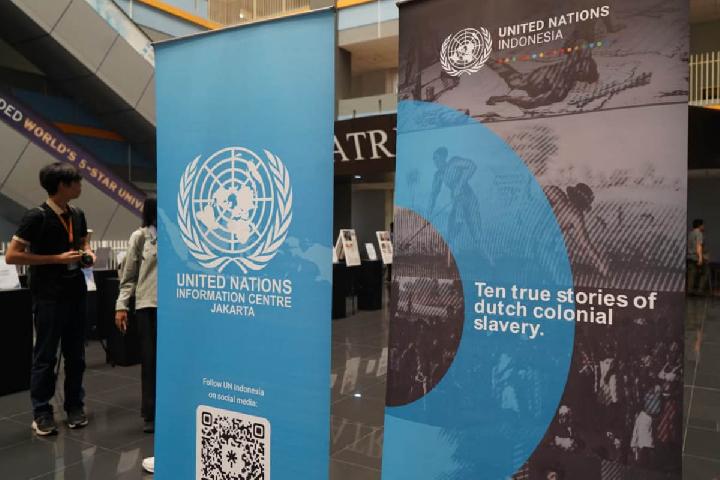
UN Exhibition Uncovers Dutch Colonial Slavery in Jakarta
Reporter
September 29, 2026 | 07:39 pm
TEMPO.CO, Jakarta - The United Nations Information Centre (UNIC) in Indonesia and BINUS University on September 29, 2026, opened Slavery: Ten True Stories of Dutch Colonial Slavery, a travelling poster exhibition developed by the Rijksmuseum in Amsterdam.
On display at BINUS University on September 29–30, the exhibition invites students and the wider public to encounter the history of slavery through individual lives, including those of people who were enslaved, resisted and benefited from the system.
The exhibition’s stories reach across the Netherlands, Indonesia, Suriname, the Caribbean and other places connected by Dutch colonial rule. Historical objects reveal how slavery shaped lives across this network. Several stories lead directly to the Indonesian archipelago, including Batavia, the Banda Islands, and Java.
Among them is Untung Surapati, who was enslaved in Bali, escaped the Dutch East India Company (VOC) in Batavia, and led resistance against colonial rule. Later recognized as a National Hero of Indonesia, his story places a familiar figure in the struggle for freedom. Another story follows six people trafficked from the Bay of Bengal and dispersed through the VOC network, including to Batavia and the Banda Islands.
“We need to talk about the history of slavery so that the people who lived through it are not forgotten, and so we can understand how injustice came to be treated as normal. Those lessons matter today. Slavery is not confined to the past: people are still subjected to forced labour, and other forms of modern slavery. Remembering this history should strengthen our commitment to protect everyone’s freedom,” said Miklos Gaspar, Director of UNIC Indonesia.
A discussion alongside the opening, “Slavery, Past and Present: Confronting Historical Injustice and Contemporary Forms of Exploitation,” brings together historian Asep Kambali, Miklós Gáspár and Dr. Lili Yulyadi, B.IRK., B.HSc., M.HSc. The speakers discussed Dutch colonial slavery’s connections to Indonesia and how individual experiences are preserved and represented. They also focused on what this history could teach the public about present-day exploitation vis-à-vis collective responsibility.
For BINUS University, hosting the exhibition and discussion provides students with an opportunity to explore history through individual experiences and reflect on how the past continues to shape understandings of freedom, dignity and responsibility. The program also encourages young people to engage with historical stories and materials while considering their relevance to society today.
“The exhibition and discussion offer an opportunity for us to understand slavery not only as a historical system, but through the experiences of the people who lived through it. By exploring their stories, historical memory and the meaning of freedom, we hope students and the wider community can reflect on human dignity and how our understanding of the past can inform our sense of responsibility today,” said Rini Setiowati, Vice-Rector for Collaboration & Global Engagement, BINUS University.
The United Nations’ human rights framework prohibits slavery and the slave trade in all their forms. In March 2026, the UN General Assembly adopted resolution 80/250, which addresses the trafficking and racialized chattel enslavement of Africans and calls for stronger remembrance, education and research into that history and its enduring legacies. While the resolution addresses a specific history, its emphasis on truth and education reinforces the importance of learning about other histories of enslavement, including those connected to Indonesia.
“One of the stories that caught my attention was the story of Untung Surapati. I learned how he was enslaved in Bali, escaped the VOC in Batavia, and later became a figure who resisted colonial rule. His story showed me that the exhibition is not only about slavery, but also about the different experiences and struggles of the people who lived through it.” said Felicia Chritsty, a student of Marketing Communication, B29, BINUS University.
Following its opening at BINUS University on September 29–30, the exhibition is planned to travel to Monas on October 23–25, around United Nations Day, and then to a Jakarta mall on November 5–8, 2026. The Monas and mall venues and dates are subject to final confirmation.
Read: Could IEU-CEPA Grant Indonesia Trade Edge over Vietnam?
Click here to get the latest news updates from Tempo on Google News
Source: jawawa.id (https://jawawa.id/newsitem/un-exhibition-uncovers-dutch-colonial-slavery-in-jakarta-1790689868)
Originally published by Tempo (English) (https://en.tempo.co/read/2120573/un-exhibition-uncovers-dutch-colonial-slavery-in-jakarta)