
UMY Visit to the Vatican: Agreement to Combat Economic War and Campaign for World Peace
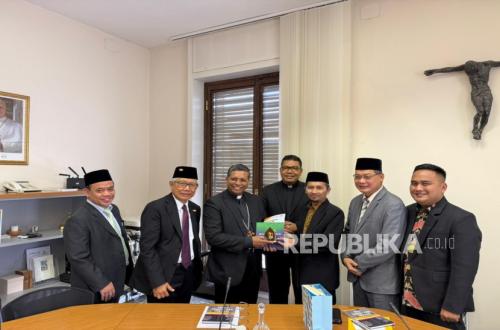
REPUBLIKA.CO.ID, SLEMAN - A delegation from Universitas Muhammadiyah Yogyakarta (UMY) conducted an official visit to the Vatican on 5–6 May 2026. The visit resulted in important agreements, including efforts to combat the global economic war that has recently continued to trigger humanitarian crises in various countries.
In the meeting, the UMY delegation was directly received by the Minister for Interreligious Dialogue (Dicastery for Interreligious Dialogue) Cardinal George Jacob Koovakad, Cardinal George Jacob, and attended by Rev Fr Markus Solo SVD, an Indonesian priest who is now the Secretary of the Dicastery for Interreligious Dialogue at the Vatican.
UMY Rector, Prof Dr Achmad Nurmandi, stated that the current global situation is in a worrying state due to conflicts and wars occurring in various parts of the world. According to him, during the meeting, Cardinal Koovakad described the ongoing conflicts as a form of ‘economic war’ or economic war.
Several factors of concern included the weakening authority of the United Nations (UN), the neglect of international law, and actions by some superpower countries deemed to harm militarily and economically weaker nations.
“Globally, the world is not in a good state. Wars in various parts of the world. The impact of this economic war is that strong countries will always try to dominate militarily weak countries,” he said during a press conference at Universitas Muhammadiyah Yogyakarta (UMY) on Monday (11/5/2026).
Achmad explained that the Vatican and Muhammadiyah agreed that world religious organisations need to build a joint coalition to voice peace and stop economic war practices that impact civilian suffering. “The Cardinal conveyed the need for a joint movement to stop economic wars around the world that cause human suffering, including children and women,” he said.
He explained that this cooperation also follows up on the Istiqlal Declaration, which contains two main agendas: humanisation and education.
“We agreed in that meeting on how the Vatican and Muhammadiyah can collaborate to deliver messages of peace, criticism, advocacy, and concrete actions,” he said.
“And coincidentally, we already have an agreement between Indonesia and the Vatican, which is the Istiqlal Declaration agreement. There are two points in that declaration. The first is humanisation, maintaining peace. The second is education,” he added.
During the visit, the UMY delegation also attended a general audience with Pope Leo XIV. Achmad said he directly conveyed the importance of interfaith cooperation in maintaining world peace.
Pope Leo reportedly welcomed the meeting’s outcomes and stated they could be immediately followed up with concrete actions with clear messages for world peace.
“In that meeting, I also conveyed the need for us to cooperate among the world’s religious communities to maintain world peace. And he expressed strong agreement and it will soon be followed up with concrete steps on the ground,” he said.
Meanwhile, the Secretary of Universitas Muhammadiyah Yogyakarta, Bachtiar Dwi Kurniawan, stated that the visit was also utilised to expand international academic networks. In addition to meeting Vatican officials, the UMY delegation visited the Pontifical Institute for Arabic and Islamic Studies (PISAI) and was received directly by its President, Rev. Don Wasim Salman. In that meeting, Wasim Salman emphasised the importance of introducing Indonesian Islamic thought, particularly Muhammadiyah, more widely to Vatican academics and the international community. He assessed that Muhammadiyah’s concept of progressive Islam is relevant to addressing various global issues currently faced by the world.
“I think this is a crucial point for Muhammadiyah, which has long worked in serving the community, the poor, the needy, humanity, and peace itself,” said Bachtiar.
PISAI also invited Muhammadiyah academics to teach at the institute in the future, while strengthening academic collaboration for lecturers and students to build understanding and advance knowledge.
“Thus, if there is an opportunity, this will expand the academic horizons, the spectrum of interactions for our academic community, including our students, to get to know cultures, systems, and academic environments abroad, including in Italy and southern Europe,” he said.
In addition to the academic agenda, the UMY delegation visited the headquarters of the Sant’Egidio community in Rome. In that meeting, both parties agreed to strengthen cooperation in the fields of humanitarian affairs, peace promotion, and service to vulnerable, poor, and oppressed groups. Muhammadiyah and Sant’Egidio are seen to share a common vision in advocating for tolerance and human progress.
“We hope the world is no longer governed and led by power alone, but the world is guided by moral strength, namely goodness and truth. What should win is goodness and truth itself, not power or strength as demonstrated by superpower countries,” he said.