
UMY Hosts Book Discussion on Religious Capitalism, Exploring Islamic Civilisation through an Economic Lens
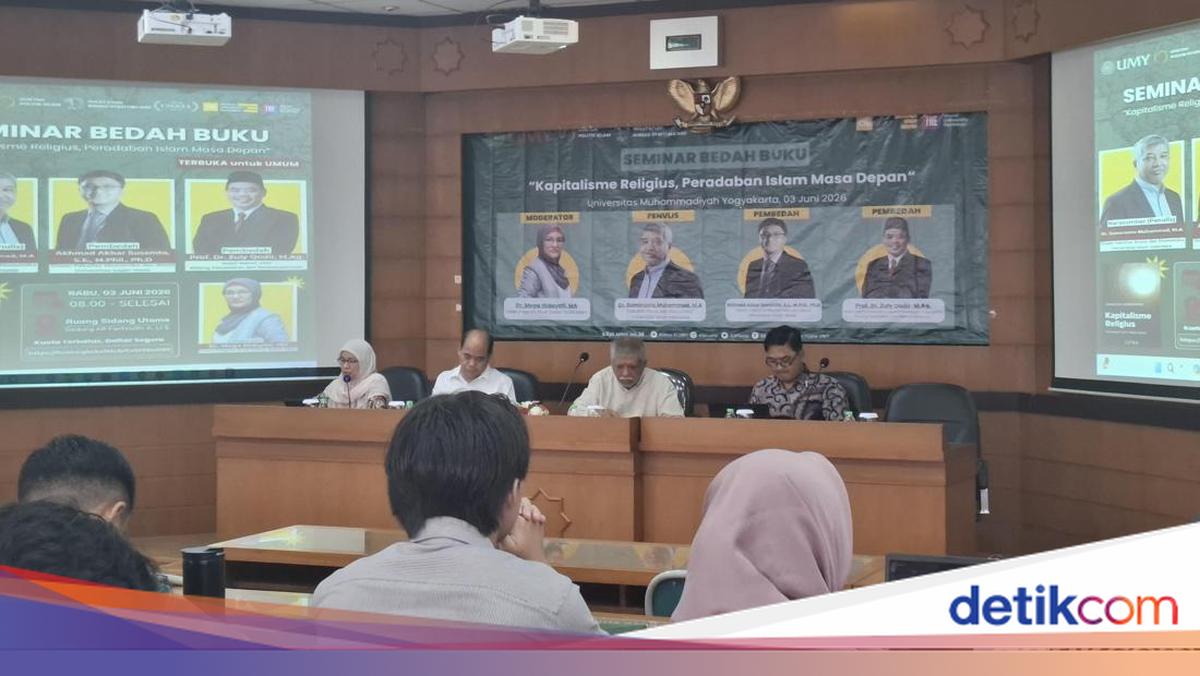
Universitas Muhammadiyah Yogyakarta (UMY) held a book discussion today for ‘Religious Capitalism: The Future of Islamic Civilisation’. The book explores Islamic civilisation from an economic perspective.
Authored by Dr Suwarsono Muhammad, a lecturer at the Faculty of Business and Economics, Universitas Islam Indonesia (UII), the book posits that Islamic civilisation once played a vital role in world history, acting as a force capable of ‘rejuvenating’ global civilisation. During the event, Suwarsono expressed his belief that Islam has the potential to rise again in the future. He analysed the position of the Islamic world amidst changes in the global order, characterised by the decline of the West and the rise of China.
“One of the extraordinary roles played by Islamic civilisation was the rejuvenation of the world. When the West collapsed, the process of recovery did not happen directly through the West; there was an intermediary, which was Islam. It was Islam that rejuvenated the world,” Suwarsono stated during his presentation on Wednesday (3/6/2026).
He noted that history shows Islam was once a centre of civilisational progress. Consequently, he argued that the resurgence of Islam cannot be understood solely through political or religious lenses, but must also be viewed from an economic aspect.
Suwarsono shared that his interest in studying economics within Islamic history began after discussions with the former Chairman of PP Muhammadiyah, Ahmad Syafii Maarif. He was troubled by why Islamic civilisation is predominantly discussed in terms of politics and culture, while the economic aspect rarely receives attention.
“I noticed that the history of Islamic civilisation is rarely analysed from an economic perspective. Most discussions focus on politics, culture, and religion, but rarely on economics. I asked myself, was there no economy back then?” he remarked.
Through his research, Suwarsono concluded that Islam during the era of Prophet Muhammad SAW and the Khulafaur Rasyidin was not a poor civilisation. “In my view, Islam was wealthy in the past,” he said.
He cited the early Muslim community’s ability to dominate trade and possess various resources as indicators of high levels of prosperity. “What is the indicator that the era of Muhammad and the Khulafaur Rasyidin was wealthy? Look at the warfare equipment owned by Muslims at that time; it was far more sophisticated. Horses, camels, arrows, various swords—it would be impossible for a poor civilisation to possess such things,” he added.
Based on these thoughts, Suwarsono proposes the concept of ‘religious capitalism’ as a development strategy for the future of Islamic civilisation. He noted that while Arab society practised merchant capitalism long before Islam, the expansion of Islam introduced religious values and state intervention. “Pre-Islamic Arabia was merchant capitalism. After Islam, it transformed into state capitalism—a state capitalism where the sources and inspiration are derived from religion,” he explained.
In his view, religious capitalism could serve as an alternative to the dominance of socialist ideas that have heavily influenced many Islamic nations post-independence. Suwarsono expressed hope that this idea would not remain merely a book or a topic for discussion. He proposed that religious capitalism should be developed into a school of thought studied and expanded by academics. “If we want to make religious capitalism a dominant school of thought, we must at least establish journals. Building a school of thought and developing theory requires a systematic approach; it cannot simply end with writing a book,” he concluded.