
UMY Achieves 12th National Rank in UI GreenMetric 2026, Highlighting Sustainability Milestones
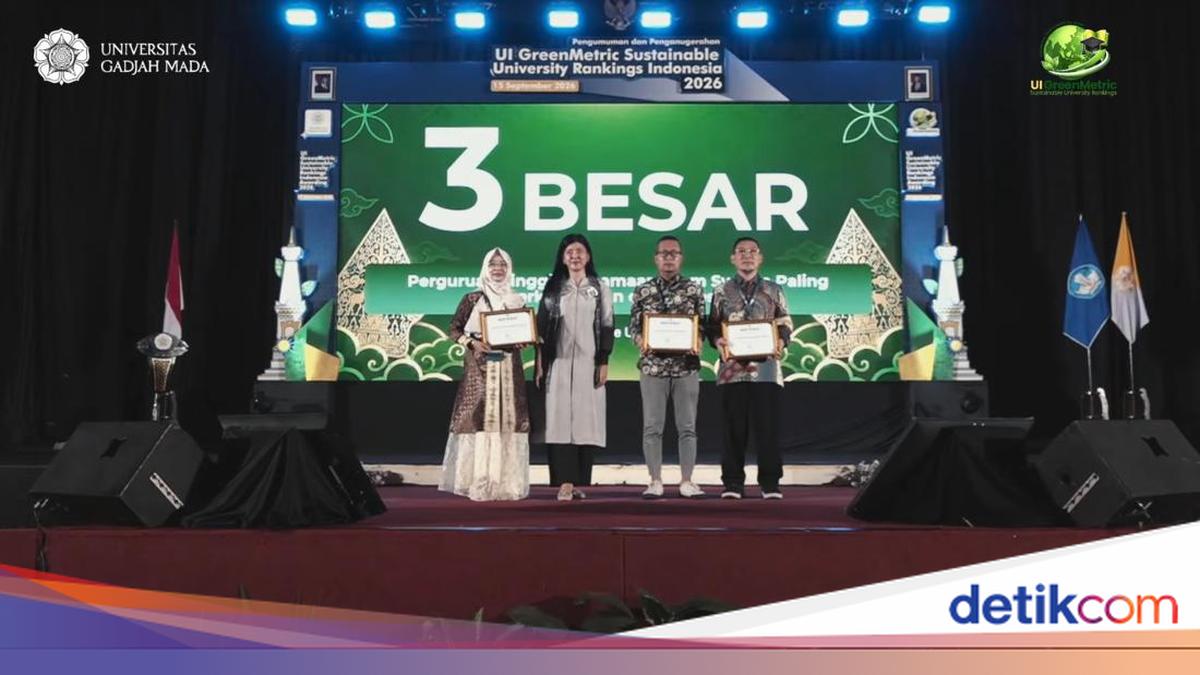
Universitas Muhammadiyah Yogyakarta (UMY) has achieved three significant milestones in the UI GreenMetric Sustainable University Rankings Indonesia 2026. UMY ranked 12th nationally, first in the Private Islamic Higher Education Institution (PTKIS) category, and second in the Private Higher Education Institution (PTS) category.
These results were announced during the UI GreenMetric Sustainable University Rankings Indonesia 2026 Awards held at Grha Sabha Pramana, Gadjah Mada University (UGM), on Tuesday (15/09/2026). This achievement is a result of a sustainability strategy that UMY has been systematically developing since 2025. The strategy includes initial condition mapping, institutional strengthening, programme standardisation, and the integration of sustainability principles into university governance.
UMY Vice Rector for Resources, Dyah Mutiarin, stated that this achievement reflects UMY’s commitment to building sustainable campus governance. “When competing with both public and private universities across Indonesia, the results show that the sustainability perspective is beginning to be integrated into campus governance,” Dyah said in a written statement on Sunday (20/09/2026).
Sustainability Roadmap to 2029
This year’s achievement is part of a five-year sustainability roadmap established by UMY in 2025. In the initial phase, UMY conducted audits and mapping of baseline conditions for various campus sustainability indicators. In 2026, UMY strengthened its Sustainability Centre to implement and standardise sustainability programmes across various fields. This strengthening is expected to make previously scattered programmes more directed, measurable, and integrated.
“The next phase is planned to run until 2029. Acceleration and innovation will take place in 2027, followed by the integration of sustainability impacts in 2028, leading to the target of global recognition by 2029,” explained Dyah. The roadmap indicates that rankings are not viewed as the ultimate goal; rather, UMY intends to use rankings as an evaluation instrument to measure the progress of sustainability policies and implementation within the campus environment.
She explained that this achievement is the result of synergy across various departments and work units at UMY. According to her, the implementation of the sustainability strategy cannot be the responsibility of a single unit, as it encompasses resource management, infrastructure, education, research, governance, and technology. Acceleration and innovation in sustainability programmes will continue to be coordinated with the Global Reputation and Planning Agency (BPRG), the Resource Division, the Infrastructure Division, and other units within Uability UMY.
From solar panels to independent waste management
In terms of physical infrastructure, several transformations represent the tangible face of UMY’s achievements. Solar panels on new buildings, one thousand biopores in parking areas, and waste houses that process waste without sending any to Landfills (TPA) are being built gradually as a foundation for a truly sustainable campus.
“New buildings will utilise solar panels, so they will no longer rely on conventional electricity,” said Dyah Mutiarin. In addition to solar panels on new buildings, UMY also routinely conducts energy audits in every work unit. These audits aim to identify units using excessive energy so that efficiency measures can be implemented immediately.
To maintain water absorption, UMY has planted 1,000 biopore points in the parking areas of all campus buildings. This programme runs alongside efforts to preserve existing trees and vegetation on campus. Regarding waste management, she claimed that UMY no longer relies on landfills. Both organic and inorganic waste are processed independently through facilities known as ‘waste houses’.
“We have implemented independent waste management and are no longer dependent on landfills. No waste is sent to the landfill because we have waste houses that produce compost,” she noted. In addition to waste houses, UMY is developing integrated farming land in the Ngrame, Kasihan area, which will function to manage both plastic and organic waste in an integrated manner. She added that UMY is even designing technology to convert organic waste into small-scale electricity sources, for example, to charge mobile phones.
Water management is also a priority. Ablution water from the campus mosque is reused to water plants, while other irrigation needs are met using water from artificial ponds within the campus environment.
Non-physical foundations: Institution, Curriculum, and Identity
Beyond physical infrastructure, institutional strengthening, curriculum integration, and the affirmation of institutional identity serve as the three non-physical foundations behind UMY’s achievements. These three aspects run alongside the physical infrastructure development that has been the most visible face of UMY’s sustainable campus transformation.
Dyah explained that institutional strengthening is realised through the Sustainability Centre, which was formed to strengthen the implementation and standardisation of sustainability programmes across all campus units. “This Sustainability Centre was formed together with the Global Reputation and Planning Agency (BPRG), as well as the resource and infrastructure divisions. We are strengthening implementation and formulating standardisation,” added Dyah.
She noted that the existence of this institution is vital so that all work units share the same understanding, ranging from waste reduction methods to strengthening carbon emission reductions within the campus environment. From an academic perspective, she mentioned that the principles of the Sustainable Development Goals (SDGs) have begun to be integrated into the UMY learning curriculum. She believes this step is essential so that sustainability awareness is embedded within the teaching and learning process.
Source: jawawa.id (https://jawawa.id/newsitem/umy-achieves-12th-national-rank-in-ui-greenmetric-2026-highlighting-sustainability-milestones-1789880069)
Originally published by detikcom (https://news.detik.com/berita/d-8670894/umy-raih-peringkat-12-nasional-ui-greenmetric-2026-ini-sederet-capaiannya), translated from Indonesian