
UMS Strengthens ASEAN Teacher Trainees’ Professionalism through SEAMEO Executive Meeting 2026
SOLO — Universitas Muhammadiyah Surakarta (UMS) has reaffirmed its commitment to improving the quality of prospective teachers and expanding educational collaboration in Southeast Asia by participating in the SEAMEO Executive Meeting, held on 20–21 October 2026 at the Seda Manila Hotel in the Philippines. The annual meeting served as a forum to review education cooperation programmes, particularly SEA Teacher, which seeks to improve prospective teachers’ competencies through cross-border teaching practice.
The UMS delegation was led by Vice-Rector I Prof Ihwan Susila, accompanied by three other delegates: Koesoemo Ratih, representing the Head of the Learning Innovation Institute, and Dr Muhammad Khalid, Vice-Dean IV of the Faculty of Teacher Training and Education (FKIP). The event, organised with The Philippine Normal University, was attended by around 245 participants from SEAMEO member countries.
UMS FKIP Dean Prof Anam Sutopo said the meeting provided an opportunity both to evaluate the programme and to strengthen collaboration strategies for improving teacher education in ASEAN.
“The meeting reviews programmes that have been carried out, especially SEA Teacher. Through this programme, universities send and receive students so they can gain teaching practice experience in another country. The aim is not only to improve teaching competence, but also to broaden prospective teachers’ understanding of cultures and community life across ASEAN,” he said in a statement on Wednesday (21 October 2026.
SEA Teacher is a SEAMEO initiative that facilitates the mobility of student teachers, enabling them to undertake teaching practice in partner countries. The programme gives students the opportunity to develop pedagogical skills while learning about education systems, student characteristics and school environments different from those in their home countries.
At the meeting, participants assessed the impact of SEA Teacher at member universities. Exchanges of student teachers were considered to provide valuable experience and improve their preparedness for diverse learning environments.
Students learn not only to prepare lesson plans, select teaching methods and materials, and conduct classroom lessons. They also gain first-hand experience of differences in language, culture, traditions, food and everyday practices in the countries where they complete their teaching placements.
UMS, for example, has sent students to undertake teaching practice at several universities in the Philippines, including Aklan Catholic University, Cavite University and Aklan State University. In turn, students from partner countries have had the opportunity to learn about Indonesia’s educational environment and culture.
Anam said this cross-cultural experience was an important part of developing prospective teachers with a global perspective.
“Prospective teachers need more than the ability to plan and deliver lessons. They also need to learn about, understand and adapt to differences in language and culture. This gives them a broader perspective on ASEAN and helps them grow into global citizens,” he said.
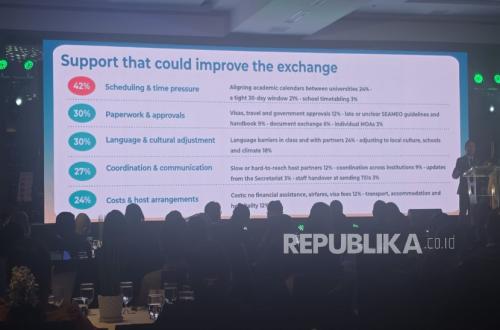
Although the programme has had a positive impact, the review also identified several implementation challenges. Language barriers were a key concern, as not all students, teachers or pupils have sufficient English-language proficiency. The use of local languages, differing communication styles and cultural adaptation also affect students’ experiences during teaching placements in partner countries.
These findings informed discussions on how to improve the programme, particularly by better preparing students before they take part in international mobility schemes.
In addition to reviewing the programme, the SEAMEO Executive Meeting included conference sessions and the sharing of best practices from several countries. These practices illustrated how universities can make the most of SEA Teacher to improve prospective teachers’ competencies.
The forum also opened opportunities to develop cooperation between educational institutions, including through memorandums of understanding (MoUs) to support student exchanges and cross-border teaching placements. For UMS, however, stronger cooperation means more than adding agreements to the books. The university wants existing international partnerships to be translated into concrete, sustainable programmes.
“UMS already has many MoUs. Therefore, in line with the Rector’s direction that there should be no ‘sleeping MoUs’, we are focusing more on strengthening the implementation of cooperation. This could take the form of visiting professors, joint conferences, co-publications, collaborative research and community service,” Anam said.
This approach is consistent with UMS’s efforts to expand its international academic network through activities that deliver tangible benefits for education, research and community service. The Vice-Rector I’s participation in the delegation also strengthened coordination to align cooperation development with the university’s academic and research agenda.
On the second day, the forum continued with the drafting of recommendations to guide SEAMEO members in improving the implementation of education cooperation programmes, including SEA Teacher.
Anam said UMS’s active participation in the meeting was expected to strengthen the university’s role in building a collaborative, adaptable and globally oriented teacher education ecosystem.
“Through increasingly practical cross-border cooperation, UMS continues to encourage the development of prospective teachers who are not only pedagogically competent, but also able to understand diversity and contribute to the development of education across ASEAN,” he said.
Source: jawawa.id (https://jawawa.id/newsitem/ums-strengthens-asean-teacher-trainees-professionalism-through-seameo-executive-meeting-2026-1792734726)
Originally published by Republika (https://rejogja.republika.co.id/berita/tnchp4291/ums-perkuat-profesionalisme-calon-guru-asean-melalui-seameo-executive-meeting-2026), translated from Indonesian