
UMS Named Indonesia’s Most Productive Private University in STEM by Diktisaintek 2026
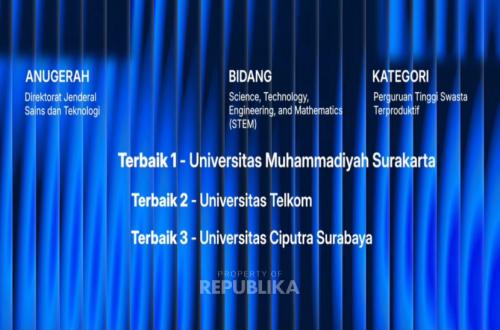
SURABAYA — Universitas Muhammadiyah Surakarta (UMS) has received the 2026 Diktisaintek Award as the top-performing private university (PTS) in Science, Technology, Engineering and Mathematics (STEM). The award, presented by the Ministry of Higher Education, Science and Technology (Kemendiktisaintek), recognises UMS’s achievements and contributions to the development of science, innovation and STEM research. It was presented at Universitas Airlangga in Surabaya on Tuesday, 10 November 2026.
UMS took first place in the most productive private university category for STEM, followed by Telkom University and Universitas Ciputra Surabaya. Among state universities (PTN), the top three were Universitas Gadjah Mada (UGM), IPB University and Sepuluh Nopember Institute of Technology (ITS).
UMS Rector Prof. Harun Joko Prayitno said the achievement reflected the university’s commitment to strengthening education and research in STEM. He said 65 per cent of UMS’s achievement rate was above both the national average and the government’s target of 30 per cent.
“In terms of adapting study programmes to STEM, UMS has reached 67 per cent. This is also above the national average of 37 per cent and the 57 per cent target set by Bappenas and the government,” Harun said after receiving the award.
The achievement reflects UMS’s commitment to developing STEM as part of universities’ contribution to advances in science and technology and to meeting society’s needs.
Prof. Sarjito, director of UMS’s Directorate of Research, Community Service, Publications and Intellectual Property Centres (DRPPS), said the result stemmed from the university’s sustained support for research and community service.
“DRPPS continues to encourage UMS lecturers to produce research and work with a wider impact, including through downstream commercialisation, supported by both internal and external funding,” he said.
That support includes outreach, assistance with research proposals and the implementation of research findings. DRPPS has also developed a partner-village model through its Community Service programme (PkM) and fostered a scientific publishing culture with a global outlook through national and international collaboration.
Rois Fatoni, deputy for research, innovation and intellectual property centres at DRPPS, said universities applying for the Diktisaintek Awards must submit data on their latest and leading innovations from the three-year period between 2023 and 2025.
UMS submitted six leading innovations for assessment, which it said represented the strengths of its lecturers’ research and technology. Rois said these were not simply academic publications, but science and technology work developed by UMS lecturers, with research outputs including publications, patents and other forms of intellectual property.
UMS also submitted data on international scientific publications, active cooperation agreements with businesses and industry, and 11 leading products considered to have an impact on society and industry. The assessment also covered the university’s research and innovation facilities, including laboratories across its 13 faculties, and its programmes to develop lecturers and early-career researchers as part of efforts to build a sustainable research ecosystem.
One achievement highlighted by UMS was its 65 researchers under the age of 40 who recorded an overall SINTA score above 1,000 over the past year. The score is one indicator of lecturers’ productivity and academic performance across research outputs, scientific publications and intellectual property.
Rois said the results reflected structured development and support from DRPPS. Assistance ranges from preparing research proposals and developing ideas to writing for national and international journals and registering intellectual property, including patents, industrial designs, copyright and other forms of protection.
“We provide structured support to lecturers and researchers on how to prepare proposals and express their ideas in a research proposal,” he said.
He added that UMS manages research according to quality standards based on the National Standards for Higher Education (SN Dikti), with the aim of exceeding those national standards. They cover researchers, governance, facilities and infrastructure, funding and research evaluation.
Rois said STEM productivity assessments consider not only research outputs, such as journal papers and patents, but also outcomes — the extent to which research is used by society and industry.
“Outcomes do not stop at journals, patents or documents; the question is how they can deliver wider benefits and have an impact on industry or society,” he said.
He said UMS’s first-place finish among private universities in STEM was the result of a collective effort across the institution. Leadership policies and funding, DRPPS programmes, and the involvement of lecturers, faculties and study programmes all contributed to research and innovation productivity.
“Praise be to God, this year UMS has become number one among private universities across Indonesia. This is certainly a very proud achievement,” Rois said.
Source: jawawa.id (https://jawawa.id/newsitem/ums-named-indonesias-most-productive-private-university-in-stem-by-diktisaintek-2026-1794455597)
Originally published by Republika (https://rejogja.republika.co.id/berita/todd7b291/ums-jadi-pts-terproduktif-bidang-stem-seindonesia-menurut-diktisaintek-2026), translated from Indonesian