
UMS Marks 68th Anniversary with Strategic Plan Indicators 113.3% Achieved
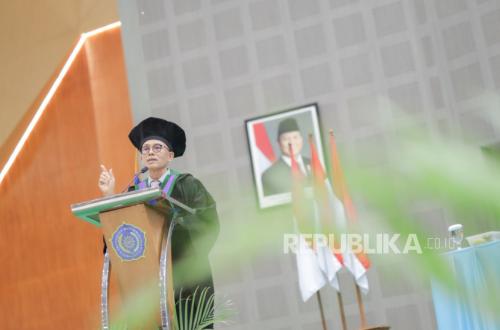
SOLO — Universitas Muhammadiyah Surakarta (UMS) reaffirmed its commitment to continued growth based on quality, public benefit and a contribution to civilisation. The commitment was conveyed at an open Senate meeting held as part of the university’s 68th anniversary ceremony at the KH Ahmad Dahlan Edutorium building on Saturday (24 October 2026).
The event provided an opportunity to reflect on UMS’s journey and reaffirm the university’s future direction. This year’s anniversary theme was “Strengthening Synergy, Spreading Benefit and Strengthening Civilisation”, with an emphasis on synergy, impact and sustainability.
UMS Rector Prof Harun Joko Prayitno reported that the university continued to grow, as reflected in its student population. UMS now has more than 31,000 active students from 436 regencies and municipalities. Of these, 25.8% come from outside Central Java and 10.4% from outside Java.
Growth was also evident in new student admissions, with an increase in the number of students completing registration. Harun said registrations currently amount to about 30% of the total number of applicants converted into registered students.
In his report, Harun also presented UMS’s performance in implementing its Strategic Plan (Renstra) for the 2025/2026 academic year. The plan contains 111 performance indicators. Realisation data are available for 109 indicators, or 98.2% of the total. Of those, 66 indicators have met or exceeded their targets, while a further 15 are close to doing so.
Overall, the average achievement across all measurable indicators was 113.3% of target. This, the report said, showed that most UMS performance indicators were progressing in line with the direction set out in the strategic plan.
The highest-performing pillar was the transformation of UMS’s planning and quality systems through data integration, evidence-based policy and continuous quality improvement, which achieved 153.6% of its target.
Meanwhile, the pillar covering the transformation of UMS’s infrastructure and financial governance towards a modern, independent, accountable and sustainable university achieved 82.6%. This area will require greater attention in the university’s future development.
“Please pray for us; hopefully UMS can grow on the basis of quality, gradually and continuously advancing,” Harun said.
He said UMS’s future development would involve a number of strategic steps, from making the most of opportunities and expanding services to strengthening foundations, resilience and financial independence. The university would also continue to develop research, community service, impactful and commercially oriented publications, and its networks.
Harun stressed that every member of the UMS academic community had an important role in building a university that was high-quality, affordable, grounded in Islamic values and able to deliver tangible benefits.
“Let us work together to ensure that UMS graduates have strong career prospects. They should not only find work, but also have the capacity to innovate and become entrepreneurs, work in line with their expertise and competencies, and become pioneers of change in their communities,” he said.
He also called for UMS research, community service, innovation and publications to have greater impact and potential for downstream development and commercialisation. These efforts form part of the university’s goal for 2029: to become more modern, data-driven, accountable and excellent, and to serve as a driver of change.
Prof Aisyah Endah Palupi, head of the Higher Education Service Institute (LLDIKTI) for Region VI, praised UMS’s development. She said the university’s efforts to produce graduates who make an impact were in line with the needs of businesses, industry and the wider labour market, collectively known in Indonesia as DUDIKA.
She said the focus of higher education had moved beyond “link and match” towards “plug and play”, in which graduates are expected to be readily absorbed into the workforce and contribute immediately.
“It is no longer just ‘link and match’, but ‘plug and play’. We are guiding graduates so they can be absorbed into DUDIKA and start working straight away,” Aisyah said.
She added that UMS had a strong record in programme accreditation, with about 75% of its study programmes rated Excellent. Aisyah congratulated the university on its 68th anniversary and urged it to continue improving the quality of its human resources and infrastructure.
UMS alumnus Fajar Riza Ul Haq, Deputy Minister of Primary and Secondary Education, also highlighted the strength of the university’s intellectual tradition. He said UMS’s development was underpinned by a strong academic culture, inclusive leadership and open governance.
“UMS’s remarkable development to this day is due in part to its strong intellectual tradition, supported by a robust academic culture, inclusive campus leadership and open governance,” he said.
He said academic freedom was an important foundation for the growth of scholarship. Universities needed to make room for differing ideas, managed constructively so they could generate new knowledge.
Deputy Minister of Marine Affairs and Fisheries Prof Irwan Meilano stressed the importance of universities and Muhammadiyah in building Indonesia’s blue civilisation. He said food from the sea was an important resource for the nation’s continued well-being.
“A sustainable blue civilisation is a collective undertaking involving the state, universities, the Muhammadiyah organisation and coastal communities,” he said.
He called on all parties to work together more closely to revive Indonesia’s maritime civilisation, noting that history showed Indonesian seafarers had built civilisations across many countries.
Chairman of Muhammadiyah’s Central Executive Board, Prof KH Haedar Nashir, urged UMS and Muhammadiyah to continue reflecting on their identity and contribution to national progress.
“UMS and Muhammadiyah must always ask: ‘Who are we, and what do we want to do with the character we possess?’” he said.
He said Muhammadiyah’s character as a movement was rooted in Islam as a religion of civilisation and progress. That spirit, he said, must continue to guide the development of Muhammadiyah, including UMS and all Muhammadiyah and ’Aisyiyah universities (PTMA).
“The spirit of building civilisation, the spirit of advancing progress, the spirit that continually generates an ethos of progress — that is what moves us forward,” he said.
He expressed hope that this spirit would be sustained so that Muhammadiyah, UMS, all PTMA institutions and Muhammadiyah’s charitable enterprises could continue to grow, advance and excel.