
UMJ Vice-Rector IV Provides Input on Asset Forfeiture Bill at DPR RI
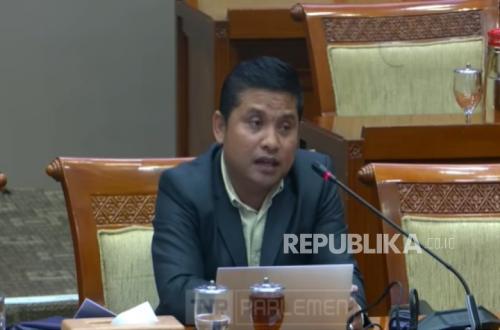
The Vice-Rector IV of Universitas Muhammadiyah Jakarta (UMJ), Dr Septa Candra, SH, MH, attended a Public Hearing (RDPU) held by the Working Committee on the Draft Law on Asset Forfeiture for Criminal Acts together with Commission III of the DPR RI.
The hearing took place in the Commission III meeting room, Nusantara II Building, Parliament Complex, Jakarta, on Monday (20/07/2026). Septa stressed that the Asset Forfeiture Bill needs to be deliberated and passed promptly.
According to him, the regulation is needed to seize assets derived from criminal acts so that the national economy can be restored.
“This bill is important to deliberate and pass because it is very much needed to seize assets resulting from criminal acts, so that the state’s economy can be recovered and returned to the public for development purposes,” said the UMJ Faculty of Law lecturer.
Septa outlined several substantive elements of the bill, including its urgency, scope, objects of asset forfeiture, procedural legal mechanisms, the Non-Conviction Based (NCB) principle, prerequisites for its application, the ex parte principle, asset management, voluntary asset return, and recommendations for refining the bill.
According to Septa, asset forfeiture plays a strategic role in preventing criminal acts while returning assets to the state for losses suffered by state finances.
He also explained that the Non-Conviction Based (NCB) principle allows assets to be forfeited without a criminal conviction against the perpetrator. However, this mechanism can only be applied when criminal prosecution is not possible or has not been successful.
In addition, Septa proposed that the Asset Forfeiture Bill provide room for the voluntary return of assets.
The proposal aligns with the direction of criminal punishment under Law Number 1 of 2023 on the Criminal Code and Law Number 20 of 2025 on the Criminal Procedure Code, which have shifted from a retributive to a restorative approach.
“Consideration should be given to providing room for voluntary asset return through restorative justice (RJ) and plea bargaining,” said Septa.
He explained that this mechanism is expected to encourage perpetrators to voluntarily hand over assets derived from criminal acts. Once all assets have been returned, accompanied by the perpetrator’s admission, the case can be dropped.
In this way, the return of assets derived from criminal acts can proceed to the fullest extent. Septa then put forward four substantive points for the Asset Forfeiture Bill.
First, asset forfeiture should be positioned as a last resort when criminal proceedings cannot be carried out or fail. Second, clarifying the objects of criminal assets that can be forfeited, along with their mechanisms and prerequisites.
Third, strengthening the application of the ex parte principle through the Non-Conviction Based Asset Forfeiture instrument to cripple the economic mobility of criminals. Fourth, establishing a special asset management body staffed with multidisciplinary personnel so that the economic value of assets is preserved.
“If law enforcement is carried out by violating the law, then there is no difference from criminals who act unlawfully,” he said.
Septa also proposed the establishment of a special body to manage forfeited assets. According to him, such a body needs to focus on asset management so that its economic value is maintained.
“That way, the economic value of assets is preserved and not damaged. With clear authority, this body would manage forfeited assets with certainty,” he proposed.
According to Septa, UMJ’s presence at the forum demonstrates the contribution of higher education institutions to drafting legislation. He believes that drafting regulations requires input from academics at various universities.
“As a university, UMJ can contribute to drafting a bill that truly needs input from academics across campuses, including UMJ, which has many experts in the field of law,” he said.
He added that UMJ’s direct involvement is proof of the university’s tangible contribution to the nation’s problems.
On the same occasion, the Chair of Commission III of the DPR RI, Dr Habiburokhman, SH, MH, highlighted the importance of oversight in the implementation of the Asset Forfeiture Bill. According to him, oversight must run at its fullest so that law enforcement officials do not abuse the execution of asset forfeiture.
The public hearing was attended by members of Commission III of the DPR RI from several factions. The forum also served as a space for academics to provide input on the drafting of the Asset Forfeiture Bill currently being deliberated by the DPR RI.