
UMJ Researcher Highlights Strategy to Prevent Indonesians Falling Victim to Online Scams
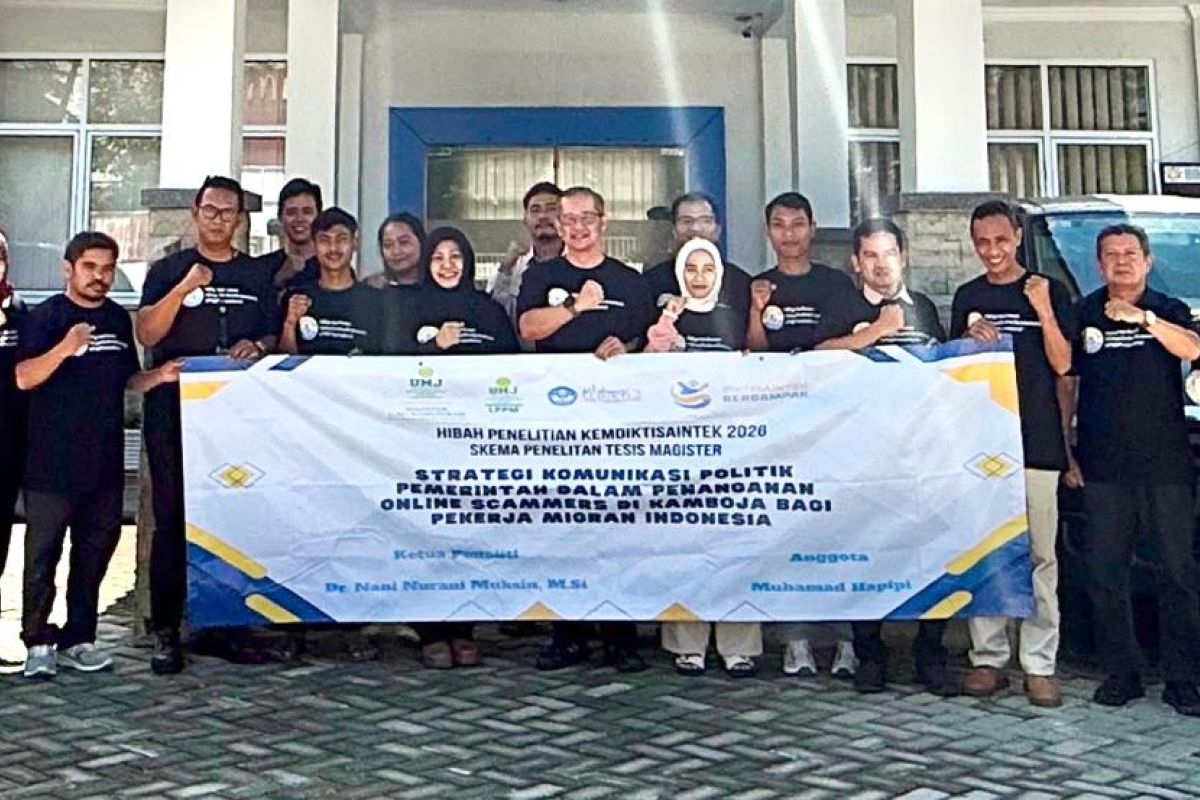
Jakarta (ANTARA) - Researcher and lecturer at Universitas Muhammadiyah Jakarta (UMJ) Nani Nurani Muksin has highlighted the need for a political communication strategy to tackle online scammers who ensnare many prospective Indonesian migrant workers seeking jobs abroad.
“Online scammers in Cambodia are not just a cybercrime issue, but also a public communication problem. Therefore, a political communication strategy is needed to reach the public before they decide to work overseas,” said Nani, who is also a recipient of the 2026 Ministry of Higher Education, Science, and Technology Research Grant, as quoted by the Ministry of Protection of Indonesian Migrant Workers (KP2MI) on Monday.
She made the statement during a Focus Group Discussion (FGD) at the Indonesian Migrant Workers Protection Agency (BP3MI) in North Sumatra on Thursday, 2 July, which discussed the government’s political communication strategy research in handling online scammers. According to her, government communication must present information that is easily understood by the public, especially the productive age group targeted by non-procedural recruiters through social media and digital platforms.
She assessed that disseminating information about safe migration is not enough if done formally, but must also utilise various digital communication channels that are close to the public. Head of BP3MI North Sumatra, Police Grand Commissioner Budi Novijanto, welcomed the research. He said that academic findings are urgently needed as a basis for policy formulation and government communication strategies to protect prospective Indonesian migrant workers.
“Through this research, it is hoped that recommendations will emerge that can strengthen synergy between the government, academics, law enforcement officials, and the community in preventing more Indonesian citizens from becoming victims of online scammer networks,” he said. In the FGD, participants also discussed various challenges in handling cases, ranging from digital recruitment patterns and low safe migration literacy, to the importance of cross-ministerial and institutional collaboration in conveying prevention messages to the public.
Muhamad Hapipi, a Master of Communication Science student at UMJ and an employee of the General Bureau of the Ministry of Protection of Indonesian Migrant Workers (KP2MI), hopes this research can make a real contribution to strengthening government communication policies in protecting Indonesian migrant workers from non-procedural recruitment practices that lead to online scammer exploitation. “From a communication perspective, a more effective and adaptive political communication strategy is needed, one that is capable of reaching community groups vulnerable to recruitment through digital media,” he said.
“Through this research, we aim to produce academic-based recommendations that can support the formulation of public communication policies,” Hapipi added. He further noted that collaboration between academics, the government, and stakeholders is a key factor in producing a communication strategy that can improve safe migration literacy while simultaneously raising public awareness of transnational crime modes that exploit digital media. “The hope is that the results of this research will not only serve as an academic output for the Kemdiktisaintek grant, but also become strategic input in formulating public communication patterns that have an impact on protecting Indonesian migrant workers who wish to work abroad,” he said.