
UMJ Rector: Economic Transformation Must Be Based on Values and Benefit Society
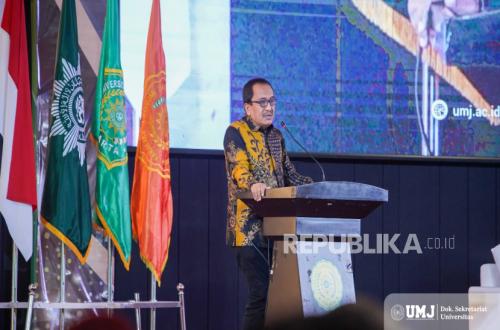
The Rector of Universitas Muhammadiyah Jakarta (UMJ), Prof Dr Ma’mun Murod, has stated that economic transformation must be based on moral values and deliver a real impact for society. He made the remarks during the 2nd International Conference on Economics, Management and Accounting (ICEMA) 2026, held as part of the National Congress and Work Meeting of the Association of Muhammadiyah and ‘Aisyiyah Higher Education Institutions’ Faculties of Economics and Business (AFEB PTMA) 2026. The event took place at the KH Ahmad Azhar Basyir Auditorium, Cendekia Building, UMJ, on Tuesday (4/8/2026), and was attended by academics, researchers, and participants from various Muhammadiyah and ’Aisyiyah higher education institutions.
Ma’mun stated that academic collaboration is a crucial foundation for generating solutions to various global challenges. According to him, the conference theme reflects a world undergoing rapid change due to the digital revolution, the development of artificial intelligence, business transformation, climate change, and geopolitical dynamics, all of which are creating new paradigms in economics, management, and accounting. “This rapid transformation must remain rooted in values so that it produces a tangible impact for society. The values of ethics, justice, integrity, and humanity must be the foundation of every innovation we create,” he said.
Ma’mun added that from an Islamic perspective, economic development is not only measured by an increase in per capita income, but also by the presence of collective benefit, equitable welfare distribution, and responsibility for environmental sustainability. He argued that academics, policymakers, and economic actors have a strategic responsibility to provide solutions to the various problems of economic inequality in Indonesia, as well as to offer constructive criticism of public policies.
Ma’mun expressed hope that the conference would not stop at the presentation of research findings, but would also produce international collaboration networks, quality scientific publications, joint research, academic exchanges, and policy recommendations that make a real contribution to national and global economic development, as well as supporting the achievement of the Sustainable Development Goals (SDGs). “This conference is a commitment to answering economic challenges, both in Indonesia and globally,” he concluded.
The AFEB PTMA 2026 Congress took place over three days, from 4 to 6 August 2026, under the theme ‘From Values to Impact: Advancing Digital, Inclusive, Sustainable, and Islamic Economies’. The series of activities included the AFEB PTMA organisational session, the formulation of a national work programme, the 2nd ICEMA 2026, the International Collaboration Forum (ICF), the signing of international cooperation agreements, and various other academic and institutional agendas. The event was co-hosted by several universities, including UM Semarang, UM Sidoarjo, UM Kalianda, UM Yogyakarta, UM Prof Dr Hamka, UM Gresik, UM Jember, UM Palopo, UM Kalimantan Timur, and UM Tangerang. The conference also received support from a number of sponsors, including Adira Finance Syariah, Asuransi Takaful Ulum, Ayam Joyo Highres, Bank Mega Syariah, Bank Muamalat, Bank Syariah Indonesia, CIMB Auto finance, Mentari Madani, Pertamina, Zurich Insurance, and CPA Australia.