
UMJ Public Administration Study Programme Retains Superior Accreditation
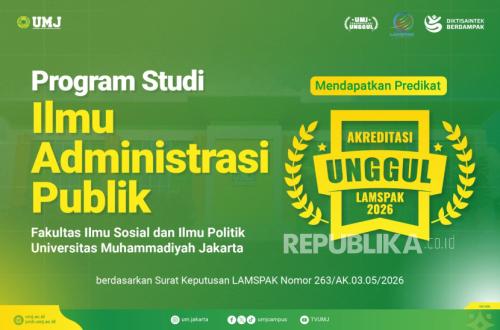
The Public Administration Study Programme of the Faculty of Social and Political Sciences at the University of Muhammadiyah Jakarta (FISIP UMJ) has officially retained its Superior Accreditation. The decision was issued by the Executive Board of the Independent Accreditation Institute for Social, Political, Administrative, and Communication Sciences (LAMSPAK) under decree number 263/AK.03.05/2026, published on 10 August 2026. This accreditation status is valid from 17 April 2026 to 17 April 2031. This marks the second time the Public Administration Study Programme at FISIP UMJ has achieved the Superior Accreditation predicate.
Head of the Public Administration Study Programme at FISIP UMJ, Dr. Mawar, S.IP., M.AP, expressed her gratitude for the accreditation achievement. She stated that this accomplishment is a collective result based on cooperation, support, and collaboration among the entire academic community of UMJ, particularly FISIP UMJ. “As programme managers, we thank everyone for their excellent support, assistance, and cooperation,” said Mawar.
Mawar explained that preparations for the accreditation began early with the formation of a team to compile the study programme’s self-evaluation. This step was strengthened by a digital archiving system for data on the implementation of the Catur Dharma of Higher Education, making it easier to access and collect the data required for the accreditation process. “We prepared the self-evaluation team early. Data on the implementation of the Study Programme’s Catur Dharma has been digitally archived, making it easy to access and collect the necessary data,” Mawar stated.
Furthermore, the UMJ Public Administration Study Programme conducted a field assessment simulation by inviting experts from the programme association, the Indonesian Association for Public Administration (IAPA). The simulation was carried out to ensure the programme’s readiness for the assessment process while identifying aspects that still needed strengthening. One of the main focuses was improving lecturers’ scientific publications, particularly in reputable international journals. This effort was supported by increasing lecturers’ research activities. The programme also paid attention to improving the Cumulative Grade Point Average (GPA) of graduates and the percentage of on-time graduation. The strategy was implemented through regular monitoring and evaluation of student study progress.
Strengthening academic networks was also pursued by increasing lecturers’ active participation in professional organisations and associations. Mawar noted that around 90 per cent of the Public Administration Study Programme’s lecturers are board members of programme associations, both within the Muhammadiyah and ’Aisyiyah Higher Education (PTMA) network through APSANAP and at the national level through IAPA. Expanding cooperation is also part of the quality improvement strategy. The UMJ Public Administration Study Programme broadens its networks in implementing the Catur Dharma of Higher Education, through partnerships with other universities, the business and industrial world (DUDI), and non-governmental organisations (NGOs).
Mawar hopes that the Superior accreditation achievement can be maintained and further improved in the future. According to her, this predicate should serve as a foundation to boost the achievements of lecturers and students, increase student enrolment, and enhance the quality of graduates. “In terms of achievement, both lecturer and student accomplishments can be improved. Then, the number of students can also increase, the quality of graduates with various competencies in Public Administration can be enhanced, and the employability of alumni in the job market can be competitive not only nationally but also globally,” she said.