
UMJ Lecturer's Dissertation Reveals Digitalisation Portrait of Shallot Farmers in Yogyakarta
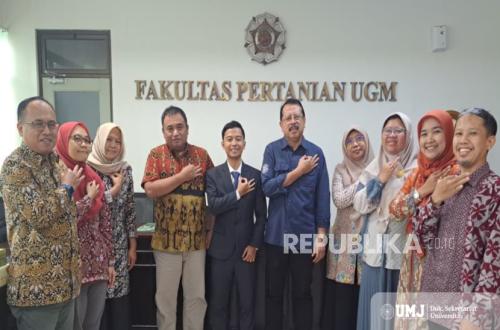
Alif Haidir Adana, a lecturer in the Agribusiness Study Programme at the Faculty of Agriculture, Universitas Muhammadiyah Jakarta (UMJ), underwent a closed dissertation examination for the Doctoral Programme in Agricultural Science at the Faculty of Agriculture, Universitas Gadjah Mada (UGM), Yogyakarta, on Wednesday (19/8/2026). The examination discussed the adoption of digital technology and the resilience of shallot farming across various agroecological zones in the Special Region of Yogyakarta (DIY).
Alif defended a dissertation titled ‘Comparative Study of Digital Technology Adoption and Shallot Farming Resilience in Various Agroecological Zones in the Special Region of Yogyakarta’. The research examined the use of digital technology, barriers to adoption, and the influence of digital technology on shallot farming resilience. Alif studied three zones: the coastal area, the highlands, and the lowlands.
In his research, Alif employed a quantitative descriptive method with a case study approach. He involved 316 shallot farmers as respondents. Alif analysed the data using quantitative descriptive analysis, Partial Least Square Structural Equation Modelling (PLS-SEM), and logistic regression.
‘This research looks at the use of digital technology by shallot farmers while identifying various barriers in the adoption process. I also measured farming resilience through the dimensions of adaptation, recovery, anticipation, and innovation,’ said Alif.
The results showed that farmers most frequently used smartphones, mobile phones, social media, and search engines. Conversely, advanced technologies such as Artificial Intelligence (AI) and the Internet of Things (IoT) were almost entirely unused in farming activities.
Alif’s research also found that the level of farming resilience remained low. A total of 52.33 percent of the 316 farms studied fell into the less resilient category. Meanwhile, the average resilience score reached 14.335.
‘More than fifty percent of shallot farms in the Special Region of Yogyakarta are less resilient. Shallot farms in the coastal agroecological zone have the highest level of resilience compared to other agroecological zones,’ he said.
The findings demonstrate the importance of digital transformation in strengthening farming resilience. Alif believes the research results can serve as a consideration in formulating agricultural sector policies. Policies also need to take into account the characteristics of agroecological zones and the conditions of farmers.
‘Collaboration between technology providers, researchers, and farmers is key to designing digital technology suited to small-scale farming. Such technology needs to have low investment costs and be easy to operate and maintain,’ said Alif.
Alif also encouraged the government to accelerate digital transformation in the agricultural sector, particularly at the farmer level. According to him, improving digital knowledge and skills must go hand in hand with providing technology that meets farmers’ needs.
After completing his doctoral studies, Alif hopes to apply the knowledge gained during his studies and make the research results a contribution to policy and institutional development. He also wants to remain productive in publications and contribute to the advancement of the study programme, faculty, and UMJ.
‘My hope after completing my doctoral studies is to be able to properly apply the various knowledge gained during my studies. The research results can also serve as a consideration for stakeholders in making policy, while supporting me in becoming an inclusive lecturer for students, productive in publications, and contributing more to the advancement of the study programme, faculty, and UMJ,’ said Alif.
The closed examination featured Prof. Ir. Jaka Widada, M.P., Ph.D. as Chair of the Examining Committee; Prof. Dr. Ir. Irham, M.Sc. as Promotor; Dr. Ir. Lestari Rahayu Waluyati, M.P. as Co-Promotor 1; and Arini Wahyu Utami, S.P., M.Sc., Ph.D. as Co-Promotor 2. Also present were Prof. Subejo, S.P., M.Sc., Ph.D. as Examiner 1/Assessment Team; Dr. Hani Perwitasari, S.P., M.Sc. as Examiner 2/Assessment Team; Agus Dwi Nugroho, S.P., M.Sc., Ph.D. as Examiner 3/Assessment Team; Ir. Any Suryantini, M.M., Ph.D. as Examiner 4/Internal Examiner; and Dr. Raden Rara Aulia Qonita, S.P., M.P. as Examiner 5/External Examiner.
Source: jawawa.id (https://jawawa.id/newsitem/umj-lecturers-dissertation-reveals-digitalisation-portrait-of-shallot-farmers-in-yogyakarta-1787565140)
Originally published by Republika (https://news.republika.co.id/berita/tk9nbi368/disertasi-dosen-umj-ungkap-potret-digitalisasi-petani-bawang-merah-di-yogyakarta), translated from Indonesian