
UMJ Lecturer Discusses Extraordinary Crime at International Conference in Malaysia
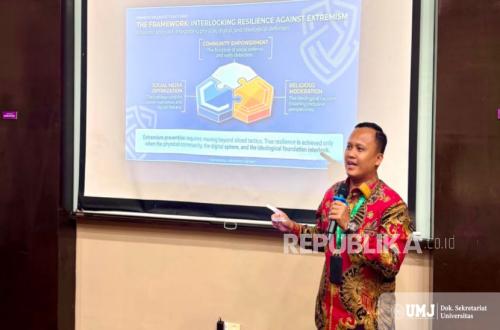
A lecturer from the Faculty of Islamic Religion at the University of Muhammadiyah Jakarta (FAI UMJ), Dr Ismail, S.Sos, M.Pem.I, discussed extraordinary crime in Indonesia at the International Conference On Islamic Civilisational Studies. The event was organised by Universiti Islam Selangor (UIS) at the Hotel Nilai Springs Resort, Malaysia, on Wednesday (10/6/2026).
In his presentation, Ismail raised the topic entitled ‘Community Based Extremism Prevention Strategies Through Social Media and Religious Moderation Education in Support of Asta Cita.’ He explained that the biggest challenges and threats in Indonesia and other countries in general are extraordinary crimes. This includes corruption, drugs, and other ideological viruses of violence such as intolerance, radicalism, and terrorism. ‘This virus of extremism remains a serious challenge to national resilience, community unity, and the sustainability of a peaceful national life,’ he said.
Therefore, vigilance and concern are expected amidst the development of digital technology, which has expanded the space for the spread of extremist ideology through social media, especially to the younger generation who are active users of digital platforms. Ismail explained his research that encourages and supports the Asta Cita programme under the government of President Prabowo Subianto.
Asta Cita includes strengthening the ideology of Pancasila, democracy, reinforcing the harmonisation of life with the environment, nature, and culture, as well as increasing tolerance between religious communities to achieve a just and prosperous society. He further explained that to actualise the President’s Asta Cita programme, synergy and collaboration from national elements in a pentahelix manner are needed to maintain the integrity of the Unitary State of the Republic of Indonesia and move towards an advanced Indonesia.
Indonesia is currently experiencing a demographic bonus phase, where around 68 per cent of the total population is of productive age (15-64 years). He stated that the total internet users in Indonesia reach 235.26 million people. The estimated number of internet users for each demographic group is around 80.9 million for Generation Z and around 72.0 million for millennials. Thus, wise social media literacy and control over social media use are needed for counter-ideology, counter-narrative, and counter-propaganda.
‘The religious moderation approach is seen to have a positive impact on mitigating the virus of violence-based extremism leading to terrorism that uses religion as a vehicle (a tool of legitimation) to spread the virus,’ he clarified. Ismail explained that the religious moderation education in question has four pillars, namely national commitment, tolerance, anti-violence, and harmony with local cultural values. In the context of inter-religious tolerance, a spirit of innovation and transformation is needed in the perspective of ukhuwah basyariyah, wathaniyah, and Islamiyah.
Furthermore, in the view of Muhammadiyah ijtihad, the concept of Darul Ahdi Wa Syahadah was initiated, a concept of national understanding that makes Pancasila and the Unitary State of the Republic of Indonesia a result of consensus or noble agreement between the nation’s founders and all elements of Indonesian society. Meanwhile, Darus Syahadah is understood as the thinking that after agreeing, Muslims have a moral obligation and theological responsibility to prove their commitment by filling, building, and advancing the nation through real and progressive works amidst differences in ethnicity, religion, race, and inter-group relations.