
UMJ Law Lecturer Discusses Foreign Loan Reformulation in Doctoral Programme
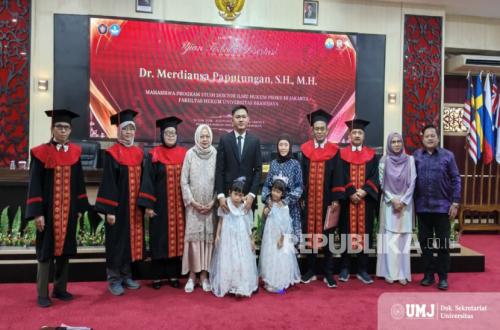
Merdian Papatungan, a permanent lecturer at the Faculty of Law, University of Muhammadiyah Jakarta (FH UMJ), completed his Doctoral Programme in Legal Science at the Faculty of Law, Universitas Brawijaya, Malang, on Wednesday (10/06/2026).
In his dissertation examination, Merdian addressed the ‘Reformulation of the Regulation of Foreign Loans as One of the Sources of State Budget Financing Post-Amendment of the 1s45 Constitution.’ The research focuses on the regulation of foreign loans following the constitutional amendments, particularly in relation to transparency, accountability, and the sustainability of the state budget.
“The aim of this research is to uncover the extent to which the regulation of foreign loans after the amendment of the 1945 Constitution has created transparent and accountable practices. This research also aims to assess its implications for the sustainability of the state budget,” Merdian stated.
He explained that the study utilised a normative juridical legal research method, applied through three approaches: the statute approach, the comparative approach, and the historical approach.
Based on his findings, Merdian discovered that the regulation and practice of foreign loans in the post-reform era have not yet fully established substantive transparency and accountability. According to him, foreign loans, which were originally intended to support economic growth and national development, could instead become a burden on the state budget.
“My research findings indicate that the regulation and practice of foreign loans after the reform era have only created pseudo-transparency and accountability,” he revealed.
Furthermore, Merdian identified four main clusters of legal issues in the regulation of foreign loans. First, the juridical cluster, involving a conflict of norms between the state financial law regime and the international law regime. Second, the philosophical cluster, where the regulation of foreign loan policies does not yet reflect their philosophical basis. Third, theoretical issues involving the clash between the state financial law regime and the international law regime at the doctrinal level. Additionally, he highlighted errors in qualifying the functions of various state institutions within foreign loan policies. Fourth, practical issues regarding the timing of DPR (House of Representatives) approval for loan agreements and the legal instruments expressing such approval.
Merdian expressed hope that this academic achievement would mark the beginning of his contribution to the development of legal science, specifically in state financial law. He emphasised that a doctoral degree is not the end of the academic process, but rather the beginning of a greater responsibility.
“I understand the doctoral degree I hold as a beginning, not an end,” he said. He also expressed his commitment to continuing the development of legal science to provide broader benefits to the community and the nation.
During this final dissertation examination, Merdian was supervised by a promoter team consisting of Prof. Dr. Setio Widagdo, SH, MH; Prof. Muhammad Alisa Fahad, SH, MH, as Co-Promoter I; and Dr. Adi Kusumaningrum, SH, MH, as Co-Promoter II. The examining board included Prof. Dr. Muhammad Fadli, SH, M.Hum; Prof. Dr. Tunggul Ansari Setia Negara, SH, M.Hum; Dr. Riana Susmawati, SH, MH; Dr. Aan Eko Widiarto, SH, MH; and external examiner Dr. Dian Puji Senugraha Simatupang from the Faculty of Law, University of Indonesia.