
UMJ Launches I-CHIP to Advance Evidence-Based Health Policy
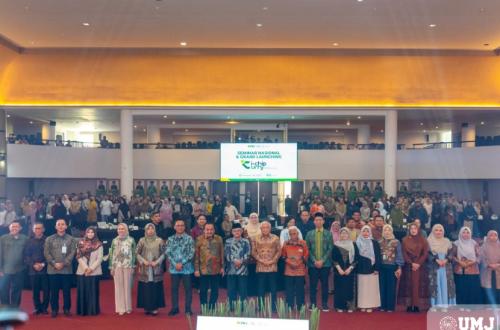
REPUBLIKA.CO.ID, JAKARTA — Universitas Muhammadiyah Jakarta (UMJ) held a National Seminar and the Grand Launching of I-CHIP under the theme “Health Sovereignty: Accelerating Transdisciplinarity Towards Evidence-Based and Equitable Policy” at the UMJ Cendekia Building on Tuesday (15/9/2026).
Minister of Health of the Republic of Indonesia, Budi Gunadi Sadikin, emphasised the importance of improving public health quality as a means of extending life expectancy. This aligns with the President of Indonesia’s directive that the population’s life expectancy should reach more than 72 to 74 years.
According to him, improving health quality must begin by encouraging the public to routinely check their health condition. “Regular health screening is an important step in detecting various diseases early,” he said.
The government is pursuing this effort through the Free Health Check programme (CKG), which has reached approximately 280 million people. The screening results have also revealed a number of health problems, such as hypertension, diabetes and high cholesterol.
The Health Minister expressed hope that UMJ can play a role in improving public health through education. He said good education produces competent graduates capable of contributing to the improvement of the Indonesian people’s health.
Meanwhile, the Minister of Primary and Secondary Education, who is also a member of UMJ’s Board of Trustees, Prof Dr Abdul Mu’ti, stressed the importance of physical and mental health in building a strong generation. He hoped I-CHIP UMJ could contribute to creating a healthy living culture supported by physical, social and family environments.
“Hopefully I-CHIP UMJ will also contribute to how we create a healthy living culture, building a way of life supported by a healthy physical environment, a healthy social environment and a healthy family environment,” he said.
He also explained the importance of synergy in implementing the government’s priority programmes, including the CKG programme, which is one of the efforts to ascertain children’s health status. He said such synergy is expected to support the creation of healthy school environments.
On that occasion, Prof Abdul Mu’ti congratulated the launch of I-CHIP UMJ and expressed hope that its existence can strengthen scientific studies in the health field. “What is more important, of course, is building a healthy society and a strong generation,” he said.
The Rector of UMJ, Prof Dr Ma’mun Murod Al-Barbasy, also hoped I-CHIP UMJ can become a gathering place for academics in health and public policy from UMJ as well as Muhammadiyah and Aisyiyah universities. He said the sustainability of the research centre requires creativity, collaboration and relationship-building with various parties.
“What is not easy is keeping the centre going. It requires creativity from its directors or chairs and extensive relationship-building from all sides,” he said.
He said I-CHIP already has a number of programmes to be developed through cooperation with various parties. Such cooperation is expected to involve other Muhammadiyah and Aisyiyah universities so that I-CHIP’s benefits can be felt more widely.
The UMJ Rector regards relationship-building as one of the keys to maintaining the centre’s sustainability. “Without extensive relationship-building, believe me, the centre will be a centre in name only,” he said.
Meanwhile, the Head of the National Research and Innovation Agency (BRIN), Arif Satria, highlighted the importance of a research and innovation ecosystem involving various disciplines to support national food and health sovereignty. A transdisciplinary approach is considered capable of strengthening collaboration between academics, researchers, government and various stakeholders in producing evidence-based policy.
He congratulated the organisation of the national seminar and the Grand Launching of I-CHIP UMJ. “I congratulate the grand launch of I-CHIP; may it develop into a transdisciplinary collaboration space that strengthens evidence-based health policy,” he said.
After the Grand Launching ceremony, the Director of I-CHIP UMJ, Dr drg Muh Arief Rosyid, said I-CHIP UMJ is intended to become a space for interaction and collaboration among various stakeholders in the health sector. He identified three issues of concern to I-CHIP UMJ: the gap between policy and research, budget spending that is not yet on target, and the role of universities, which is still seen as that of an ivory tower.
“First, regarding the policy-research gap, we believe I-CHIP UMJ can serve as a catalyst. Second, many budgets at ministries and in the regions appear not to be on target, and third, the role of universities, which is still like an ivory tower,” he explained.
The series of events continued with a panel discussion addressing health financing, health security, and the link between climate change and food, nutrition and health. The discussion featured Prof Kristen M Hurley, Prof Dr Abd Razak Thaha, Prof Dr Muhammad Hadi and Prof Dr Tria Astika EP, followed by the presentation of certificates to the speakers. The Grand Launching of I-CHIP UMJ was organised in cooperation with the Ministry of Health of the Republic of Indonesia and UMJ’s Centre for Education Development, and was sponsored by Bank Syariah Indonesia.