
UMJ Hosts MUI Ulama Gathering to Support Sustainable Environmental Management
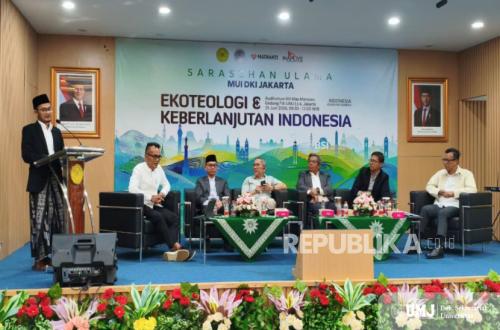
Universitas Muhammadiyah Jakarta (UMJ) hosted the Jakarta Provincial MUI Ulama Sarasehan with the theme ‘Ecotheology and the Future of Indonesia’s Sustainability’ at the FAI UMJ Auditorium on Thursday. The event discussed the role of religious values in supporting environmental management and sustainable development.
Sekretaris Umum MUI Provinsi DKI Jakarta, KH Auza’i Mahfudz, MA, stated that protecting the environment is part of human responsibility as khalifah (stewards) on earth. He noted that environmental preservation is not only an ecological issue but also a syariah obligation. ‘Allah created humans as khalifah on earth to prosper and care for it with full responsibility. Therefore, protecting the environment is not merely an ecological issue, but also part of syariah obligations,’ he said. Auza’i explained that the principle of environmental preservation has been widely discussed in Islamic scholarship, citing the rule ‘dar’ul mafasid muqaddamun ’ala jalbil mashalih’ (preventing harm takes precedence over seeking benefit) as a key foundation.
Kepala Bidang Pengelolaan Sampah dan Limbah B3 (PSLB3) DKI Jakarta, Dedy Setiono, said the waste problem now involves social, economic, health, and moral aspects. Based on data from the National Waste Management Information System (SIPSN), Indonesia produced 33.79 million tonnes of waste in 2024, with more than 50 percent coming from households. He revealed that Indonesia generates around 141,926 tonnes of waste daily, but only about 37,000 tonnes are managed. The Bantar Gebang Integrated Waste Disposal Site receives approximately 6,500 to 7,000 tonnes per day. ‘The waste problem is not merely a technological issue. It is a problem of behaviour, governance, and morality. Technology can help process waste, but collective awareness is what prevents waste from continuing to grow,’ he concluded.
The sarasehan featured several expert speakers. H Muladi Mughni presented material on ‘Fikih Lingkungan: Landasan Syariah dalam Penanganan Sampah’. Dr. Alamsyah Saragih discussed ‘Kebijakan Sampah Nasional; Antara Amanah Negara dan Akuntabilitas Politik’. Edy Sutrisman explained ‘Teknologi Tepat Guna, Terintegrasi untuk Penanganan Sampah’, while Dr. Kirman Siregar from IPB presented on ‘Penanganan Sampah Berorientasi Keberlanjutan’. Fadli Rahman, CEO of PT Daya Energi Bersih Nusantara (DENERA), explained the Processing of Waste into Electrical Energy (PSEL) as a government emergency waste management scheme.